

On this page
Forgetting a chapter you once knew is normal. The memory is weaker, not gone, and that changes how you should study it the second time.
Why is relearning faster than learning the first time?
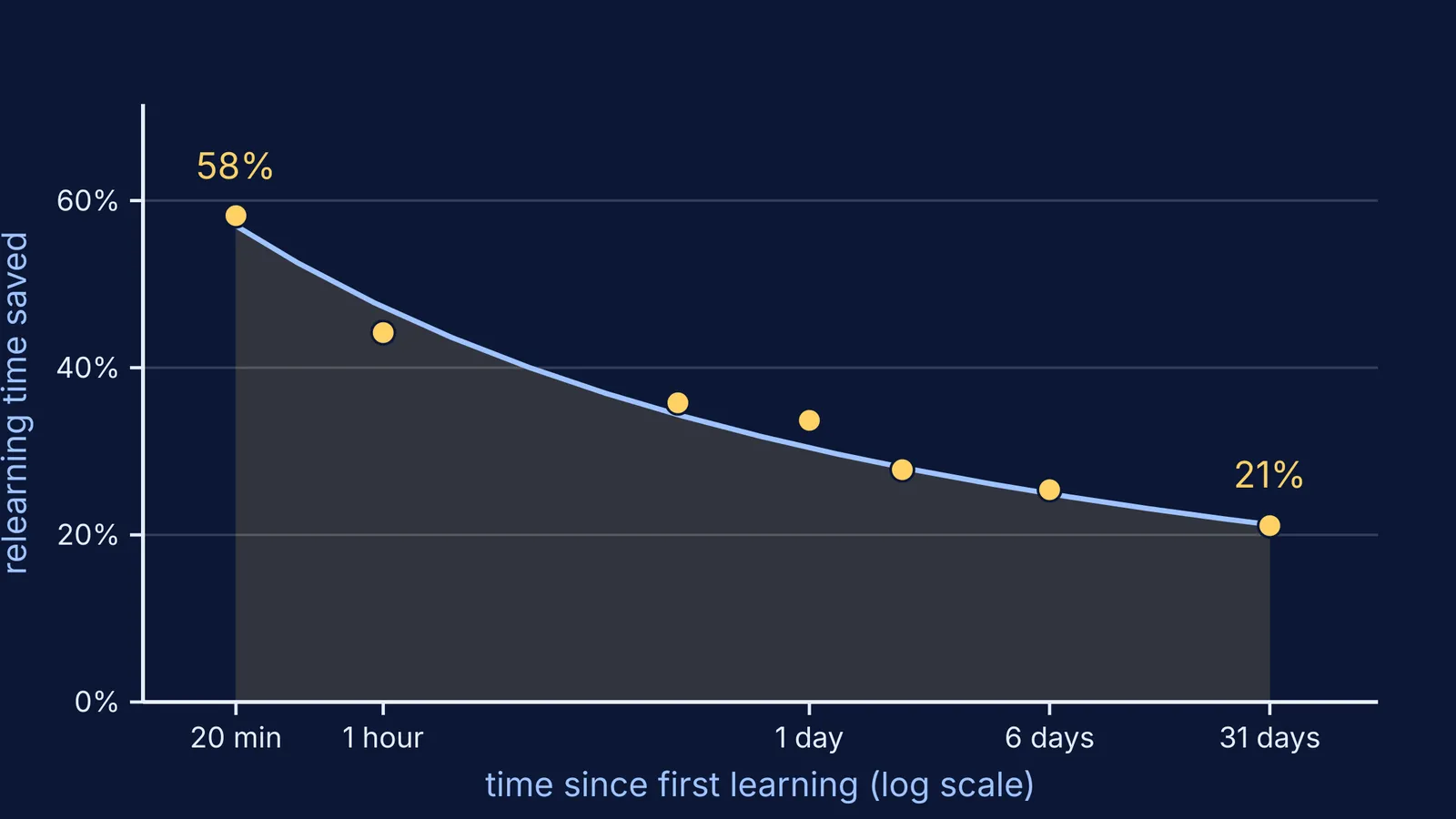
In the 1880s Hermann Ebbinghaus measured memory by timing how long it took him to relearn lists he had already learned once. Savings is the share of the original learning time you no longer need when you relearn something.
In a 2015 replication and analysis in PLOS ONE, Jaap Murre and Joeri Dros report Ebbinghaus's figures: savings of 58% after 20 minutes, 34% after one day and 21% after 31 days. Their own replication showed a similar curve.
So even a month later, about a fifth of the work is already done. The problem is that you cannot see which fifth. That is why the first step is a test, not a reread.
How do you relearn a forgotten chapter quickly?
Rereading from page one feels productive, but most of the time goes on what you still know. A review of ten study techniques by Dunlosky and colleagues (2013) rated practice testing and spaced practice as high utility, and rereading and highlighting as low utility.
In Roediger and Karpicke's 2006 experiments, rereading beat testing on a test five minutes later, but testing gave much better recall two days and one week later, even though rereading made students more confident.
Wrong answers at the start are not wasted either. Richland, Kornell and Kao (2009) found that attempting questions before studying, even unsuccessfully, beat spending the same time just studying, as the University of Chicago Learning Lab summarises.
Session one takes about an hour:
Blurt for 10 minutes: book closed, write every heading, definition, formula and diagram you can recall on one sheet.
Test for 20 minutes: do 8 to 10 questions from the end-of-chapter exercises or past papers, still closed book.
Mark it and write a miss list: every wrong answer, blank or lucky guess becomes one line.
Review only the miss list: open the book at those sections, then close it and redo each missed question until you get it right once.
If a miss turns out to be an idea you never really understood, a short lesson in the Fermi Concept Library covers that one concept. If you knew the idea but used the wrong method, the Fermi Problem Library has worked problems with a step-by-step solver that explains the reasoning rather than printing an answer.
How should you space the two recall checks?
One good session is not the finish line. Rawson, Dunlosky and Sciartelli call the combination of successful recall and study spread across days successive relearning (Educational Psychology Review, 2013). According to this summary of the study, it raised course exam performance by about a letter grade, from a C to a B, and three spaced sessions worked better than one.
How far apart? In a study of more than 1,350 people, Cepeda and colleagues (2008) found the best gap was about 20 to 40% of the time until the test when the test was a week away, falling to 5 to 10% for a test a year away. For a test in seven days, that works out to a gap of roughly two days.
Each check takes about 15 minutes:
Redo the blurt sheet from memory and compare it with your first one.
Answer four or five fresh questions, weighted towards the miss list.
Anything you miss goes back on the list for the next check.
Relearning several chapters at once? Mix their questions in the checks; our guide to interleaved practice, with a weekly plan shows how.
What does this look like for a real chapter?
Say a Class 11 student has a unit test on Saturday on work, energy and power, a chapter they studied months ago and have mostly forgotten.
Monday, session one: the blurt sheet has W = Fs cos θ and kinetic energy, but nothing on power. Four of ten questions are right. The miss list has three lines: work by a variable force (area under the force-displacement graph), the work-energy theorem with friction, and power as P = Fv. Only those sections get reviewed.
Wednesday, check one: four of five new questions right. The friction question is wrong again, so it stays on the list.
Friday, check two: a full blurt sheet and five questions, all right. Stop there and sleep.
The night before, run through this four-signal readiness checklist instead of opening the chapter again.
How can parents help without taking over?
Offer to be the quizzer, not the checker of hours. Try:
"Want me to read the questions while you answer without the book?"
"What is on your miss list today?"
Skip "You studied this already, how did you forget?" Forgetting is expected, and this plan works with it.
For physics chapters, this pairs well with our four-step plan for revising physics concepts.


