

On this page
You got a question wrong, read the solution, nodded and moved on. Two weeks later, the same kind of question beats you again. Reading a solution feels like learning, but the real test is solving it cold, from a blank page, days later. Here is a redo schedule for wrong and marked questions, and a rule for when one can leave your list.
When should I redo questions I got wrong?
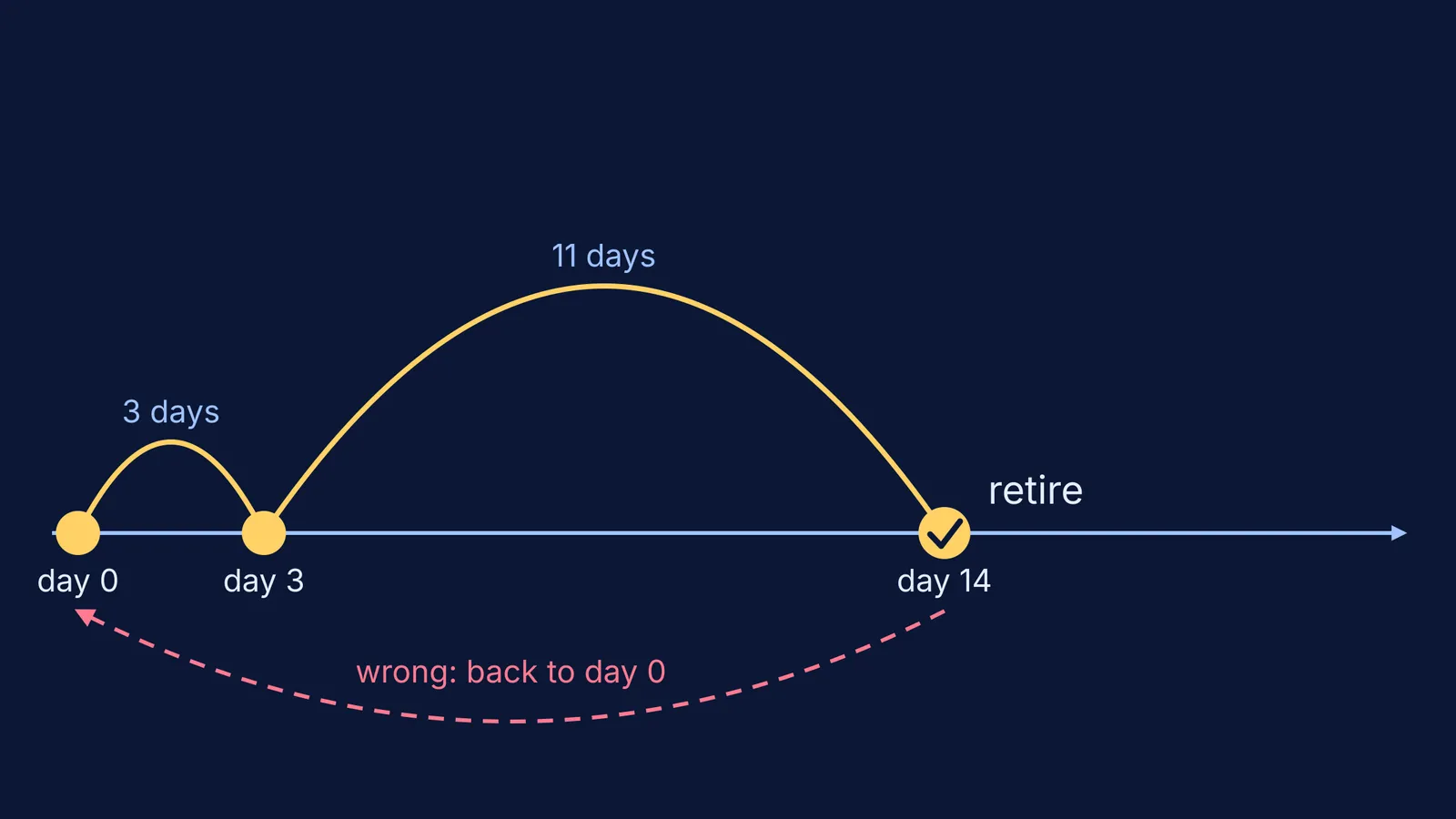
Redo each one three times, on three different days:
Same day. That evening, cover the solution and solve it from scratch.
Day 3. Solve it again, cold, mixed in with other questions.
Day 14. One more cold solve, ideally under exam timing.
Why spread it out? A 2013 review of ten study techniques rated practice testing and distributed (spaced) practice as high utility, and rereading as low utility (Dunlosky and colleagues, Psychological Science in the Public Interest). A redo is a practice test. The schedule is the spacing.
The gaps grow because the best gap depends on how far away the exam is. In a study of more than 1,350 people learning a set of facts, the best gap before a review was about 20 to 40% of the time from the review to a test one week later, falling to about 5 to 10% for a test one year later (Cepeda and colleagues, Psychological Science, 2008). Applying even the one-year proportion to an exam six months away gives roughly 9 to 18 days, so a two-week step sits inside that range.
When can a wrong question retire?
A question retires after three clean solves: same day, day 3 and day 14. A clean solve means the solution is covered, you use no hints, you get the right answer within your exam's time per question, and you can say in one sentence why your first attempt went wrong.
Why three, and why not stop after the first correct redo? In a Science study, students who kept testing themselves on foreign-language words they had already recalled correctly did much better on a delayed test, while extra studying of those words had no effect on delayed recall (Karpicke and Roediger, 2008). The same study found students' predictions of their own performance were uncorrelated with how they actually did. So the feeling of "I get it now" is not evidence.
A larger study gives a number. Across 3 experiments with 533 students, Katherine Rawson and John Dunlosky concluded that students should practise recalling concepts to 3 correct recalls, then relearn them 3 times at widely spaced intervals (Journal of Experimental Psychology: General, 2011). They tested conceptual material, not multi-step numericals, so our three-step rule is a lighter adaptation. For your weakest chapters, add a fourth check about a month later.
What counts as a marked question?
A marked question is one you got right but did not trust: you guessed between two options, took twice your target time, or felt unsure. These are risky because a right answer hides a shaky method. If you already put confidence marks on your practice answers, every low-confidence mark joins the list.
Marked questions skip the same-day redo and enter at day 3. Questions you left blank in a mock count as wrong and start at the same-day step. Our guide to unattempted questions after a mock helps you sort which are worth the time.
What does the schedule look like in a real week?
Here is one question for Riya, a Class 12 student preparing for JEE Main:
Monday: she gets a block-on-an-incline friction question wrong. She drew friction up the slope when the block was about to slide up.
Monday night: she covers the solution and solves it cleanly, and writes one line: friction opposes the relative motion, not always up the slope.
Thursday (day 3): right answer, but it takes 7 minutes against her target of 3. Not clean, so the day-3 step repeats.
Sunday: clean in 3 minutes.
Thursday of the following week, 11 days later: clean again, inside a mixed set of mechanics questions. Retired.
To keep this running, give each question one line in a notebook: the source, the date, and three boxes to tick (S, 3, 14). Start each session with whatever is due, capped at about 20 minutes. Mixing old redos into new practice fits an interleaved practice plan, because you must work out which method each question needs.
What if the same question keeps failing?
If a question fails twice at the same step, your memory is not the problem. The method or the concept is. For a method problem, the Fermi Problem Library has worked problems with a step-by-step solver that explains the reasoning rather than printing an answer, so you can find the exact step where your path split off. For a concept gap, open that concept's lesson in the Fermi Concept Library before your next redo.
Tonight, pick three questions you got wrong this week and give them their same-day redo.


