

On this page
A senior who has just been through JEE or NEET can save you months. But “how many hours did you study?” gets you a number, not a lesson. Better questions get you answers you can use, and a simple filter tells you which ones to keep.
What should you ask seniors about preparation?
Ask about decisions and changes, not routines. A decision (“I stopped making notes in Class 12 and did this instead”) is something you can test.
What did you change between Class 11 and Class 12, and why?
When did you start full-length mock tests, and how did you review them?
Which subject did you neglect, and when did you notice?
What did a normal weekday look like when school, coaching and self-study all ran together?
What did you do in the last 60 days that you would keep, and what would you drop?
Question 5 often helps most: the final weeks are hard to plan from outside, and a senior has just lived through them.
What should you ask about mistakes?
People rarely volunteer their mistakes, so ask directly and make it easy to answer.
Which mistake cost you the most marks, and how did you find out?
Was it a concept gap, a calculation slip or poor time management in the paper?
What did you keep doing for too long because everyone else was doing it?
Is there any advice you were given that turned out to be wrong for you?
The second question matters because each kind of mistake needs a different fix: re-learning, checking habits or timed practice.
Which questions about resources actually help?
“Which book is best?” gets you a list. Ask instead:
Which books or modules did you actually finish, not just buy?
Which test series was closest to the real paper in difficulty?
What did you use when you were stuck on a problem at 11 pm?
Can I see one page of your error notebook or revision notes?
If a senior offers you their old books and modules, check the edition and syllabus before you accept them. Our guide to checking second-hand books and coaching modules lists what to look for.
How do you filter a senior's advice?
Advice from people who succeeded has a built-in blind spot. Survivorship bias is “an error that arises because we look at the data we have but ignore the selection process that led us to have those data”, as the computational and behavioural scientist Sendhil Mullainathan put it in an interview published by Scientific American. Someone who did not qualify may have studied the same way as the person you are asking.
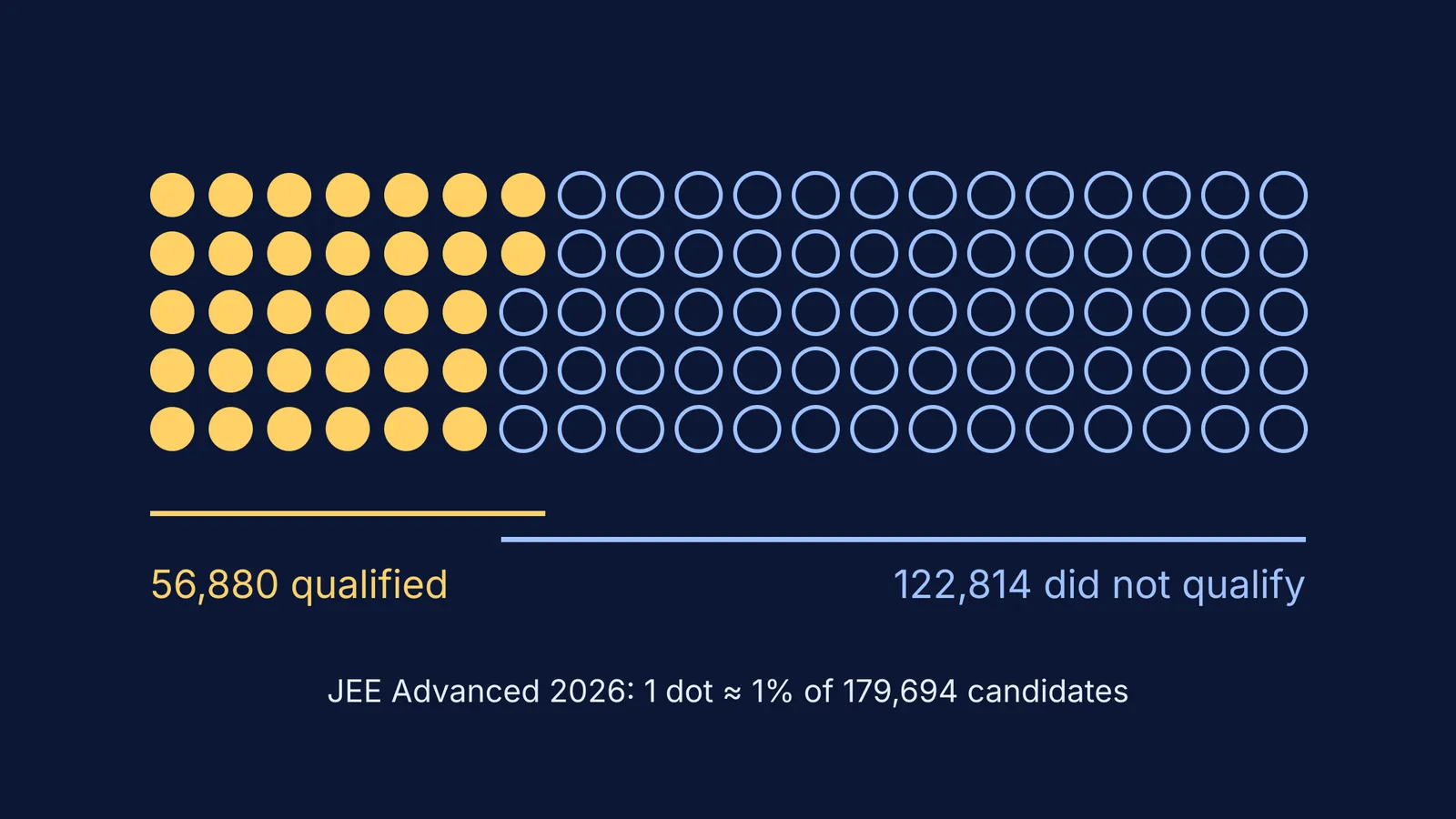
The numbers show how big that blind spot is. In JEE Advanced 2026, 56,880 of the 179,694 candidates who appeared in both papers qualified, according to the official results press release. That is about 32%, so roughly two in three candidates who sat both papers did not qualify, and you rarely hear their side.
Rules also change. NTA has said it will conduct NEET (UG) 2026 “strictly based on the syllabus as finalized and notified by NMC”, in a public notice dated 8 January 2026. For JEE Main, NTA publishes a new Information Bulletin and syllabus for each cycle on the official JEE Main website. A senior's chapter list from two years ago may not match yours.
Run each piece of advice through four checks before you act on it:
Same exam, same rules? Check it against the current syllabus and bulletin, not the senior's memory.
Same starting point? Advice from someone who was strong in maths may not fit you if maths is your weak subject.
Specific enough to test? “Revise properly” fails. “Re-solve every wrong mock question after three days” passes.
Heard it twice? If a senior who did not get the result they wanted says the same thing, take it more seriously.
The same filter works for timetables: see how to borrow from a topper's timetable without copying it. If relatives are adding their own advice, read our guide to handling conflicting study advice from family.
What can you say to start the conversation?
Seniors are busy, so ask for 20 minutes and come prepared. Here is a message you can send:
“Hi, I'm in Class 11 and preparing for JEE. Could I ask you six quick questions about what you'd change if you prepared again? Twenty minutes on a call, whenever suits you.”
On the call, ask three preparation questions, two mistake questions and one resource question. Afterwards, run each answer through the four checks and keep at most three changes to try.
If a senior's main tip is “understand where you go wrong”, the Fermi Problem Library has worked problems with a step-by-step solver that explains the reasoning rather than printing an answer. And if you finish the conversation unsure where to begin, Fermi's AI tutor can work out what you already know and build a plan for the session.
Pick one senior this week, send the message and test the first change for two weeks.


