

On this page
Most board students end up with three piles: NCERT, a thick chapter-wise question bank and CBSE's sample papers. The useful question is what job the question bank does, and when doing more of it stops helping.
Do you need a question bank if you have NCERT and sample papers?
Each of the three does a different job.
NCERT teaches the chapter. Its text and exercises teach the ideas and the language board answers use. Unsure of your exercise answers? Here is how to check your NCERT exercise answers with AI.
A question bank gives you more practice, chapter by chapter. It adds questions of each type the board asks.
Sample papers show you the exam. CBSE's sample papers and marking schemes for the 2026-27 exams are on its Class 10 sample paper page and Class 12 sample paper page. They show the format and how marks are given. Use them for full papers, not for learning a chapter.
So yes, use a question bank, in the middle: after NCERT, before full papers.
How many questions per chapter is enough?
The research suggests timing matters more than the size of the pile.
In two experiments by Doug Rohrer and Kelli Taylor, published in Applied Cognitive Psychology in 2006, 216 college students learned a maths procedure and were tested one or four weeks later. In the first, students who split 10 practice problems across two sessions a week apart scored virtually double on the four-week test compared with students who did all 10 in one session; at one week there was no reliable difference. In the second experiment, doing 9 problems instead of 3 in a single session had virtually no effect on test scores at either one or four weeks. The authors suggest that once the first few problems of a type are solved correctly, students could spend the rest of the session on problems from earlier lessons.
A 2013 review of ten study techniques by John Dunlosky and colleagues rated practice tests and distributed practice (spreading study out over time) as high utility, and rereading and underlining as low utility.
One caveat: Rohrer and Taylor tested college students on the same kind of problems they practised. Treat it as a strong hint, not a magic number.
How do you use a question bank chapter by chapter?
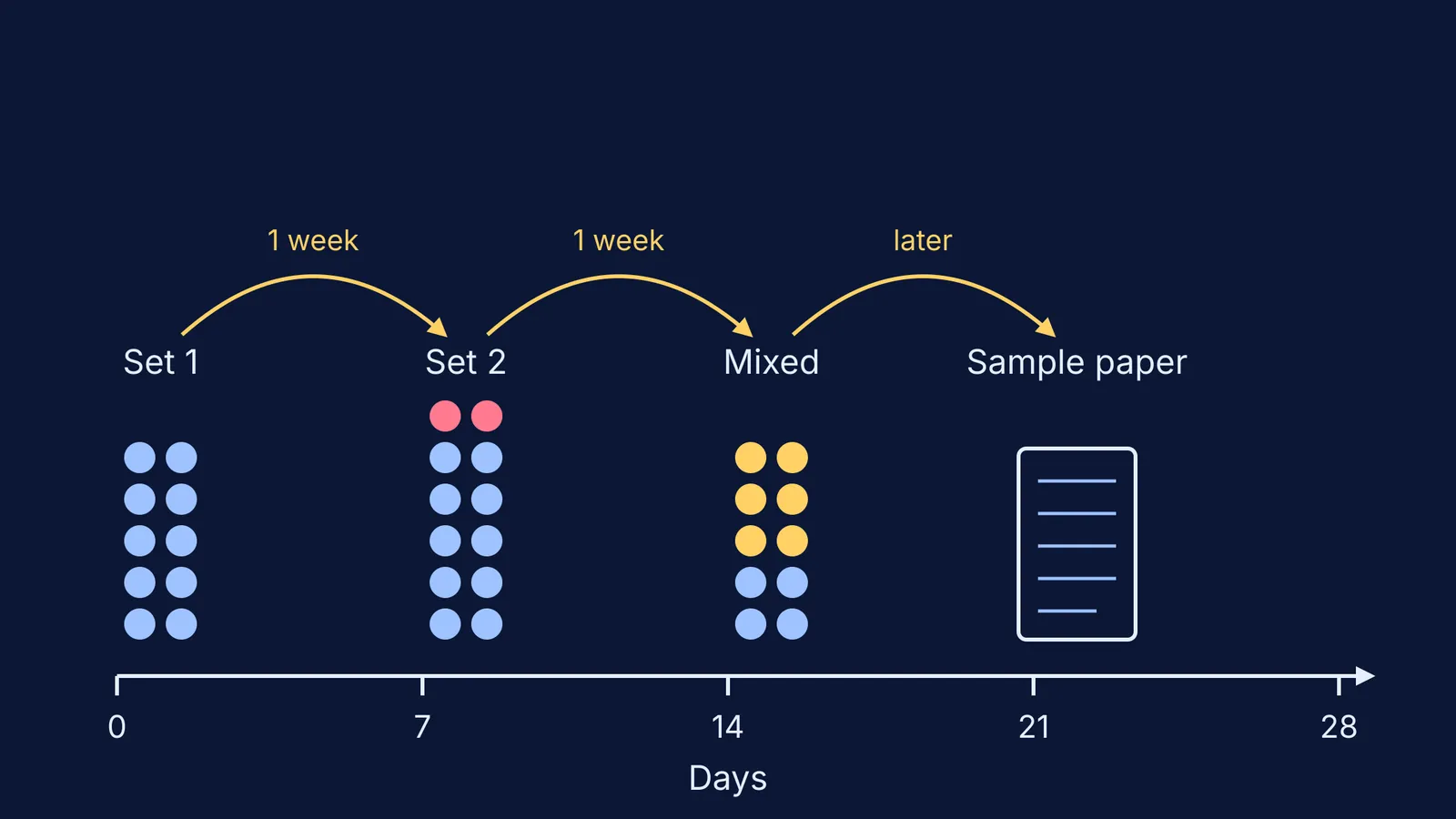
This plan follows the pattern in the Rohrer and Taylor study: a few problems of each type, then come back a week later. The exact counts are our rule of thumb, not the study's.
Round 1, the day after NCERT: about 10 questions across every type in the chapter (one-mark, assertion-reason, case-based, short and long). Stop a type after two or three correct. Mark every wrong one.
Round 2, a week later: 10 new questions, plus your round 1 mistakes redone from scratch.
Round 3, a week after that: a mixed set with this chapter and two or three older ones. Mixing is harder, and that is the point; here is why interleaved practice works, with a plan.
Then the sample paper: once several chapters are through round 3, sit a CBSE sample paper timed and mark it with the official scheme.
Worked example. You finish Class 12 Physics, Current Electricity, on a Monday. On Tuesday you do 10 questions, including two Kirchhoff's-law circuits, and get both wrong because of sign errors. Next Tuesday: 10 new questions plus those two circuits again. The Tuesday after: a mixed set from Electrostatics and Current Electricity. About 30 questions over three weeks, not the whole chapter in one weekend.
Getting one type wrong again and again? The Fermi Problem Library has worked problems with a step-by-step solver that explains the reasoning rather than printing an answer, so you can find the step where your method goes off. If the trouble is the idea itself, the Fermi Concept Library has its own lesson for each concept in physics, chemistry, biology and mathematics.
What should you look for in a question bank?
Before you buy, check a chapter you know well for:
Current syllabus year. Contents should match this year's CBSE syllabus.
Question types that match the current sample paper. If the sample paper has case-based or assertion-reason questions and the bank does not, it is out of date.
Solutions that show steps. Steps laid out the way the marking scheme gives marks beat a list of final answers.
Previous-year questions labelled. Useful, but do not do only those.
One bank per subject. Three banks mostly means more of the same, which is what adds little.
For checks at home, here is how often to set practice tests and how to mark them.
Start with the chapter you finished most recently: pick 10 questions across its types tomorrow, and put round two in your calendar for a week later.


