On this page
If home is noisy, your coaching notes keep sending you to books you do not own, or you just need a desk away from your phone, the public library in your city or district is worth a visit. Here is how to find one, what to ask, and how to fit it into your week.
Can you use a public library for competitive exam preparation?
Yes. Public libraries are open to readers like you. The Delhi Public Library, set up in 1951 with UNESCO's support, offers free access to all and holds over 16 lakh books, according to the Ministry of Culture. The same page describes the Raja Rammohun Roy Library Foundation, set up in 1972, as the nodal agency supporting public library services across India, working with state governments.
What you get differs by library, but three things are common:
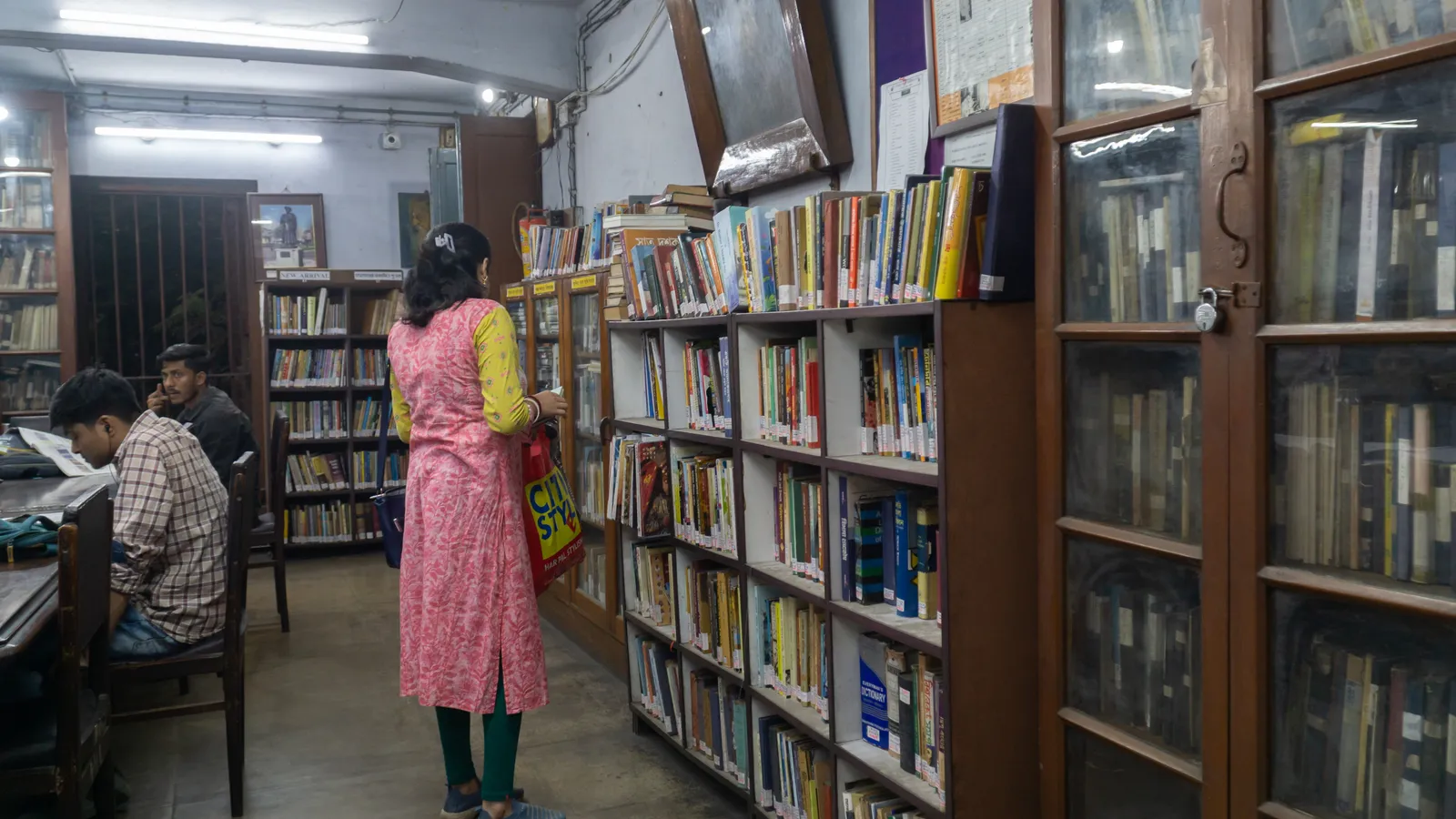
A reading room: a quiet desk for hours, often where you can bring your own books and notes.
A reference section: books you read inside the library but cannot borrow, such as handbooks, dictionaries and standard textbooks.
Newspapers and magazines: useful if your exam has a general awareness section.
How do you find a city or district library with a reading room?
Search for the district central library or state central library for your area, then ask there about smaller branches nearer home.
Ask your school librarian or a teacher which public library nearby has a reading room students use.
Check its listing on a map app, then phone before you go. Timings and weekly holidays change, and listings are often out of date.
Visit once on a weekday with a parent, if you can, and look at the reading room before you sign up.
On that first visit, take a few minutes with the librarian. A simple script:
"I am preparing for an entrance exam. Is there a reading room where I can bring my own books and notes?"
"What are the timings, and which day is the library closed?"
"What does membership cost, and which documents do I need?"
"Can non-members use the reference section?"
"Do you keep previous years' question papers or exam guides?"
"Are bags, water bottles and phones allowed inside?"
What should you do at the library, and what at home?
Use the library for the work that needs quiet and books, and keep home for the rest.
Library: timed mock tests and full past papers, long problem-solving blocks, and cross-checking a topic in two or three reference books when your notes are unclear.
Home: short revision, flashcards, watching lectures, and anything that needs the internet.
There may also be a memory reason not to study everything in one room. In the first experiment of a classic 1978 paper, Smith, Glenberg and Bjork found that studying in varied environments produced higher free recall than studying in an unchanged one. We cover this idea in more detail in our piece on why changing where you study can help you remember.
If a reference book's explanation still does not click, the Fermi Concept Library has a lesson for each concept in physics, chemistry, biology and mathematics, so you can come back the next day with the gap filled.
A sample week with a district library
Here is a plan for a Class 12 student preparing for JEE Main who lives a short bus ride from the district library. Assume the reading room is open on weekdays and Saturday.
Monday and Wednesday, after school: two hours of physics and maths problems at the library. Phone stays switched off in the bag.
Tuesday and Thursday: coaching or school work at home, plus 30 minutes of revision.
Friday: one hour at the library cross-checking chapters you found weak this week in a second reference book.
Saturday morning: a full timed paper at the library, working from previous years' question papers.
Sunday: check the paper at home. For each wrong answer, write down whether the concept, the method or the calculation went wrong.
For the method errors, the Fermi Problem Library has worked problems with a step-by-step solver that explains the reasoning rather than printing an answer.
Parents: agree in advance on how your child gets home and by what time. Our guide on studying safely in a library late at night has a checklist.
What if there is no good library near you?
Use a digital one alongside whatever is close by. The National Digital Library of India is sponsored by the Ministry of Education, run from IIT Kharagpur, and free to register. It lists access to over 5.5 lakh nationally licensed contents and has an examination preparation section for school and college students and job aspirants.
A practical mix: find material on NDLI at home, then take your notes to the nearest reading room, even a small town or panchayat library, and do the solving there.
This week, pick one library, phone it, and book your first Saturday morning paper there.