

On this page
Across Indian coaching hubs like Kota and Delhi, round-the-clock reading rooms and private study libraries have multiplied rapidly. For students in crowded hostels or paying-guest (PG) rooms, these spaces offer air-conditioned cubicles, charging sockets, and uninterrupted quiet. When exam pressure builds before JEE or NEET, studying through the night can feel like the only way to finish the syllabus.
Evaluating whether a coaching library is safe requires separating building safety from transit and biological risks. In January 2024, the Ministry of Education released its Guidelines for Registration and Regulation of Coaching Center 2024, mandating fire safety certificates, building approvals, and CCTV cameras, while capping daily coaching at 5 hours. While approved buildings mitigate indoor hazards, severe safety risks often begin outside once streets empty after dark.
Is studying in a library past midnight worth the lost sleep?
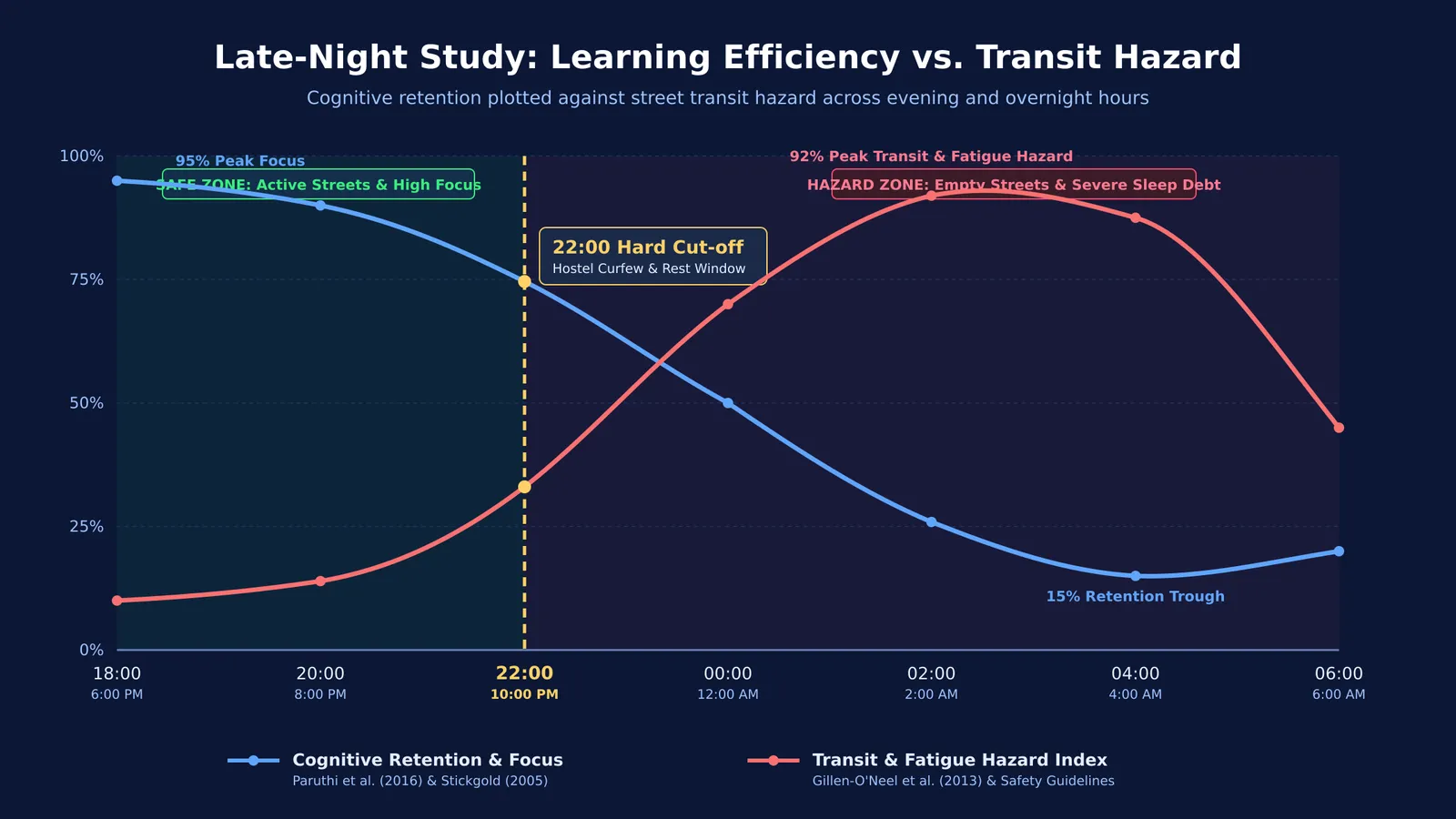
Students often assume that extra hours at a library desk produce proportional learning gains, but cognitive science shows this trade-off backfires. In a study in *Child Development*, Cari Gillen-O'Neel and colleagues (2013) tracked 535 high school students across 14 days in different school years. Regardless of a student's typical study volume, on days when they cut sleep to study more than usual, they had significantly more trouble understanding classroom material and made more errors on tests the following day.
Sleep is essential for neural storage. In *Nature*, Robert Stickgold (2005) demonstrated that post-training sleep stabilizes synaptic changes and moves memories from the hippocampus to permanent neocortical storage. An American Academy of Sleep Medicine consensus led by Dr. Shalini Paruthi and colleagues (2016) determined that teenagers aged 13 to 18 years require 8 to 10 hours of sleep per 24 hours for healthy cognition. Sacrificing slow-wave rest for late-night desks degrades memory retention, as explained in our guide on why sleep before an exam beats an all-nighter.
How should you plan your late-night travel and buddy system?
The acute physical danger of late study lies in transit between 11:00 p.m. and 5:00 a.m., when hub streets empty out and leave lone commuters vulnerable to dark alleys and stray animals. If you use a reading room at night, replace spontaneous travel with strict transit rules:
The Two-to-Travel rule: Never walk to or from a library alone after 9:00 p.m. Travel with a peer living in your hostel or PG, syncing departures so neither walks unaccompanied.
The three-point ping: Text your roommate before packing your bag, share your route, and confirm arrival the moment you enter your hostel.
Stick to lit main roads: Avoid poorly lit alleys, even if taking the main boulevard adds extra walking distance.
One ear open: Keep headphones off or at low volume in one ear to stay alert to traffic and your surroundings.
Use a clear, standard check-in message:
"Leaving library now with Rohit via Main Road. Arriving hostel by 10:20 p.m. Will ping once inside."
For emotional stress during intensive preparation, the Ministry of Health and Family Welfare provides round-the-clock support via Tele MANAS at toll-free number 14416.
What should you check before booking a late-night reading room?
Before paying fees for a study desk, check these four essentials:
Above-ground location: Choose ground or first-floor facilities with dual unobstructed staircases, avoiding unapproved basements without emergency exits.
Verified security: Look for functional entry registers, working CCTV, and an on-duty night guard.
Short commute: Pick a library within short walking distance along well-patrolled main roads.
Hard departure cut-off: Book slots ending by 10:00 p.m. rather than staying until 3:00 a.m.
When you hit a difficult question late at night, you do not need to walk out into the dark. You can resolve doubts safely at your desk with Fermi's AI tutor, which notices where you are stuck, decides whether to explain, ask, or show, and builds a plan for the session. For tough numericals, the Fermi Problem Library explains the reasoning step by step, while the Fermi Concept Library provides structured lessons across physics, chemistry, biology, and mathematics when reviewing core ideas.
Organising your own desk—as outlined in our guide on studying in a hostel or PG—and matching work to your rhythm in morning or night study, provides quiet focus with zero transit risk.


