On this page
If you like biology and physics and want to build something for one person at a time, prosthetics and orthotics is a career worth a look. A prosthesis replaces a missing body part, such as a leg below the knee. An orthosis supports or corrects one that is there, such as a brace for a weak ankle or a curved spine. In India the main entry point is the Bachelor in Prosthetics and Orthotics, usually shortened to BPO.
What does a BPO course teach?
The Composite Regional Centre in Patna describes the course as preparing healthcare professionals who "assess, design, fabricate, fit, and maintain" prosthetic and orthotic devices. The course there takes four and a half years, including a six-month compulsory internship, and is approved by the Rehabilitation Council of India (RCI).
The national institute in Chennai, NIEPMD, says its BPO course is based on RCI's BPO Curriculum Framework of 2016 and describes the field as "a unique blend of clinical and technological skills". The academic side has three strands:
The body: anatomy, physiology and how injuries, amputations and neuromuscular conditions affect movement.
The mechanics: forces, levers and how weight passes through a joint when you stand and walk. The Kalam Institute of Health Technology lists "Materials and Applied Mechanics" and "Biomechanics" among its subjects.
The making: workshop skills with plastics, metals and carbon fibre, and now digital design. The same institute names "Digital Design & Advanced Fabrication (CAD/CAM, 3D Printing)".
Ideas such as torque about the knee and the centre of mass help explain whether a limb feels stable. If those ideas are hazy, the Fermi Simulation Lab has interactive simulations for the ideas that are easier to see than to read.
What does clinical training look like?
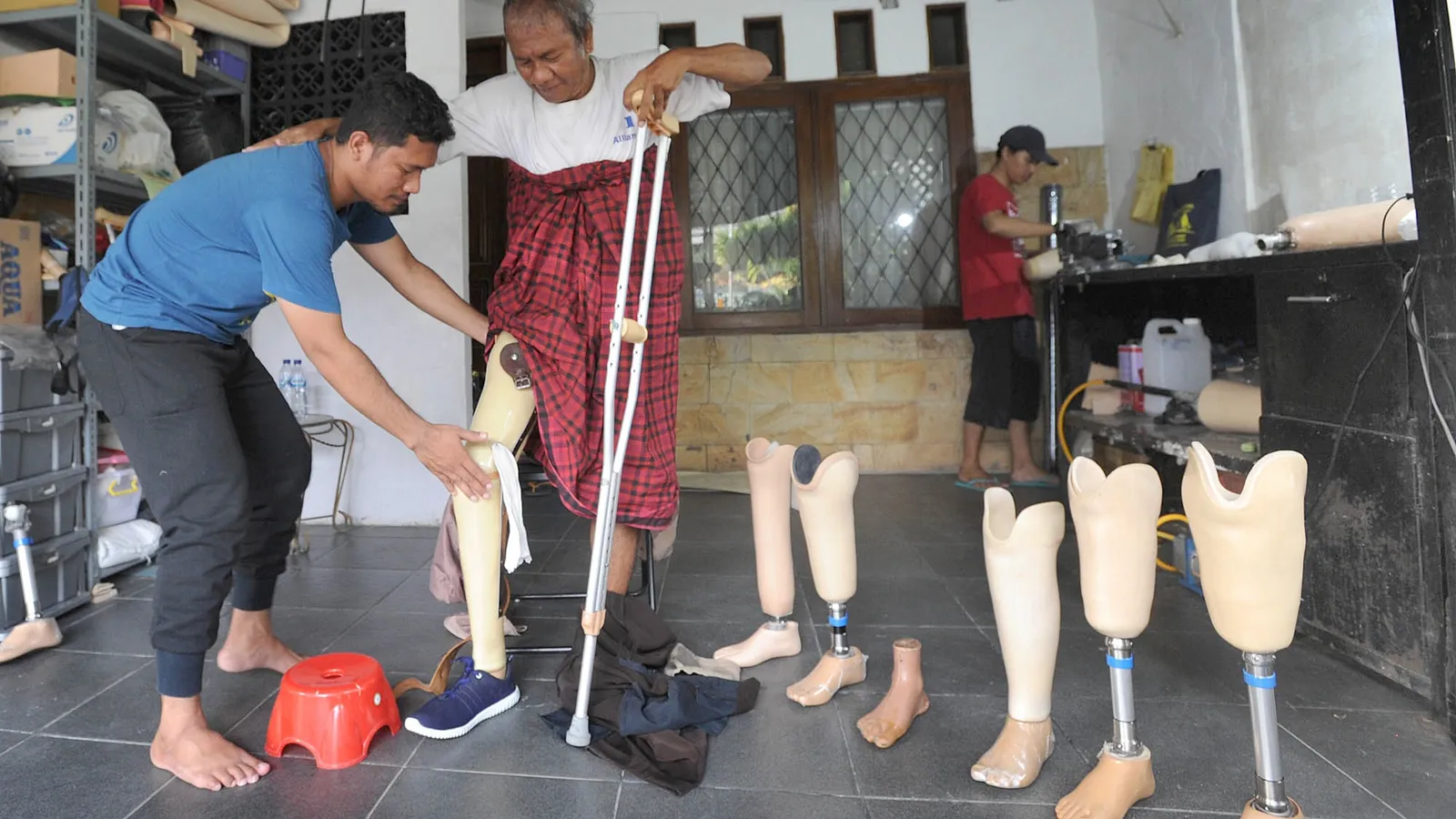
In the internship you work with patients under a qualified professional. A typical cycle, following the steps CRC Patna names, runs like this:
Assess: examine the limb, the skin and the person's daily needs. A farmer who walks on uneven fields needs something different from an office worker.
Design: take a cast or a 3D scan and choose the parts.
Fabricate: shape the socket or brace in the workshop.
Fit: watch the person walk, find pressure points and adjust the alignment.
Maintain: review as the limb changes shape, as children grow and as parts wear out.
NIEPMD says the work covers amputations and other neuromusculoskeletal disorders, as well as foot disorders, fractures, sports injuries and disorders due to ageing, so communication matters as much as good hands.
The WHO standards for prosthetics and orthotics, published in 2017 in partnership with the International Society for Prosthetics and Orthotics, estimate that only 1 in 10 people in need has access to assistive products, including prostheses and orthoses. Looking across all assistive products, WHO's fact sheet on assistive technology says more than 2.5 billion people need at least one.
Who can apply for a bachelor in prosthetics and orthotics?
NIEPMD's eligibility is 10+2 in science with physics, chemistry, biology or mathematics, and English, with at least 50% aggregate. Admission there is by national entrance test and counselling. Test names, dates and seat numbers change each year, so check each institute's current admission notice.
Before you choose a college, check that the course is approved by RCI. The Department of Empowerment of Persons with Disabilities says RCI's mandate is to regulate and monitor services for persons with disabilities, standardise syllabi and maintain a Central Rehabilitation Register of qualified professionals.
Where does a BPO career lead?
The Kalam institute lists roles such as certified orthotist, certified prosthetist, or both combined, in hospitals, rehabilitation centres, research and development organisations and independent clinical practice. If the engineering side pulls you more than patient care, read our guide to biomedical engineering jobs in medical devices. If daily therapy with patients appeals, compare it with occupational therapy and physiotherapy.
How can you test whether BPO suits you?
Try this two-week test before you decide, ideally with a parent:
Days 1-3: Revise rotational motion and levers. Can you explain why a longer lever arm needs less force? The Fermi Concept Library has a lesson for each of these concepts.
Days 4-7: Visit or call a government rehabilitation centre or a hospital's physical medicine department. Ask to watch a fitting, or to speak to a prosthetist for ten minutes.
Days 8-10: Make something by hand, such as a simple cardboard model of a brace. Notice whether the trial and error frustrates you or keeps you interested.
Days 11-14: Shortlist three colleges and check their RCI approval, internship hospital, workshop and fees.
When you call a college, you can ask: "Is your BPO course currently approved by RCI? Where do interns do their clinical posting, and how many patients do they fit? Can I see the workshop?"
If you are weighing BPO against MBBS after NEET, our guide to other admission routes for PCB students puts the options side by side.