

On this page
Applying abroad, or to some Indian private universities, from Class 12? You will be asked for something your board never gives you: predicted grades. Here is what they are, who writes them and when to ask.
What are predicted grades?
UCAS, the UK’s admissions service, defines a predicted grade as “the grade of qualification an applicant’s school or college believes they’re likely to achieve in positive circumstances” (UCAS guidance on predicted grades). They exist because you apply before your board results arrive. UCAS asks schools to base predictions on demonstrable evidence and to finalise them by the time the application is submitted; universities may only consider the predicted grades received with it, so you cannot send a better set later.
Do Indian schools give predicted grades?
CBSE, CISCE and state boards do not publish predicted marks, so the estimate has to come from your school. UCAS itself notes that “many international education systems do not normally involve predicting grades”, so advisers may need to help referees produce them (UCAS advice for international advisers). Your teachers will work from your school record: Class 11 finals, Class 12 unit tests and, later, pre-boards.
Predictions reach universities in a few ways:
The UCAS reference. When your referee is a teacher, they can add predicted grades for qualifications you are still studying, and you will not have access to the reference (UCAS on getting a reference).
A university’s own requirements. Edinburgh’s College of Arts, Humanities and Social Sciences lists predicted grades, an academic reference and a personal statement as parts of a complete application from applicants in India (Edinburgh entry requirements for India).
US school documents. On Common App, counsellors “submit school forms, upload transcripts, and track student application progress” (Common App for counsellors). Check whether each college also wants predicted board marks.
Indian universities ask too. Ashoka University’s board policy says applicants awaiting Class 12 results must submit predicted grades or scores, which “may be provided by the school counsellor/any other relevant school authority”, and accepts self-predicted scores if the school gives none (Ashoka University board-specific policies).
For how universities read CBSE marks more generally, see our guide to how CBSE results work for applying to foreign universities.
Whom should I ask for predicted grades?
Start with the person whose name will go on the document, not the teacher you like most.
College or career counsellor, if your school has one.
Class teacher or Class 12 coordinator, if it does not.
Subject teachers, for subject-wise numbers, especially in subjects your course requires.
Principal, only if a university wants a signature or stamp.
Even if a consultant helps you, UCAS wants the request to go to someone at school who knows your academic work (same UCAS international advisers page). Thinking of hiring one? Read should you hire a counsellor for abroad applications.
When should I request predicted grades?
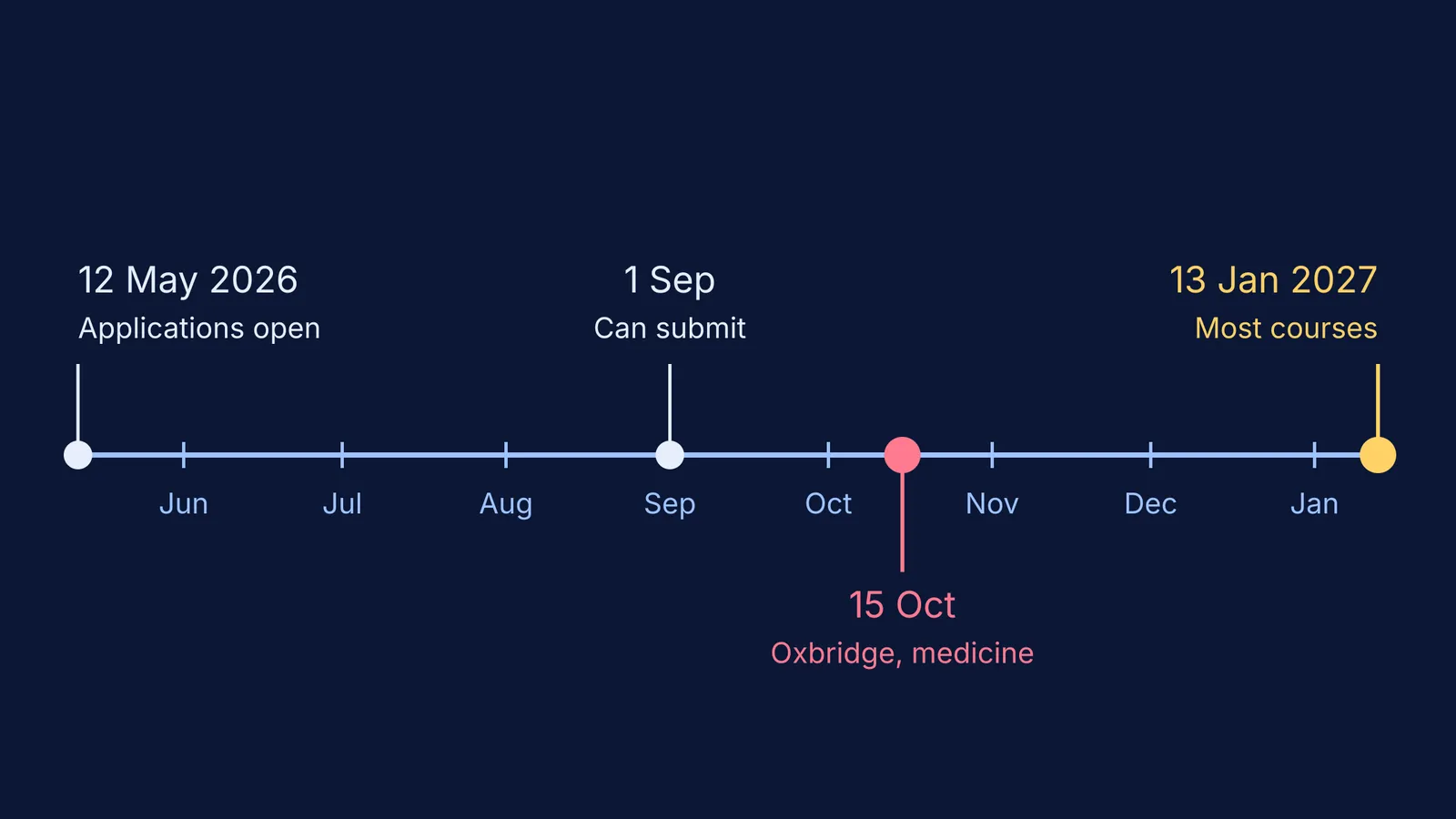
Work backwards from your school’s internal deadline, which comes before the official one. UCAS equal-consideration deadlines for 2027 entry are 15 October 2026 at 18:00 UK time for Oxford, Cambridge and most medicine, dentistry and veterinary courses, and 13 January 2027 at 18:00 UK time for most other courses (UCAS dates and deadlines). UCAS tells school applicants to check and follow their school’s deadline, and you cannot submit until your referee has added the reference.
A plan for a January application:
This week: email your counsellor your list of courses and ask for the internal deadline.
Within a fortnight: share your Class 11 marksheet, unit test marks and each course’s entry requirements.
After pre-board results: ask whether predictions will be updated, and when they become final.
Before the school deadline: finish every other section, so your referee is never waiting on you.
What should I say when I ask?
Keep it short and specific. A script you can adapt:
“Dear [counsellor’s name], I am applying to UK universities through UCAS for 2027 entry, and to Ashoka. Both need predicted Class 12 board marks from the school. Could you tell me who prepares these and the internal deadline? I have attached my Class 11 final marks, Class 12 unit test results and a list of my courses with their entry requirements. Thank you.”
It is fair to ask what the predictions are based on. It is not fair to ask for a higher number without new evidence: UCAS wants predictions grounded in demonstrable evidence, and a grade you then miss could cost you a conditional offer. The honest way to move a prediction is new evidence: a stronger unit test or pre-board in the subject holding you back.
For that subject, Fermi’s AI tutor can work out what you already know and build a plan for the session, and the Fermi Problem Library has worked problems with a step-by-step solver that explains the reasoning.
Parents worried about how earlier marks will look can read do Class 11 marks matter for college applications.
Send that email to your counsellor this week; the earlier you ask, the more time your school has to make predictions that are fair and finished.


