

On this page
If you are a high school student interested in science, you have likely seen the pitch: an email inviting you to submit a manuscript to an "international peer-reviewed journal," with publication guaranteed in days. For families preparing for competitive university admissions, the offer sounds like a fast track to standing out. Yet behind most of these solicitations lies a predatory industry that trades academic integrity for profit, leaving students with worthless credentials.
Why are paid publication offers targeting school students?
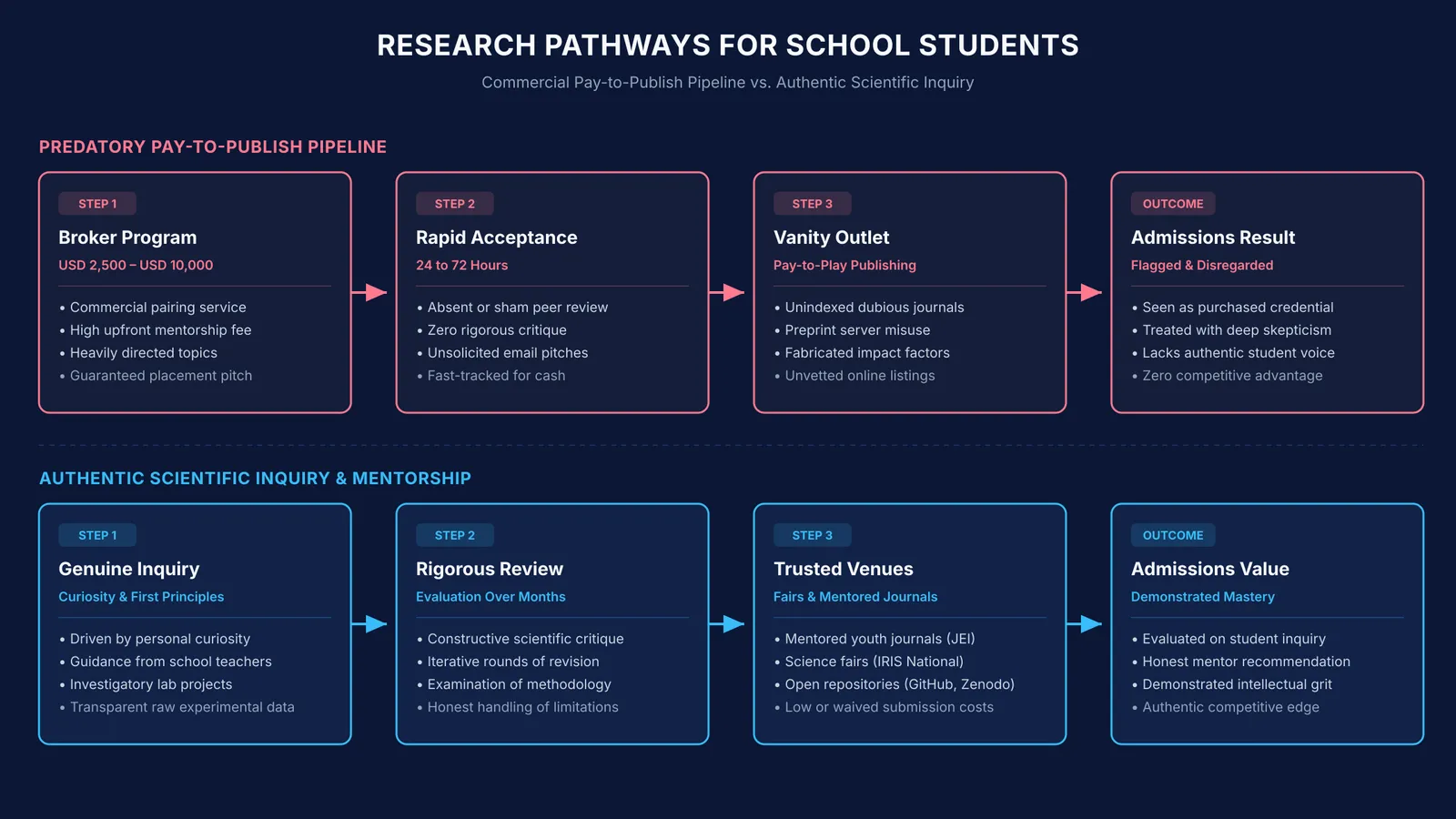
In selective college admissions, families search for credentials that stand out on an application. Commercial services have capitalized on this anxiety. A 2023 investigation by ProPublica and The Chronicle of Higher Education revealed that private research programs charge families between USD 2,500 and USD 10,000 to pair high schoolers with mentors and steer papers into print. The report estimated that these commercial programs serve at least 12,000 students per year worldwide.
To fulfill guarantees of publication, many services direct student papers into pay-to-play journals or upload unreviewed drafts to preprint servers. While preprint servers allow working scientists to share preliminary findings with peers, commercial brokers often market a simple server upload as a peer-reviewed publication. When families pay thousands of dollars for guaranteed acceptance, the process ceases to be genuine science.
What makes a journal predatory?
In 2019, an international panel of 35 scholars and publishers established a landmark consensus definition in Nature. They defined predatory journals and publishers as entities that prioritize self-interest at the expense of scholarship, marked by misleading information, deviation from best editorial practices, a lack of transparency, and aggressive solicitation.
Predatory outlets typically display several clear warning signs:
Rapid acceptance: Authentic peer review takes months. Predatory journals often promise acceptance within 24 to 72 hours.
Hidden fees: Article Processing Charges (APCs) ranging from hundreds to thousands of dollars appear only after a manuscript is accepted.
Fabricated metrics: Outlets invent fake impact factors or list academics on editorial boards without permission.
Broad scope: A single journal accepts unrelated topics ranging from oncology to high school literature without qualified reviewers.
India has faced this challenge directly. A study led by Professor Bhushan Patwardhan, reported in Nature, found that 88% of 1,009 journals recommended by universities were dubious or low-quality. This led to the UGC-CARE reference list to protect research standards. That same commercial machinery now pitches paid publishing directly to school students.
Do university admissions officers care about high school research papers?
Many students assume a published paper guarantees admission to top universities. In reality, admissions committees view the trend with skepticism. Guidance from MIT Admissions explains that optional research portfolios are evaluated on the applicant's creative thinking, understanding of methods, and an honest recommendation from a supervising mentor—not the publication line itself.
Similarly, the Turning the Tide initiative by the Harvard Graduate School of Education, supported by over 175 admissions deans, explicitly warns against manufactured credentials. Admissions officers recognize that groundbreaking research in specialized fields requires years of training. Listing an unindexed, pay-to-publish journal signals that a family purchased a credential rather than that the student mastered a discipline.
How can school students showcase authentic research work?
If you pursue genuine scientific inquiry, you do not need to pay a commercial outlet to validate your work:
Mentored youth journals: Venues like the Journal of Emerging Investigators, founded in 2011 by Harvard graduate students, provide educational peer review for middle and high school students. Graduate researchers offer constructive feedback, with a USD 49 submission fee and need-based fee waivers.
Competitive science fairs: Entering an experiment in the IRIS National Fair tests your methodology against scrutiny from working scientists.
Open repositories: Hosting documented computational models and raw datasets on GitHub or Zenodo demonstrates technical transparency.
School investigatory projects: Documenting a controlled experiment for your CBSE or ISC practical examination shows sustained dedication. You can read our guide on starting a science project from a clear question or our guide on how to read a scientific paper to strengthen your methods.
What should students do before attempting advanced research?
Before attempting to publish original papers, the most valuable investment is mastering core STEM concepts from first principles. True research begins when you have the tools to test whether a model makes physical sense.
Students eager to explore advanced topics beyond their school syllabus can learn from Fermi Courses, which combine university-level courses taught by working scientists with an AI tutor available on every lecture. When you want to see how altering parameters changes a physical system, you can explore the Fermi Simulation Lab, which provides interactive simulations for the ideas that are easier to see than to read. To build the quantitative reasoning needed for genuine science, the Fermi Problem Library offers worked problems with a step-by-step solver that explains the reasoning rather than printing an answer.
Scientific maturity is not measured by an invoice from a vanity journal. It is built through patient curiosity, transparent methods, and honest problem-solving.


