

On this page
The sudden click and darkness of a power cut can instantly derail your focus. Beyond the immediate frustration of losing internet access, unpredictable outages take a real toll on academic performance. A 2026 article by researchers at the University of the Witwatersrand notes that students link frequent loadshedding to anxiety, disrupted rest, and lower marks (DOI: 10.64628/aaj.5q34pegdu).
If you live in an area with scheduled power cuts or unreliable infrastructure, waiting for the lights to come back on is not a strategy. The key to maintaining momentum is shifting from a digital-first mindset to a prepared, "analog" routine. Here is how to build a study plan that works without the grid.
How do you manage your tasks during a power cut?
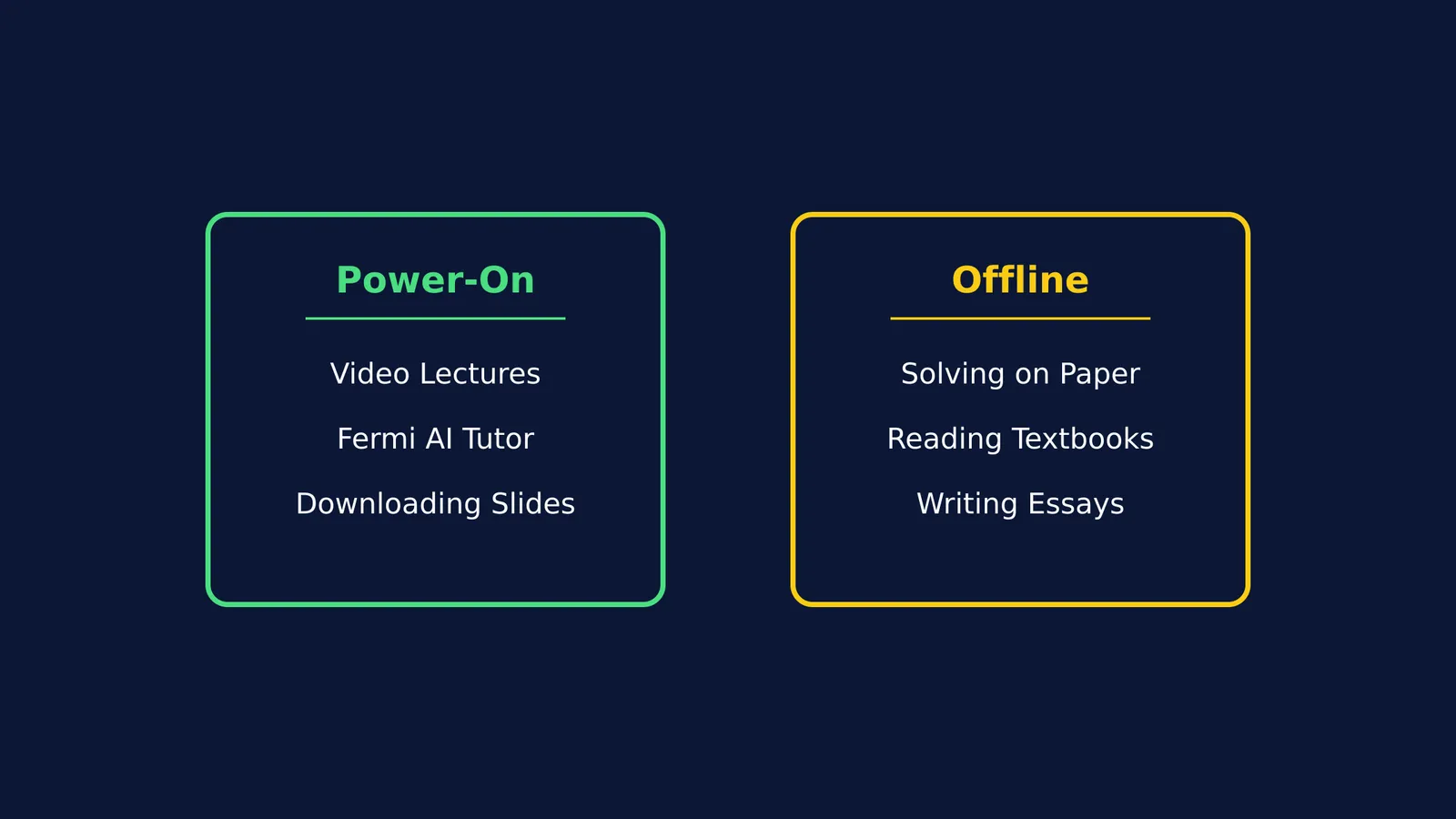
When the electricity fails, the instinct is often to take a break and wait it out. But if outages happen daily, these "breaks" quickly add up to hours of lost study time. The most effective habit is strategic task batching. Divide your daily study plan into two clear categories: "power-dependent" and "offline."
Power-dependent tasks: Do these only when the electricity is on. This includes watching online lectures, using the Fermi Concept Library to understand complex topics, researching assignments on the web, and downloading lecture slides.
Offline tasks: Save these specifically for when the power goes out. Reading physical textbooks, solving mathematics problems on paper, memorizing formulas with flashcards, and drafting essays by hand belong in this list.
For example, if you are studying physics, watch your required video lectures while the power is on. When the power cuts, immediately switch to solving your assigned problems on paper. By keeping these two lists ready, you never have to wonder what to do when the screen goes dark. You simply switch to your offline list and continue working. This is a crucial step in How to build a study routine that lasts longer than a week, as it builds resilience against inevitable disruptions.
What is the best light for studying offline?
Do not rely on your mobile phone's torch. A phone battery is a critical resource during an outage, needed for emergencies, alarms, or tethering internet data.
Instead, invest in dedicated, battery-powered lighting. An LED lantern offering 360-degree ambient light makes a room feel normal and reduces eye strain. Alternatively, a headlamp provides excellent hands-free illumination that points exactly where you are looking, eliminating shadows on your textbook.
If you are Setting up a good study space at home, keep these lighting devices plugged in and charging whenever the power is on, so they are always ready to deploy.
How can you prepare digital resources for offline use?
Make it a reflex to prepare for the next outage. Develop a "power-on" charging routine: the moment electricity returns, plug in your laptop, phone, power banks, and rechargeable lights.
Use the offline modes of your learning platforms. Download videos in lower resolution to save space, and keep local copies of essential syllabus documents on your hard drive. Do not rely entirely on the cloud; having a folder of downloaded past exam papers means you can always access them without an internet connection.
Since Wi-Fi routers shut down without electricity, consider attaching a small, inexpensive uninterruptible power supply (UPS) specifically to your router. This can keep your home network running for several hours, ensuring you do not lose connection in the middle of an online test.
Should you change your sleep schedule for power cuts?
If your local area publishes a known load shedding schedule, you might be tempted to sleep through the daytime outages and stay awake studying all night when the power is on. However, consistently disrupting your sleep cycle can harm your long-term memory consolidation and focus.
Instead of drastically altering your sleep times, adjust the difficulty of your tasks. Plan your most cognitively demanding subjects for the hours when you have the best natural lighting and the most physical energy. Save easier, repetitive tasks—like organizing notes or reviewing flashcards—for the dimly lit periods. Protecting your sleep schedule is far more important than forcing a study session at 2:00 AM simply because the Wi-Fi is active.
How can active learning help in the dark?
If your backup light is poor, use the time for active recall rather than straining your eyes reading small print. Active recall—testing yourself without looking at the material—is one of the most robust learning methods.
Sit in the dim light and try to verbally explain a concept from memory, or draw a mind map of a biology chapter by hand. If you hit a wall, make a note of it. Later, when the power returns, you can bring that specific confusion to Fermi's AI tutor, which works out what you already know, builds a plan for the session, and teaches through it.


