

On this page
A degree in botany, or plant science, prepares you to tackle some of the world's most pressing challenges, from food security and medical research to ecosystem restoration. Because plant biology intersects with so many industries, graduates can find work in laboratories, commercial farms, national parks, and classrooms. Understanding how to navigate these diverse opportunities is key to choosing a path that aligns with your professional and academic interests.
Is a botany degree worth it for research careers?
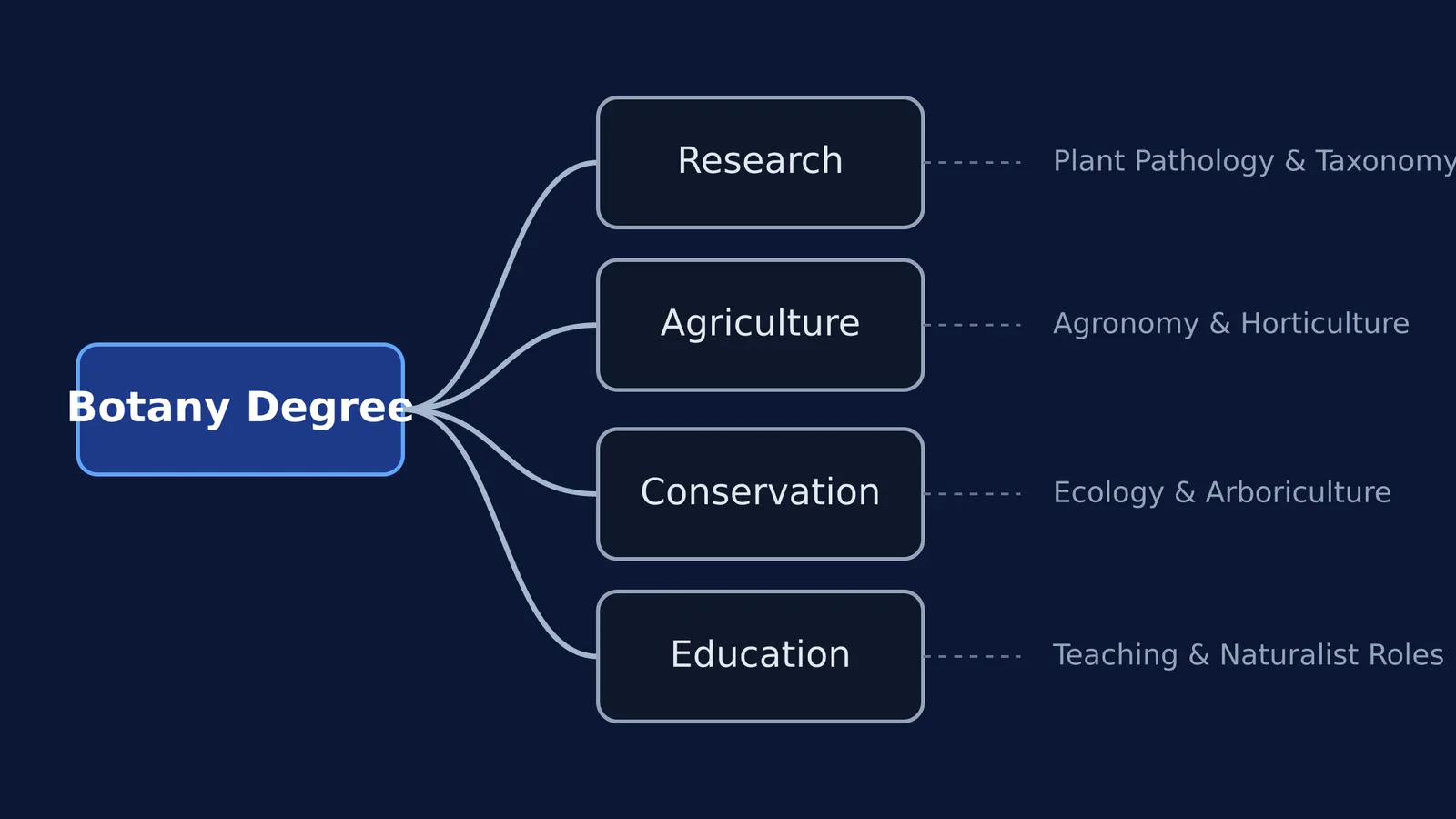
Research is one of the most direct applications of a botany degree, and professionals in this sector work heavily in laboratories, field stations, and university departments. Botanists use their expertise to understand plant genetics, map evolutionary history, and study how plants adapt to environmental stressors such as drought and pollution.
If you are currently reviewing foundations for your coursework, the Fermi Concept Library holds every concept in physics, chemistry, biology, mathematics and computing, each with its own lesson and its place in the map.
Common research specialisations include plant pathology (diagnosing and treating plant diseases) and taxonomy (identifying and classifying new species). Researchers often work for universities, biotechnology firms, or government agencies like the U.S. Department of Agriculture (USDA) or the Environmental Protection Agency (EPA), studying everything from the fundamental limiting factors in photosynthesis to new pharmaceutical compounds derived from rare flora. By combining field observations with sophisticated laboratory analysis, these scientists directly contribute to advancements in medicine and ecological sustainability.
What are the jobs in agriculture and horticulture?
Agriculture and horticulture focus on the practical application of plant science to commercial food production and land management. Professionals in this field work to maximise crop yields, develop disease-resistant seeds, and manage soil health sustainably in the face of changing climate patterns.
According to the U.S. Bureau of Labor Statistics, the median pay for agricultural and food scientists (which includes soil and plant scientists) was $81,970 per year in 2025. The same report projects a 6% growth in employment from 2025 to 2035, driven by the increasing need for resilient agricultural practices and climate change mitigation.
Roles in this sector include agronomists, who specialise in soil and crop production, and plant breeders, who develop new plant varieties that can thrive in difficult conditions. Horticulturists and greenhouse managers oversee the cultivation of plants for nurseries, public gardens, and large-scale landscaping projects, relying heavily on their understanding of principles like arithmetic vs geometric growth in plants. For many botany graduates, this sector offers a highly practical, hands-on environment where scientific theory meets daily execution.
How does botany lead to conservation and teaching?
Botany graduates who are passionate about the environment often pursue careers in conservation and ecology. Conservation scientists and ecologists study how plants interact with their surroundings to protect endangered species and restore damaged habitats. Arborists focus specifically on the health and management of individual trees, often working in urban planning or forestry to ensure cities maintain healthy, functional green spaces.
Education is another common path for those looking to share their expertise. A botany background equips you to become a high school biology teacher, provided you earn the necessary teaching credentials required in your region. Others work as park naturalists or science communicators at museums and botanical gardens, explaining complex topics like phototropism, geotropism and other tropic movements to the general public and helping foster a broader appreciation for the natural world.
A four-year plan to launch your botany career
If you are beginning a degree in botany or plant science, following a structured plan can help you build the experience necessary for the competitive job market.
Year one: Focus on excelling in your core biology and chemistry courses. Join student organisations related to botany, forestry, or agriculture to begin networking with upperclassmen and faculty members.
Year two: Identify a sub-discipline that interests you, such as genetics, ecology, or pathology. Seek out undergraduate research positions in a faculty laboratory to learn basic field sampling or lab techniques, which are crucial for later employment.
Year three: Secure a summer internship to gain practical, real-world experience. Look for opportunities with agricultural companies, commercial nurseries, botanical gardens, or government agencies like the National Park Service.
Year four: Complete a capstone project and present your research at a student symposium. Decide whether you want to enter the workforce directly or apply to graduate school for advanced research roles.
This combination of academic knowledge and hands-on laboratory experience ensures that you graduate ready to contribute meaningfully to the plant science industry.


