

On this page
Most students measure physics practice by volume. A problem diary measures something else. Once a day, take the one problem that fought back and write what you tried first, where it broke, and the idea that finally worked. Over a month, it becomes a record of how you think.
How do you improve problem solving in physics day by day?
You improve by learning to see the principle under a problem. In a classic study, Michelene Chi, Paul Feltovich and Robert Glaser found that experts sort physics problems by the principle that solves them, while novices sort them by literal features, such as whether it involves an inclined plane or a spring.
Explaining a solution to yourself builds that habit. A 1989 study of students working through mechanics examples found that stronger students generated many self-explanations that connected each step to textbook principles and monitored their own understanding accurately. Weaker students explained less and leaned on the examples.
Writing helps too. A meta-analysis of 48 school writing-to-learn programmes found a small, positive effect on academic achievement. The effect was larger when programmes used metacognitive prompts or ran for longer, and smaller with longer writing assignments. That suggests a few lines a day can be enough; a page is not needed.
What goes in a physics problem diary?
One entry per day, one hard problem. Use the same five lines each time:
Problem: where it is from, in one line.
First approach: the method you reached for, in one sentence.
Where it failed: the exact step, equation or assumption that went wrong.
The idea that cracked it: the principle, trick or diagram that worked.
Next time I see…: a rule in the form “when I see X, I will check Y”.
Line 5 matters most: it turns one solved problem into a category, the way Chi's experts organised what they knew.
What does a good diary entry look like?
Here is an entry for a JEE-style mechanics problem.
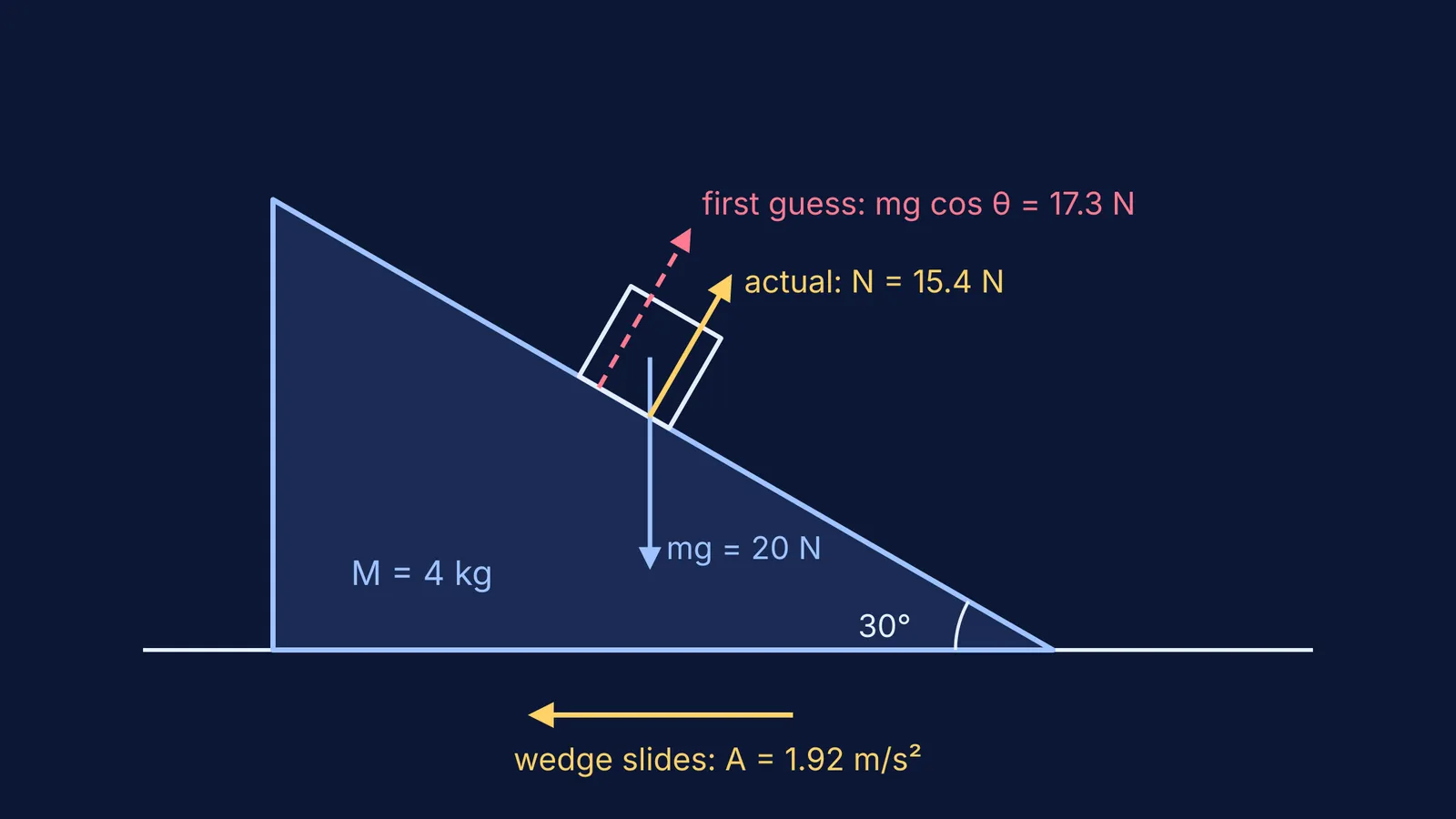
Problem: A 2 kg block slides down the smooth 30° face of a 4 kg wedge. The wedge sits on a smooth floor and is free to move. Find the normal force between block and wedge (take g = 10 m/s²).
First approach: Resolve the weight along and perpendicular to the incline, so N = mg cos θ = 20 × 0.866 = 17.3 N.
Where it failed: That formula assumes the wedge stays still. Here the block pushes it left, so the surface moves away from the block. My answer was too big.
The idea that cracked it: Work in the wedge's frame and add a pseudo-force mA on the block. Perpendicular to the incline: N + mA sin θ = mg cos θ. For the wedge, horizontally: N sin θ = MA. Solving gives A = mg sin θ cos θ / (M + m sin²θ) = 1.92 m/s² and N = 15.4 N.
Next time I see: a surface that can move, I will ask “is this frame accelerating?” before writing N = mg cos θ.
Check: N sin θ = 7.7 N and MA = 4 × 1.92 = 7.7 N. For a fuller walk-through, see how to solve physics problems step by step, with a worked example.
Why write down the approach that failed?
Because the failure shows which idea you were missing. Tanmay Sinha and Manu Kapur's meta-analysis of 53 studies found that students who tried problems before being taught generally learned more than those taught first, with a moderate effect size (Hedges' g = 0.36). Those studies tested lesson design, not diaries, so read it as support for struggling first rather than proof that a diary works.
In an introductory physics course of about 200 students, students who discussed why some homework solutions used better strategies drew diagrams on more final-exam problems, even with no marks for doing so. Across both groups, students who drew more diagrams did better.
If an honest attempt still stalls, the Fermi Problem Library has worked problems with a step-by-step solver that explains the reasoning, so you can compare its reasoning with your own attempt. If line 3 says “I didn't know the idea”, you are missing a concept, not a method. The Fermi Concept Library gives each concept in physics its own lesson.
How do you keep the habit going?
Same time, same notebook. Write straight after your evening problem set, while the dead end is fresh.
Sunday review. Group the week's entries by line 4. If several say “pseudo-force”, that is a topic to revise.
Retry, don't reread. Once a week, cover lines 2 to 5 and solve an old problem from scratch; see why mixing problem types works, with a plan.
Mark your confidence. Note how sure you were before checking; marking confidence while solving practice questions shows how.
Start tonight with the problem that annoyed you most today.


