On this page
If you enjoyed the ray optics chapter, or like the idea of building the hardware that carries the internet, photonics is worth a look. Photonics is the science and engineering of making, guiding and detecting light: lasers, fibre optics and imaging. You can reach it from physics or from electronics.
What do people in optics and photonics actually do?
According to SPIE's 2026 global industry report, global revenue from producing core optics and photonics components reached $381 billion in 2024. The same report counts 5,417 photonics companies headquartered in 65 countries.
The jobs fall roughly into three groups:
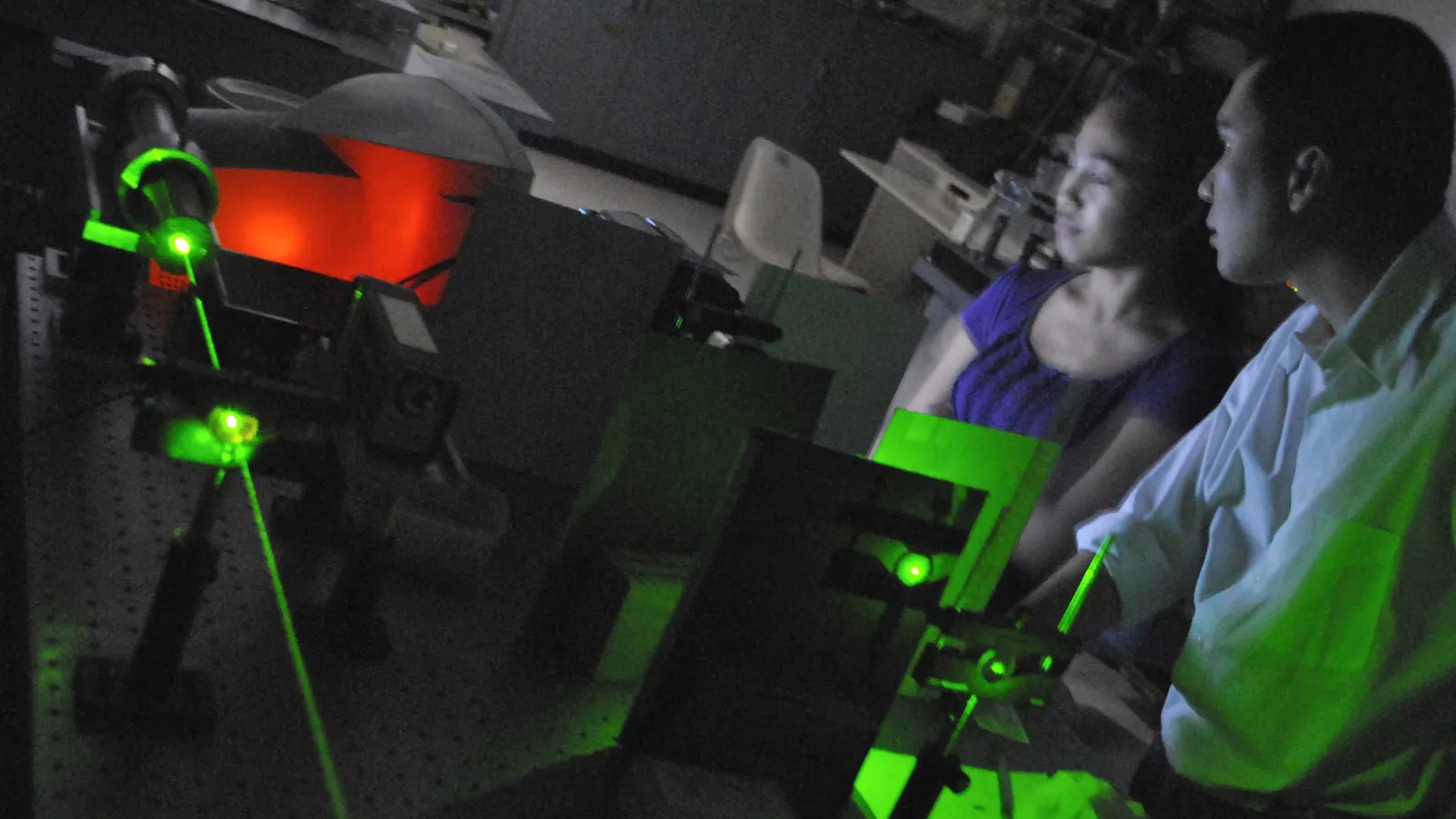
Lasers: designing laser sources and using them for cutting, medicine and research. In India, the Raja Ramanna Centre for Advanced Technology (RRCAT) in Indore was set up by the Department of Atomic Energy for work in two areas: lasers and accelerators.
Fibre optics and optical communication: the glass fibres, amplifiers and networks behind phone and internet traffic. If you want the history, read how Charles Kao showed pure glass fibres could carry the internet.
Imaging and sensing: cameras, microscopes, holography, biomedical optics and fibre sensors.
Many roles sit between optics and electronics, building detectors and instruments. Our guide to scientific instrument design careers covers that side.
Which degree should you choose after Class 12?
There are two main doors and one side door, and they lead to the same rooms.
Physics route: BSc Physics, then an MSc, then an MTech or PhD in optics. This suits you if you like waves, quantum mechanics and lasers.
Electronics route: BTech in electronics and communication or electrical engineering, then an MTech in optoelectronics or optical communication. This suits you if you like circuits and signals.
Direct route: the International School of Photonics at CUSAT in Kochi says it is the only institute in India that offers core photonics straight after higher secondary studies. It runs a five-year Integrated MSc in Photonics, alongside an MTech in Optoelectronics and Laser Technology.
The two main routes really do meet. IIT Delhi's MTech in Opto-Electronics and Optical Communication is offered jointly by its Electrical Engineering and Physics departments, has been running since 1980, and is open to students with a BTech in electrical or electronics and communication engineering or an MSc in Physics. Its placement brochure says graduates have worked in industries such as telecom, networking, VLSI and optics, and in research organisations such as ISRO, DRDO and C-DOT.
How do you get into an MTech or PhD in photonics?
For a master's at an IIT, two national exams matter. JAM 2027, organised by IIT Kharagpur, is on 14 February 2027 and is the entrance exam for postgraduate science programmes, such as the MSc, at the IITs. For an MTech, look at GATE: Physics (PH) and Electronics and Communication Engineering (EC) are both among the 30 GATE 2027 test papers. IIT Delhi lists an MTech in Applied Optics in its Physics department next to the joint optical communication programme. Check each programme's admission page for which GATE paper it accepts, since rules change.
If you are already in a BSc, our piece on how your MSc physics specialisation shapes your career walks through the choice.
For research, LIGO-India, a planned gravitational-wave observatory with RRCAT among its four lead institutions, received the Indian government's in-principle approval in February 2016.
What does a photonics problem look like? A worked example
Here is a first-week fibre optics calculation using only Class 12 physics. Take a fibre with a core of refractive index 1.48 and a cladding of 1.46.
Critical angle at the core-cladding boundary: sin C = 1.46 / 1.48 = 0.986, so C is about 80.6 degrees. Light that meets the wall at more than this angle from the normal, a glancing hit, stays trapped.
Numerical aperture: NA = square root of (1.48 squared minus 1.46 squared) = square root of 0.0588, which is about 0.24.
Acceptance angle in air: sin of the half-angle = 0.24, so light must enter within about 14 degrees of the fibre's axis.
That narrow cone is why aligning a laser into a fibre takes patience. If total internal reflection still feels abstract, the Fermi Simulation Lab has interactive simulations for ideas that are easier to see than to read.
A five-step plan to test whether photonics suits you
Class 11 and 12: get ray optics, wave optics and dual nature of light properly solid. If a concept such as interference or polarisation feels shaky, the Fermi Concept Library gives each concept its own lesson.
First year of college: choose physics or electronics based on whether you prefer theory or circuits, not on which is "closer" to optics.
Second year: ask a professor who teaches optics if you can help in their lab over a summer.
Third year: take electives in lasers, fibre optics or signal processing, and read a few programme brochures.
Final year: prepare for JAM or GATE in the paper your target programme accepts, and apply to two or three photonics programmes.
Start with step one this week: rework the last optics chapter you studied until you can explain total internal reflection to someone at home.