On this page
Every year across India, thousands of Class 10 graduates face a defining choice: select Physics, Chemistry, and Mathematics (PCM) for engineering, or Physics, Chemistry, and Biology (PCB) for medicine. Choosing both—PCMB—seems like an ideal compromise. In 2024, the National Testing Agency recorded 2,406,079 candidates registered for NEET-UG and 1,476,557 unique candidates registered for JEE Main. When families hesitate between these two competitions, enrolling in all four science subjects appears to keep every career option open without committing early.
Yet taking Mathematics and Biology together does not simply mean carrying one extra textbook. It combines two disparate learning styles and creates the heaviest continuous academic workload permitted in Indian senior secondary schools.
What does taking PCMB mean for your daily workload?
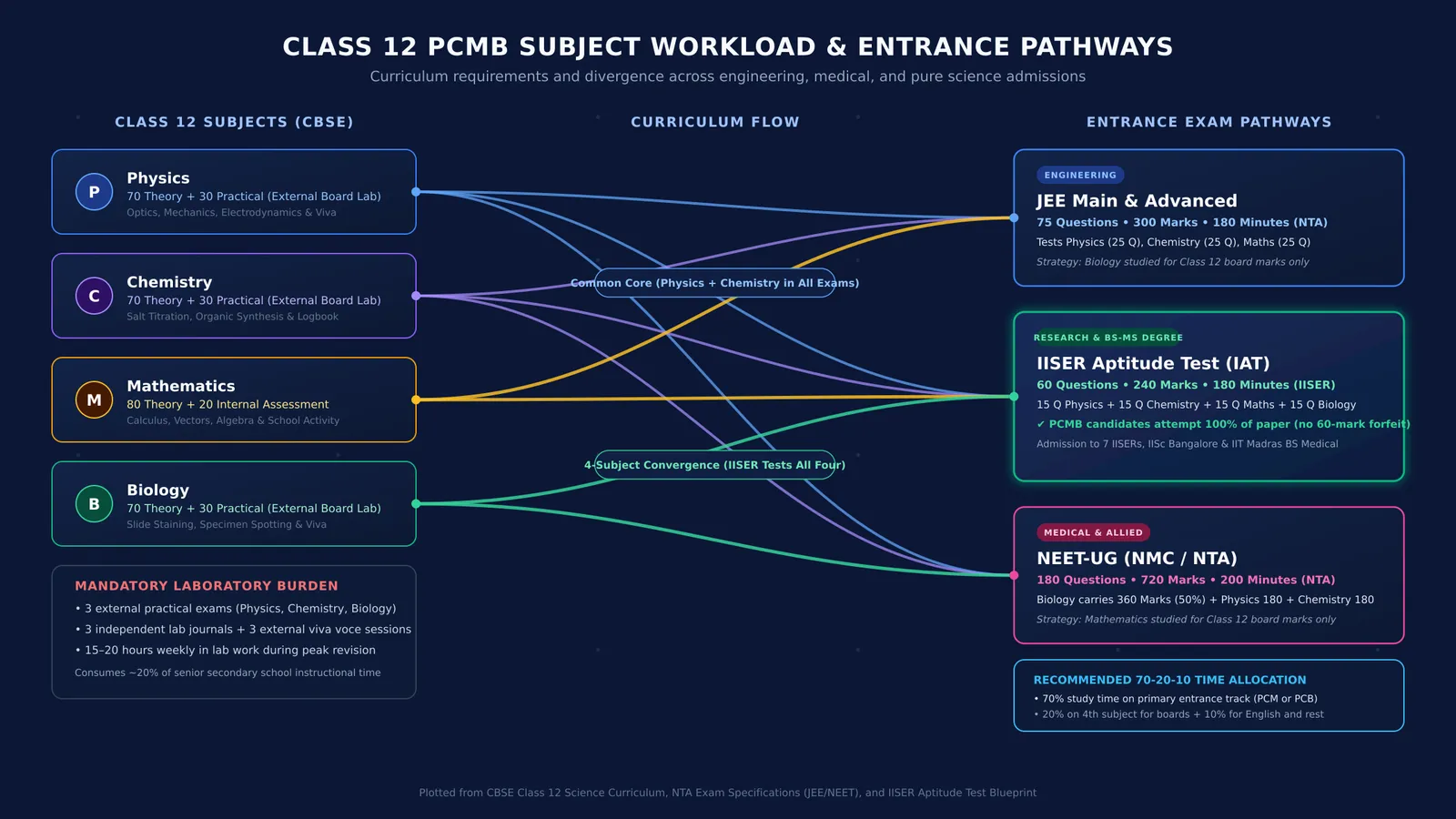
The immediate reality of PCMB appears in the laboratory schedule. In the Senior School Curriculum established by CBSE Academic, Physics, Chemistry, and Biology each carry 70 marks of theory and 30 marks of laboratory practical assessment. Mathematics carries 80 marks of theory and 20 marks of internal assessment.
A PCM or PCB student maintains two laboratory journals. A PCMB student maintains three, completes three viva voce preparations, and sits for three external board practical exams. In January and February, when entrance revision demands peak focus, PCMB students spend 15 to 20 hours weekly on logbooks, salt titrations, slide staining, and optical benches.
Beyond physical lab hours, cognitive switching extracts a steep toll. Educational psychologist John Sweller showed that human working memory holds only 3 to 4 novel elements at once (Sweller, 1988). Shifting between calculus derivations and botanical taxonomy requires constantly dismantling and rebuilding mental schemas. Our guide on balancing Class 12 boards and entrance exams offers practical pacing checkpoints for families managing multiple syllabi.
When switching between organic reaction pathways and calculus derivations, you can use the Fermi Concept Library to review lessons mapped across physics, chemistry, biology, and mathematics.
Can you realistically prepare for JEE and NEET together?
Students often consider taking PCMB in Class 12 for JEE and NEET both, hoping to clear two exams administered by the National Testing Agency. Because Physics and Chemistry overlap, many assume they can manage both exams with only 25 percent additional study effort.
In practice, the testing styles diverge sharply. As structured by the National Testing Agency, JEE Main tests multi-step mathematical problem-solving across 75 questions in 180 minutes, prioritizing calculus and mechanics. NEET-UG tests rapid factual recall across 180 questions in 200 minutes, where Biology alone provides 360 out of 720 marks.
Scoring in NEET Biology requires memorising NCERT textbooks line by line. Scoring in JEE Mathematics requires solving hundreds of complex calculus and algebra variations. Splitting revision between these demands usually prevents students from achieving top ranks in either. Rather than guessing at intermediate steps, the Fermi Problem Library provides worked problems with a step-by-step solver that explains the reasoning rather than just printing an answer. For students balancing both, an interleaved practice plan helps separate problem formats and minimise mental interference.
Which college admission routes does PCMB keep open?
Despite the workload, PCMB provides unmatched flexibility across four main routes:
Medicine and healthcare: You retain full eligibility for MBBS, BDS, and allied degrees. On 22 November 2023, the National Medical Commission confirmed that candidates who study Biology or Biotechnology even as an additional subject alongside or after Class 12 can appear for NEET-UG.
Engineering: You preserve eligibility for all B.Tech and B.E. programs via JEE Main, JEE Advanced, and state counselling without missing mathematics requirements.
Pure science and research: PCMB students gain a major advantage in the IISER Aptitude Test (IAT). As detailed by IISER Admissions, the IAT tests all four subjects—15 questions each in Physics, Chemistry, Mathematics, and Biology—totaling 240 marks. While single-stream candidates routinely forfeit 60 marks, PCMB students can attempt every section.
Interdisciplinary degrees: Biomedical Engineering, Biotechnology, Bioinformatics, and Agricultural Technology actively value candidates with both quantitative mathematical skills and biological foundations.
How should you allocate your study time for PCMB?
To succeed in PCMB without burning out, adopt a structured "70-20-10" weekly routine based on CBSE Academic demands:
Primary entrance track (70 percent of study time): Pick one primary focus—engineering (PCM) or medicine (PCB)—by the start of Class 12. Devote 70 percent of your self-study to those three subjects.
Secondary school anchor (20 percent of study time): Restrict the fourth subject to school and board exams. If your focus is JEE, study NCERT Biology for board marks without memorising entrance trivia. If your focus is NEET, solve standard NCERT exercises in Mathematics to clear your board threshold. If you need to catch up, our guide on starting JEE prep in Class 12 provides a structured recovery schedule.
Revision and wellbeing (10 percent of study time): Dedicate 10 percent of your hours to English, internal assignments, and rest. If academic pressure feels unmanageable, speak with a counselor or reach out to the national helpline Tele MANAS at 14416.
When you sit down to study and feel unsure which subject needs attention, Fermi's AI tutor can work out what you already know and build a plan for the session, giving you a clear next step instead of a blank page.