

On this page
When you secure admission to a college, handing over a stack of documents is part of the process. But leaving your original 10th and 12th mark sheets, transfer certificates, and migration certificates with the institution can feel risky. What happens if you need them for a scholarship or decide to change colleges?
The University Grants Commission (UGC) has clear rules on this. Here is what you need to know about your rights and what colleges are allowed to do.
Can colleges keep your original certificates?
The short answer is no. Colleges and Higher Educational Institutions (HEIs) cannot keep your original certificates under any circumstances.
According to the UGC's October 2018 notification, which forms the basis of these rules, institutions are only permitted to ask for self-attested copies of your documents for their records. They are strictly prohibited from taking your original certificates, such as 10th and 12th mark sheets, school leaving certificates, or migration certificates, into "institutional custody". This rule applies to all undergraduate and postgraduate programs across central, state, deemed, and private universities recognized by the UGC.
What happens during document verification?
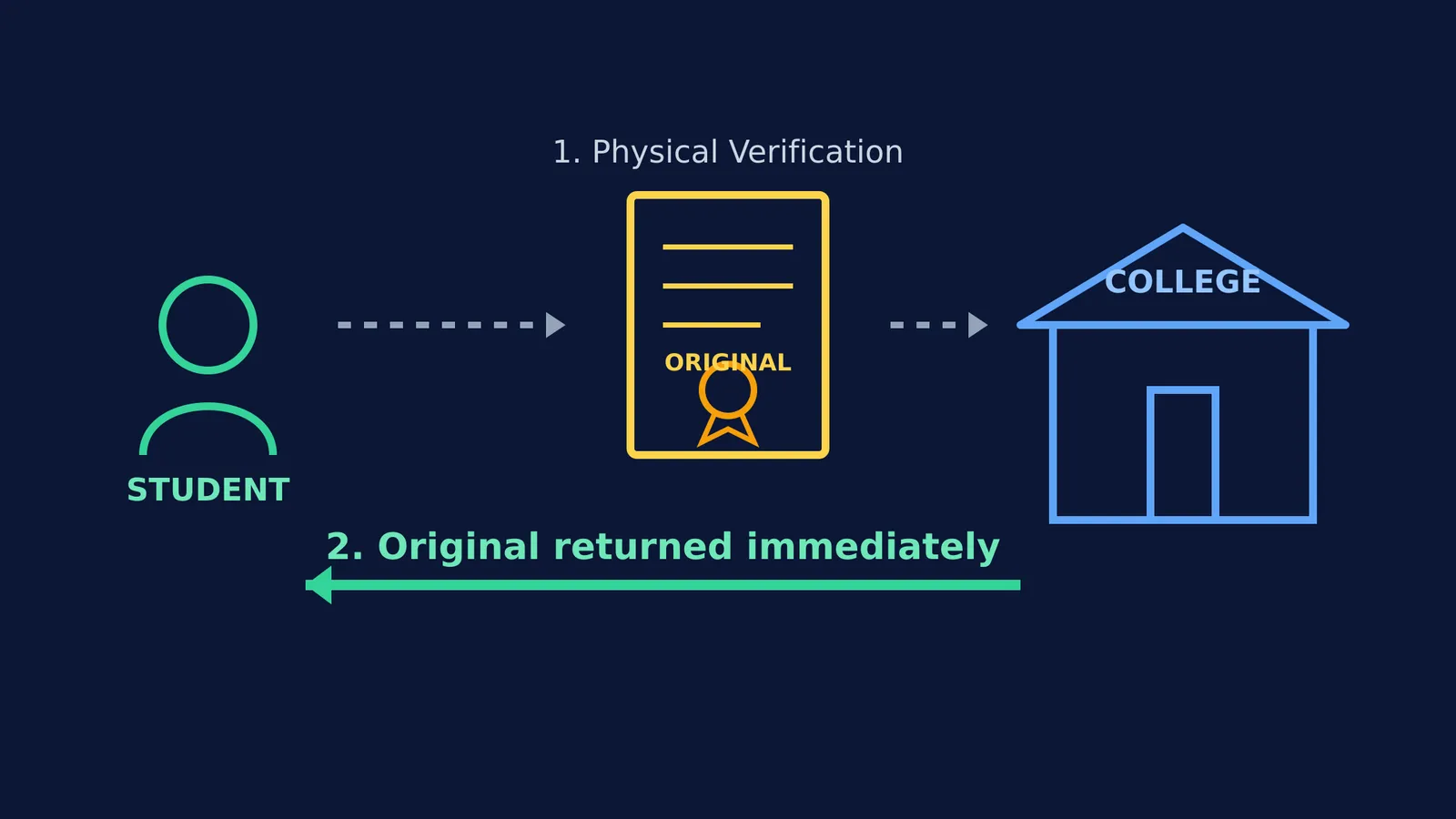
Colleges do need to check that your qualifications are genuine. During admission, the institution is allowed to ask for your original certificates for physical verification.
However, this verification must happen in your presence. Once the college staff has checked the documents against the copies you provided, they must return the originals to you immediately. If the college suspects a document is fake, they must contact the issuing board to verify it, but they still cannot keep your original certificate while they wait for an answer.
When you head to college, your focus shifts from gathering documents to surviving the coursework and learning what to expect in Your first semester at science or engineering college: what changes. If you find yourself stuck on a hard physics problem or a concept that does not make sense, Fermi's AI tutor can work out what you already know and build a plan for the session, giving you a clear next step instead of a blank page. You can also start preparing early with How to improve your CGPA: a semester plan backed by research.
What are the rules for fee refunds?
Often, colleges hold on to original documents to prevent students from leaving or to force them to pay the full year's fee. The UGC has also set strict timelines for fee refunds to stop this.
While the UGC often announces special, extended full-refund windows for specific academic years, the underlying rule is a standard tiered refund system.
How does the standard tiered refund system work?
Under the standard UGC tiered refund system, the refund percentage drops depending on how many days have passed since the formally notified last date of admission.
100% refund: If you withdraw 15 days or more before the last date of admission (the college can deduct up to 5% of the fees paid, maximum ₹5,000, as processing charges).
90% refund: If you withdraw less than 15 days before the last date.
80% refund: If you withdraw 15 days or less after the last date.
50% refund: If you withdraw more than 15 days, but less than 30 days, after the last date.
0% refund: If you withdraw more than 30 days after the last date.
In all cases where a refund is due, the college must process it and return the money to you within 15 days of receiving your written application.
What to do if a college refuses to return your certificates?
If an institution insists on keeping your original documents or delays your fee refund, you do not have to accept it. Follow this checklist to resolve the issue:
Cite the rules: Show the college administration the UGC Notification on Refund of Fees and Non-Retention of Original Certificates.
File a grievance: Every college is required to have a Student Grievance Redressal Committee (SGRC). Submit a formal written complaint to them.
Approach the UGC: If the college does not resolve the issue, you can escalate it by filing a complaint on the official UGC e-Samadhaan portal.
Institutions that violate these norms face punitive actions, which can include the withdrawal of their UGC grants or withholding of affiliation.


