

On this page
Preparing for advanced olympiads can feel isolating. Turning to online study communities for olympiad preparation is a natural step. Forums like Art of Problem Solving (AoPS) or dedicated Discord servers offer access to peers who are solving the same tough questions, providing a space to share ideas and overcome hurdles together.
However, these spaces are a double-edged sword. While they provide help when you are stuck, they can easily become a massive drain on your time if you are not careful about how you use them.
Why do online study forums become a time drain?
Online environments are inherently more prone to multitasking and distraction. Unlike a physical library where the social norm is quiet, focused work, an online forum is built to keep you clicking. You might log on with the intention of asking a single physics question, but quickly find yourself reading several unrelated threads, debating a concept, and losing much of your precious study time.
The cognitive cost of this context-switching is steep. A widely cited study on interrupted work found that the average person takes 23 minutes to fully refocus after being distracted by a notification or shifting their attention to a new topic. If you check a forum several times during a study session, you have essentially wiped out a large block of deep focus.
If you struggle with this, reading about multitasking while studying can help you understand why task-switching makes learning feel so much harder than it actually is. The key is to separate your problem-solving time from your community-browsing time.
How to ask good questions on a study forum?
To get the most out of an online community without wasting time, you need to ask questions that respect the community's time and show your own effort. High-quality platforms have strict guidelines for a reason. If you just post a blurry photo of a problem and say "Help," you are unlikely to get a useful response, and you may even face harsh criticism.
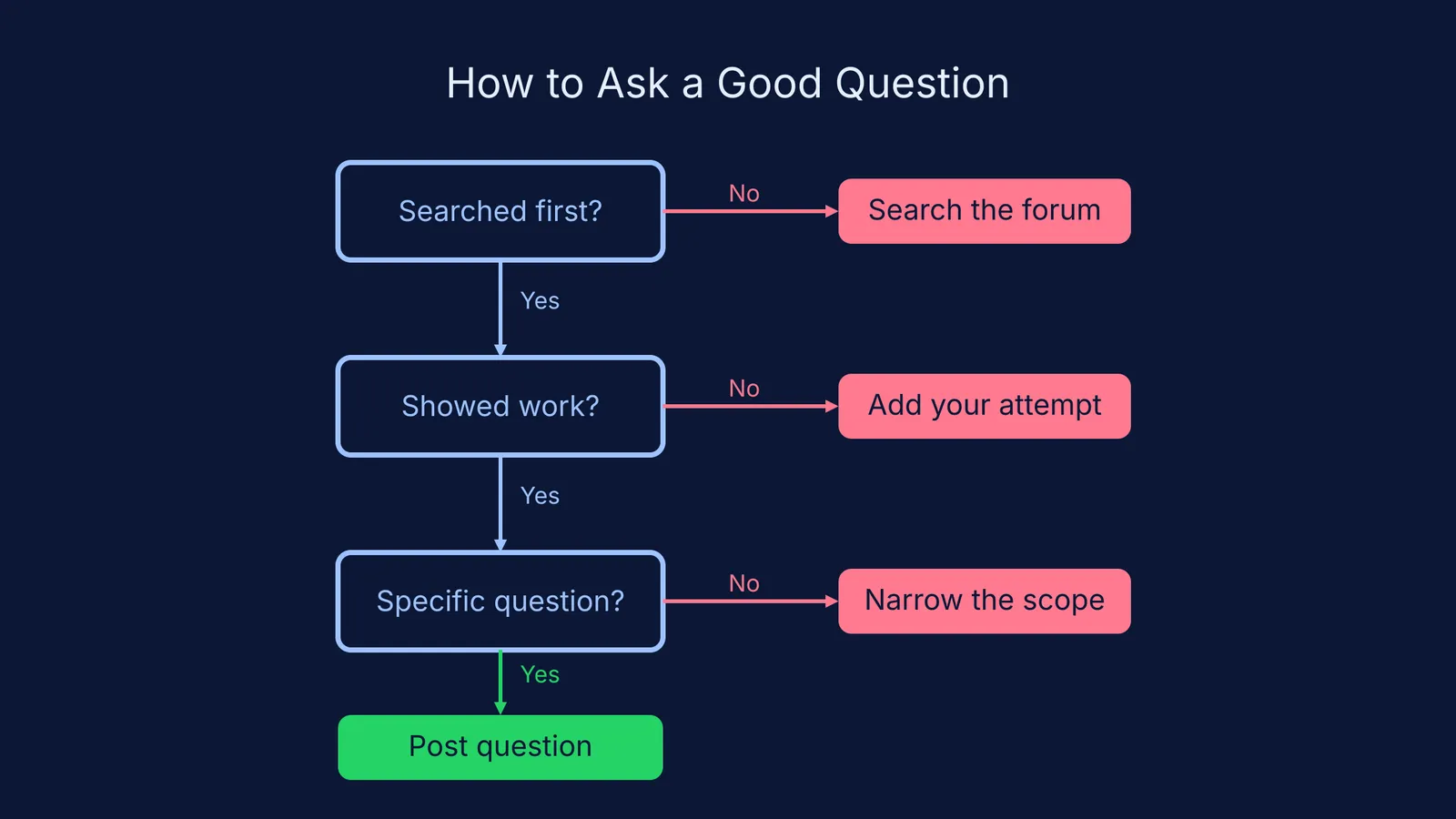
Instead, follow this checklist before you hit submit:
Search first: Ensure your question has not already been answered on the forum. Often, a quick search will save you hours of waiting for a reply.
Give context: Mention exactly what the problem is from (e.g., a past paper or a specific textbook chapter). This helps experts instantly recognise the difficulty level and the concepts you are expected to use.
Show your work: Explain exactly where you got stuck. Are you unable to set up the initial equations, or did you make a calculation error halfway through? Posting your partial solution allows others to pinpoint your exact conceptual gap.
Be specific: Narrow the scope of your question. Asking "How do I solve circuit problems?" is too broad. Asking "Why does the node potential method fail when there is an ideal voltage source between these two nodes?" is highly specific and easy to answer.
If you are tired of waiting for human replies or dealing with unhelpful forum comments, Fermi's AI tutor can be a strong alternative. Fermi teaches rather than just answering. If you bring a tough problem, the tutor works out what you already know, builds a plan for the session, and teaches through it — writing on a board, drawing the figure, and checking your understanding as it goes. You get the benefit of a one-to-one discussion without the distractions of a public forum.
What is the best way to use online study communities?
The most effective way to use online communities is for structured accountability rather than casual browsing. When used correctly, virtual group study leads to significantly higher focus levels.
To keep your olympiad preparation on track, treat online study groups as a tool for focus, not entertainment:
Join focused sessions: Use platforms or Discord voice channels meant strictly for silent coworking or the Pomodoro technique. The presence of others studying quietly can be highly motivating.
Set a timer: Give yourself a strict time limit for checking forums, posting questions, or reading replies. When the timer goes off, log out.
Move off-screen: Once you have your hint or answer, close the browser and return to pen and paper.
If you are using digital tools to review your answers, getting useful AI feedback on your step-by-step solutions can keep you moving forward without the social distraction. Managing your focus is a learned skill. If you are struggling to stay on task during live sessions, check out these practical tips for staying focused in live online classes. By treating the community as a resource rather than a hangout spot, you can solve harder problems faster.


