On this page
How does the computing olympiad differ from collegiate competitive programming?
In school competitions such as the International Olympiad in Informatics (IOI) or the Indian Computing Olympiad (including the ZCO and INOI), you compete alone. You sit in front of your own computer for five hours with three problems, aiming to score points through partial subtasks. If a full O(N) solution eludes you, an O(N²) brute force often yields 30 to 50 points. Our guide on The Indian Computing Olympiad: stages, practice and how to start covers how early algorithmic training begins.
Collegiate competitive programming, governed by the International Collegiate Programming Contest (ICPC), upends this model. Under official ICPC Regional Rules, a team consists of three students sharing a single computer workstation for five hours. Instead of three problems with partial scoring, you face 10 to 15 problems scored on a binary basis: a solution either passes every hidden test case or earns zero points. Furthermore, every rejected submission adds a 20-minute penalty once the problem is solved.
A 2026 study in *The Journal of Competitive Learning* by Tolga Can, Ryan Farrell, and Christian Yongwhan Lim compared structural formats, problem types, and contestant pathways between the IOI and ICPC. The authors found that while school olympiads incubate individual algorithmic depth, the collegiate contest demands higher execution speed, robust error handling, and collaborative resource sharing. Former olympiad contestants often stumble initially because they spend hours chasing an optimal algorithm on a hard problem while rival teams clear five easier tasks.
Why does sharing a single computer change contest strategy?
When three programmers share one keyboard, typing speed is rarely the bottleneck. The real constraint is terminal access. Sitting at the computer to debug logic errors in real time paralyzes your teammates.
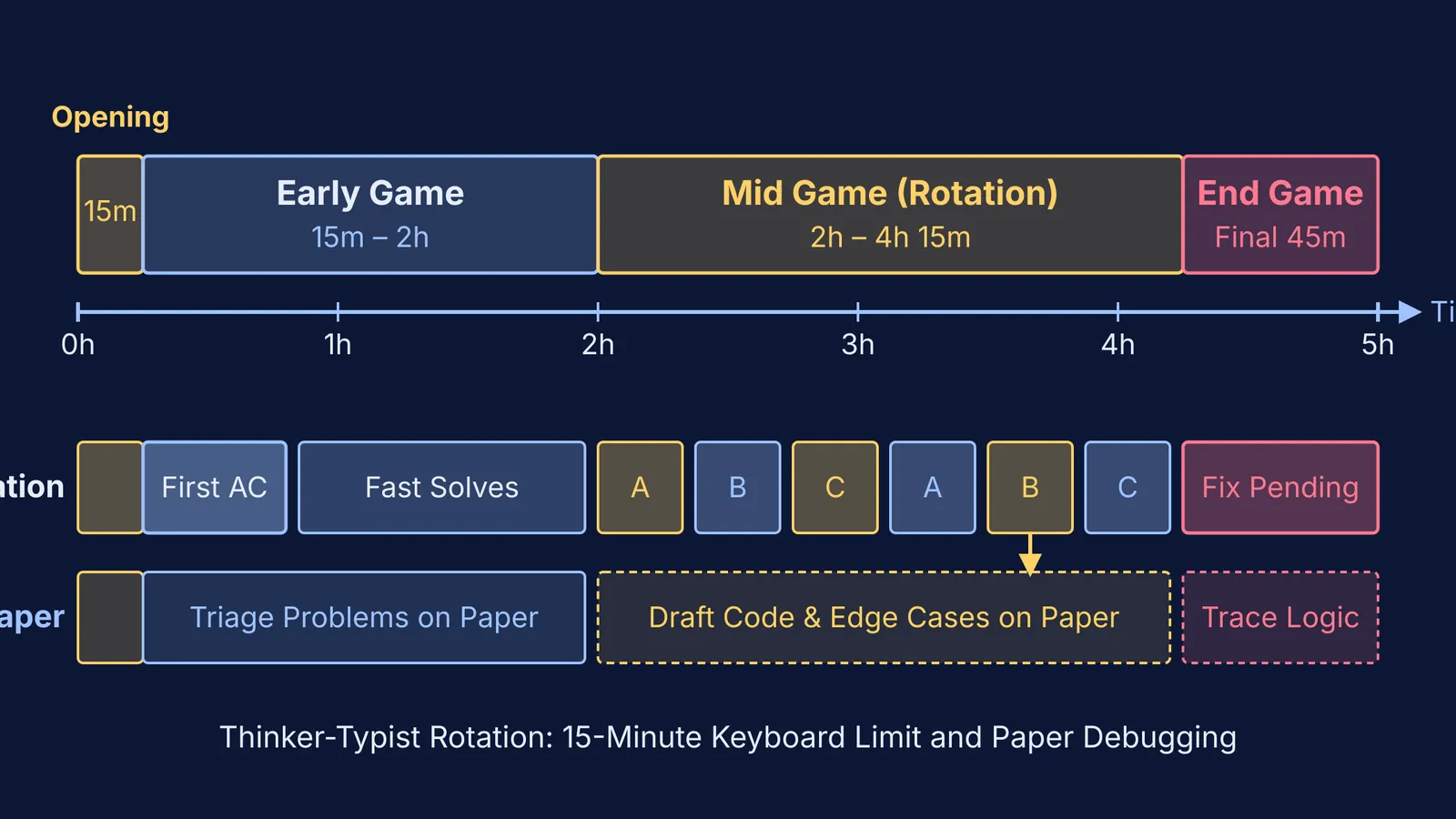
A classic paper in *SIGCSE '16* by Aaron Bloomfield and Borja Sotomayor outlined a four-phase strategy for managing this constraint:
The Opening: During the first 15 minutes, the team scans for straightforward problems so one coder can immediately submit an accepted solution and get on the scoreboard.
The Early Game: While the first solution is typed, the other two members categorize remaining questions on paper by topic and difficulty.
The Mid Game: Operating in a thinker-typist rotation, no coder claims the workstation until their algorithm and edge cases are drafted on paper.
The End Game: In the final 45 minutes, teams stop starting new problems and focus entirely on debugging near-complete attempts.
How should you organize practice between solo contests and team mocks?
Transitioning into college requires balancing solo practice with synchronous team mocks. You cannot rely on weekend team contests alone to build algorithmic reflexes.
In *The Journal of Competitive Learning*, Zhongtang Luo and Ethan Dickey analyzed ten years of ICPC standings from 2015 to 2024. They discovered that individual Codeforces ratings correlate more strongly with World Finals performance (Kendall's tau = 0.596) than superregional qualifying ranks do (weighted tau = 0.407). Frequent solo rounds provide the pattern recognition and implementation speed that drive team success.
To build this dual competence during term time, structure your training around three weekly habits:
Compete in two solo online contests each week to maintain speed and accuracy under time pressure.
Run one weekly five-hour team simulation using past regional problem sets, strictly enforcing the single-computer rule and paper debugging.
Spend two hours after every contest "upsolving"—writing clean, accepted solutions for the first two problems your team could not solve live.
When you encounter difficult data structures during upsolving, jumping straight to full solutions halts learning. Fermi's AI tutor notices where you are stuck and decides whether to explain, ask, or show, while the Fermi Problem Library provides worked problems with a step-by-step solver that explains the reasoning rather than printing an answer.
How can you join or build a thriving college programming club?
Adjusting to university academics as a first-year student takes deliberate planning. Our guide on your first semester at science or engineering college: what changes explains how to protect your study hours.
Joining your campus coding club or ACM chapter is an effective way to find complementary teammates. A well-rounded team balances three roles:
An algorithmic specialist: excels at complex dynamic programming, network flows, and tree structures.
A mathematical solver: strong in combinatorics, number theory, probability, and geometry.
An implementation anchor: writes clean, bug-free implementations quickly and creates stress-testing scripts.
If your college lacks an active club, start one with regular peer problem-solving sessions. Our guide on how to run a study group that actually helps you learn shares techniques for keeping meetings focused and collaborative. Organise mock contests, track internal leaderboards, and invite experienced seniors to review contest strategy. That shared community turns individual high school passion into lasting collegiate success.