

On this page
If you live in Dubai, Doha, Riyadh or Singapore, you can sit JEE Main and NEET-UG without flying to India. What changes is the clock, the exam centre and how your school syllabus lines up with the official one.
Can you take JEE Main or NEET-UG from abroad?
Yes, at overseas cities the National Testing Agency (NTA) lists in each year's bulletin. The NEET-UG 2026 information bulletin listed 14 cities outside India: Kuwait City, Dubai, Abu Dhabi, Sharjah, Doha, Manama, Muscat, Riyadh, Kathmandu, Singapore, Bangkok, Colombo, Kuala Lumpur and Lagos. The same bulletin set the fee for a centre outside India at ₹9,500, against ₹1,700 for a General candidate in India.
The JEE Main 2026 information bulletin listed 15 cities outside India, including eight in the Gulf as well as Washington, Munich and West Java. It says foreign candidates choose exam cities based on their present and permanent address, and that NTA may allot a different city for administrative or logistic reasons.
What time is JEE Main or NEET in Dubai or Riyadh?
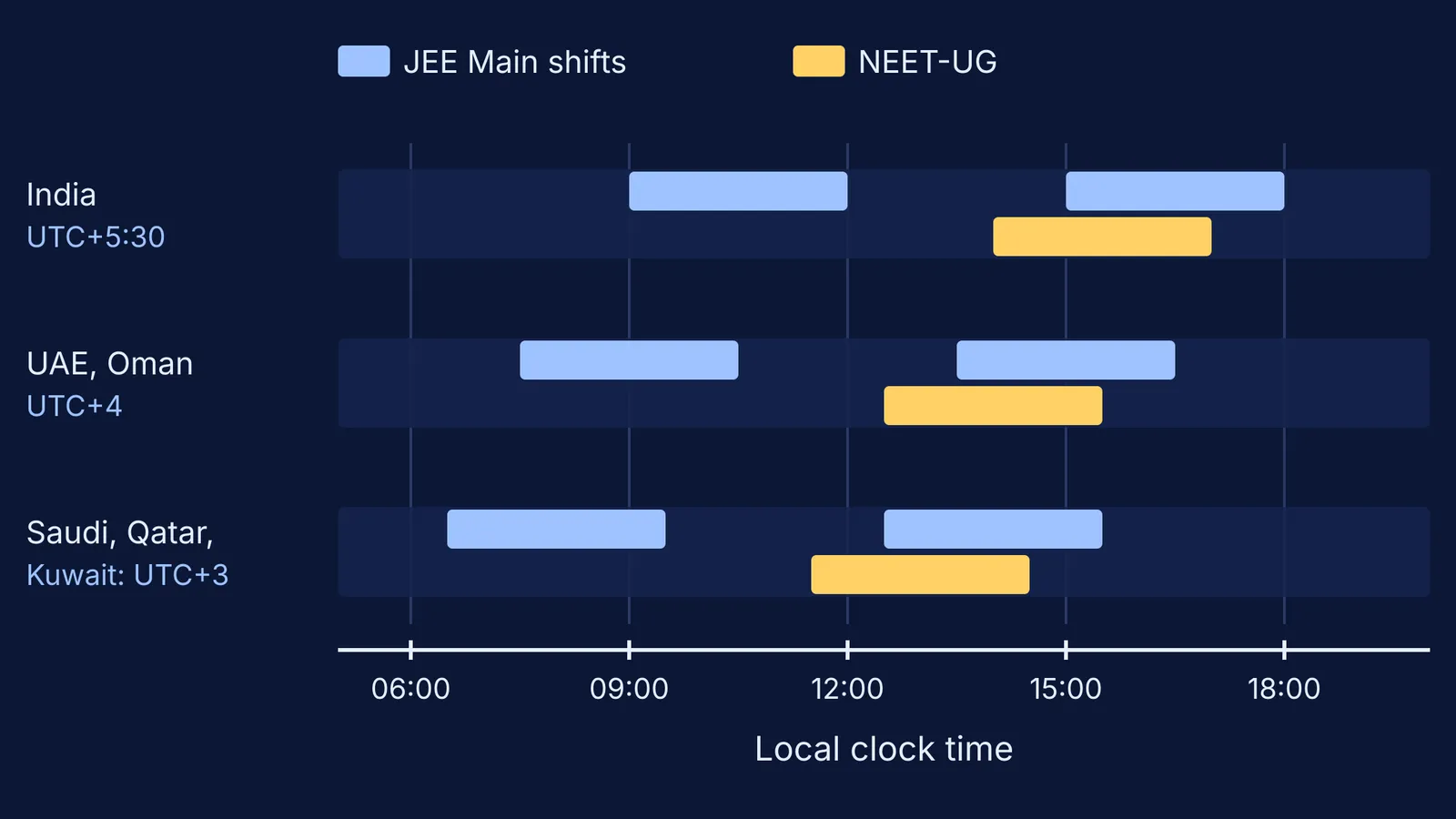
NTA fixes exam times in Indian Standard Time. The JEE Main 2026 bulletin set two shifts, 9:00 am to 12:00 noon and 3:00 pm to 6:00 pm IST, and the NEET-UG 2026 bulletin set 2:00 pm to 5:00 pm IST. The bulletins give no separate local times for overseas centres. When NEET-UG was re-held in the UAE on 21 June 2026, All India Radio's news service reported it starting at 12:30 pm UAE time, which is 2:00 pm IST.
India runs on UTC+5:30 with no daylight saving. The UAE and Oman use UTC+4, and Saudi Arabia, Qatar, Kuwait and Bahrain use UTC+3; neither group changes its clocks in summer. So the gap is 1 hour 30 minutes in Dubai and 2 hours 30 minutes in Riyadh, all year. If your centre follows the IST timetable:
JEE Main morning shift (9:00 am IST): 7:30 am in Dubai or Muscat, 6:30 am in Riyadh, Doha or Kuwait City.
JEE Main afternoon shift (3:00 pm IST): 1:30 pm in Dubai, 12:30 pm in Riyadh.
NEET-UG (2:00 pm IST): 12:30 pm in Dubai, 11:30 am in Riyadh.
Your admit card has the final timing; go by it, especially at distant centres such as Munich or Washington, where daylight saving moves the gap.
If your JEE shift could start at 6:30 am local time, sit some weekend mock tests at 6:30 am so hard physics at that hour feels normal. For your own study hours around live classes, our piece on morning or night study and chronotype research covers what the evidence says.
Does a non-CBSE syllabus work for JEE or NEET?
If your school follows IB, Cambridge or another curriculum rather than an Indian board, check two things.
First, eligibility. The NEET-UG 2026 bulletin asks candidates from foreign or international boards to check their qualifying exam against its Code 07: it must match an Indian Class 12 science exam in scope and standard, with Physics, Chemistry and Biology or Biotechnology studied in the last two years of 10+2, practical tests in each, and English. Read it, and our explainer on NEET UG eligibility rules, before you choose subjects in Class 11.
Second, coverage. The exams test the official syllabus, not your school's, so build a syllabus map:
Download the current syllabus from the NTA site for JEE Main or NEET-UG.
List every unit down one side of a page.
Mark each unit: covered at school, partly covered, or not covered.
Put the not-covered units into your weekly plan first, because no school class will reach them.
The Fermi Concept Library has every concept in physics, chemistry, biology, mathematics and computing, each with its own lesson and its place in the map, so you can fill a gap without waiting for a class.
What paperwork do NRI students need?
For NEET-UG, NRI and OCI candidates upload a certificate from the Indian diplomatic mission in their country of residence with the application and keep the original for counselling, according to the NEET-UG 2026 bulletin. Its certificate format says it is valid for six months only, so time your request.
For engineering, the DASA 2026 information brochure says NITs, IIITs and other government-funded institutes admit foreign nationals, OCI, PIO and NRI candidates under the Direct Admission of Students Abroad scheme on the basis of JEE Main 2026. For B.Tech it also asks for 75% (or a CGPA of 7.5 out of 10) in aggregate across five Class XII subjects, and its category tags include Children of Indian Workers in Gulf (CIWG).
A year plan for an aspirant abroad
Month 1: download the current bulletins and syllabus; build your syllabus map.
Month 1: pin the IST-to-local conversion for your city above your desk.
Months 2 to 9: not-covered units first, then partly covered ones.
When applications open: pick overseas cities that match your address.
Before applying for NEET-UG: request the embassy certificate, valid for six months per the NEET-UG 2026 bulletin.
Last eight weeks: full mocks at your exam shift's local time.
For timing, see our guide to planning your year around JEE Main's two sessions. If you sit down and don't know where to start, Fermi's AI tutor can work out what you already know and build a plan for the session.


