

On this page
If you are planning to study a bachelor's degree in New Zealand after 12th grade, you will find a university system that values both academic rigour and practical skills. New Zealand's eight universities are all government-funded and globally recognised. For Indian students, the application route is straightforward but requires careful financial and academic planning.
What are the academic requirements?
The academic requirements depend on the university and the specific course you choose. According to Education New Zealand, Indian students typically need to have completed their All India Senior School Certificate (CBSE) or Indian School Certificate (CISCE) with a strong average.
Most universities require an aggregate of 75% or higher in your best four academic subjects for direct entry into a bachelor's program, according to official university course guidelines. Highly competitive fields, such as engineering or health sciences, often demand 80% to 90%, along with specific subject prerequisites like mathematics or biology.
If your 12th-grade marks do not meet the direct entry cutoff, you can take a Foundation Studies programme. These bridging courses generally last between six and 12 months. They are offered by universities or partnered colleges and guarantee entry into the degree upon successful completion.
When planning your subjects and career path, you might also want to explore options outside the usual engineering or medical routes. Our guide on Talking about STEM careers beyond engineering and medicine can help you and your parents weigh different degrees.
What are the English language requirements?
Because classes are taught in English, you must prove your proficiency through a standardised test. The standard minimum requirement for an undergraduate degree is an IELTS (Academic) overall score of 6.0, with no single band scoring less than 5.5, per Education New Zealand standards. Alternatives like the TOEFL iBT (usually requiring a score of 80) or the PTE Academic (an overall score of 50) are also widely accepted.
If you struggle with the technical vocabulary required for university-level science or maths, Fermi's AI tutor can help you build confidence before you go. It works out what you already know and teaches through concepts step-by-step, making sure you understand the foundational ideas rather than just giving you the answers.
How much does it cost to study in New Zealand?
Budgeting is the most critical step for international students. Your costs are split into tuition fees and living expenses.
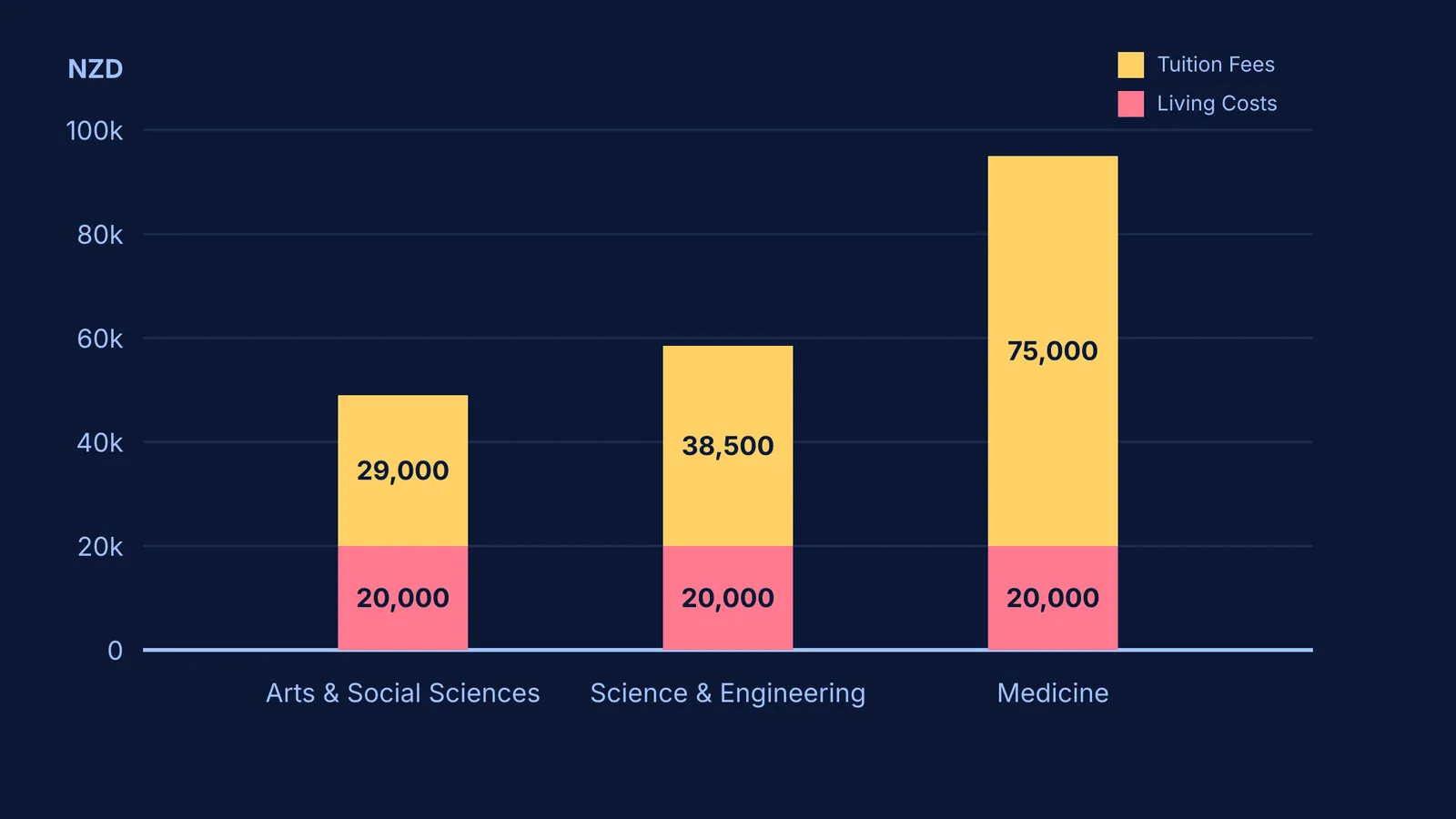
Tuition fees vary by subject. On average, international undergraduate students can expect to pay between NZD 25,000 and NZD 75,000 per year:
Arts and Social Sciences: NZD 25,000 to NZD 33,000 per year.
Science and Engineering: NZD 32,000 to NZD 45,000 per year.
Medicine and Veterinary Science: NZD 75,000 or more per year.
For a standard three-year degree, or four years for an honours programme, you must multiply these annual costs accordingly.
How much money do you need for a student visa?
To obtain a student visa, Immigration New Zealand requires you to prove that you can support yourself financially.
You must show evidence of NZD 20,000 per year for living costs if your study programme lasts one year or more, as mandated by Immigration New Zealand. You will also need to show that you have paid your first year's tuition fees and have enough money for a return ticket home. Any single deposit over NZD 2,000 usually requires an explanation and supporting documents, such as tax returns or business records, to prove the money is from a genuine source.
Acceptable proof of funds includes bank statements for the past six months, education loan sanction letters, or fixed-term deposits.
A planning checklist for Indian students
Start your application process eight to ten months before the intake. New Zealand's main intake is in February, with a secondary intake in July.
Research courses: Use the official Course Search tool on the Study with New Zealand website to find exact entry requirements.
Take your English test: Book your IELTS or TOEFL in your 12th-grade year.
Prepare your finances: Ensure your parents or sponsors have liquid funds maturing or maintain stable bank balances for at least six months before you apply for the visa, as recommended by Immigration New Zealand.
Apply to universities: Submit your 10th and 11th-grade marks for a conditional offer while waiting for your 12th board results.
Clear any concepts: Use the Fermi Concept Library to brush up on specific physics or maths topics required for your degree so you do not fall behind in your first semester abroad.
Studying overseas is a big financial and emotional commitment for a family. If you are having trouble agreeing on the right path, read our advice on When your child's career choice differs from yours to help navigate the discussion.


