

On this page
A ship is a massive floating city that must withstand the crushing forces of the ocean while carrying thousands of tonnes of cargo. Designing these vessels is the job of a naval architect.
As India expands its shipbuilding capacity and offshore energy projects, naval architecture and ocean engineering has emerged as a specialized but critical STEM career. Modern trade and naval defence depend entirely on ships that are safe, fuel-efficient, and capable of operating in extreme conditions. Here is a look at what the field involves, what you will study, and how to start a career in it.
What do naval architects and ocean engineers do?
Naval architects are responsible for the overall design, stability and safety of a marine vessel. They start with the basic hull form, calculating its shape to minimize water resistance so the ship uses less fuel. They also work out the ship's centre of gravity and its centre of buoyancy, ensuring that if a wave tilts the ship, the physical forces naturally right it again. Beyond the hull, they plan the internal layout to maximize cargo space while keeping the structure rigid enough to survive rough seas.
Ocean engineers apply similar principles to offshore structures that remain fixed in the ocean. This includes designing oil rigs, subsea pipelines, and offshore wind turbines. These structures must survive decades of storms, wave impacts, and saltwater corrosion. Ocean engineers calculate the loads from underwater currents and design foundations that anchor safely into the seabed.
Which institutes offer naval architecture in India?
Because the branch requires specialized wave tanks and heavy simulation equipment, only a select few universities in India offer it.
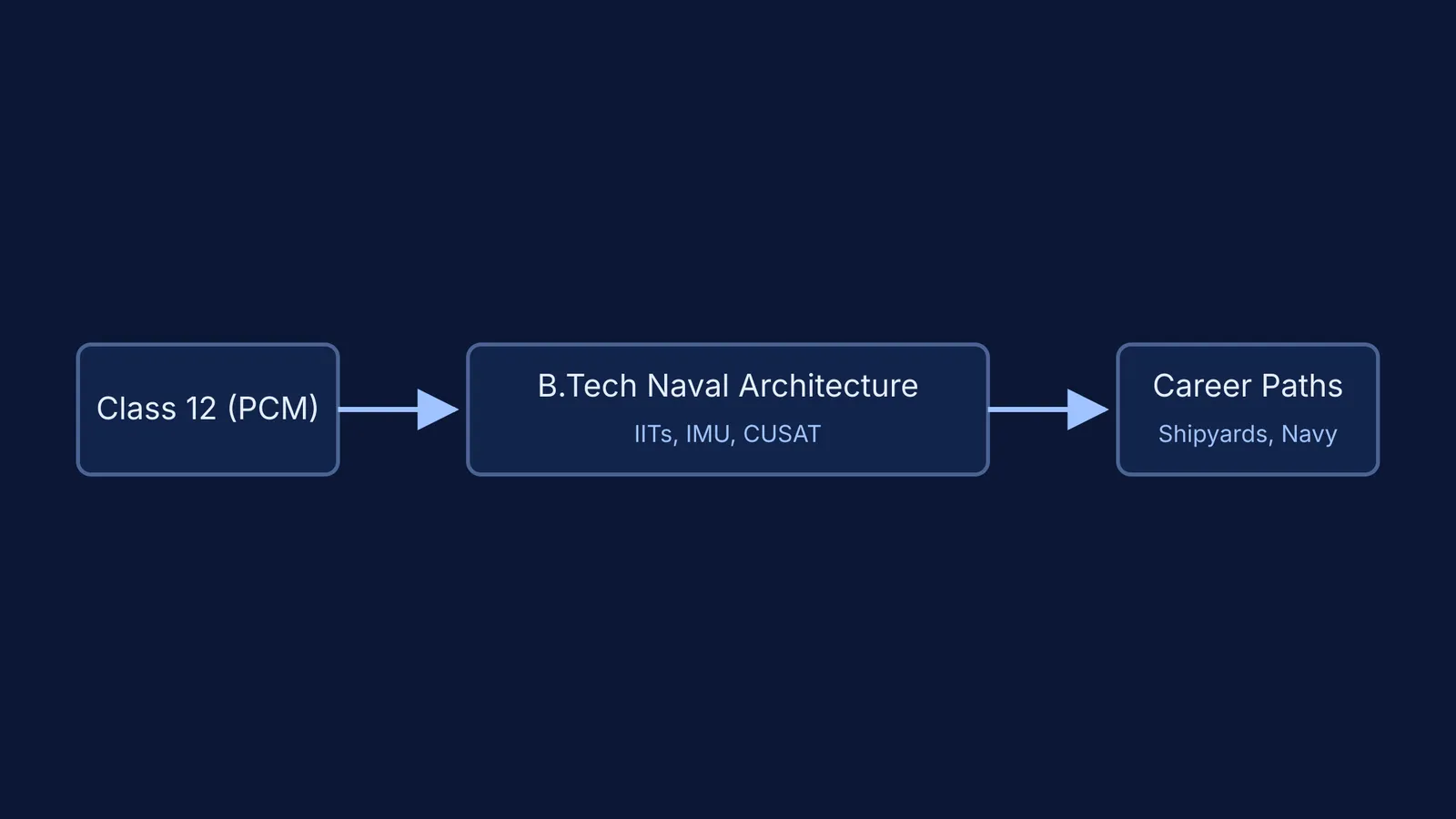
IIT Madras and IIT Kharagpur: These are the premier institutes for the discipline, offering B.Tech and Dual Degree (B.Tech + M.Tech) programmes. Students at these institutes learn through advanced computational fluid dynamics (CFD) software and physical towing tanks. Admission is strictly through JEE Advanced.
Indian Maritime University (IMU): This central university offers a B.Tech in Naval Architecture and Ocean Engineering across its Visakhapatnam and Chennai campuses. Combined, these two campuses have a focused intake of around 120 students per year (Indian Maritime University). Admission requires clearing the IMU-CET.
Cochin University of Science and Technology (CUSAT): Located near one of India's largest shipyards, CUSAT offers a highly regarded B.Tech in Naval Architecture and Ship Building. The proximity to active shipbuilding provides students with frequent industrial exposure.
What is the career scope and salary?
The demand for naval architects is tied closely to global trade and national defence. In India, the maritime sector handles about 95% of the country's external trade by volume (Ministry of Ports, Shipping and Waterways). This massive flow of goods relies on a constant supply of new, efficient commercial ships.
Graduates typically find roles in large shipyards, such as Cochin Shipyard or Mazagon Dock, where they oversee the construction and launch of vessels. Another major career path is working for classification societies, such as the Indian Register of Shipping. These organizations inspect and certify that ships meet international safety standards. The Indian Navy also recruits naval architects to design and maintain its fleet of warships and submarines.
Because the skill set is rare and highly technical, compensation is strong. At IIT Madras, the median salary for B.Tech Naval Architecture and Ocean Engineering graduates was ₹12.70 LPA in the 2023-24 placement season (IIT Madras Career Pathway Centre).
How can you build the right skills?
Naval architecture relies heavily on applied physics—specifically mechanics, thermodynamics, and fluid mechanics. To succeed in this field, a strong grasp of how pressures, flow rates, and forces interact is non-negotiable. You will spend your degree solving complex differential equations that model water flow around a hull.
If you are working through the physics of hydrostatic forces and need a clearer picture, the Fermi Concept Library breaks down the foundational ideas of buoyancy and stability. When you are ready to test your knowledge, the Fermi Problem Library offers worked problems with a step-by-step solver that explains the reasoning rather than just printing an answer.


