On this page
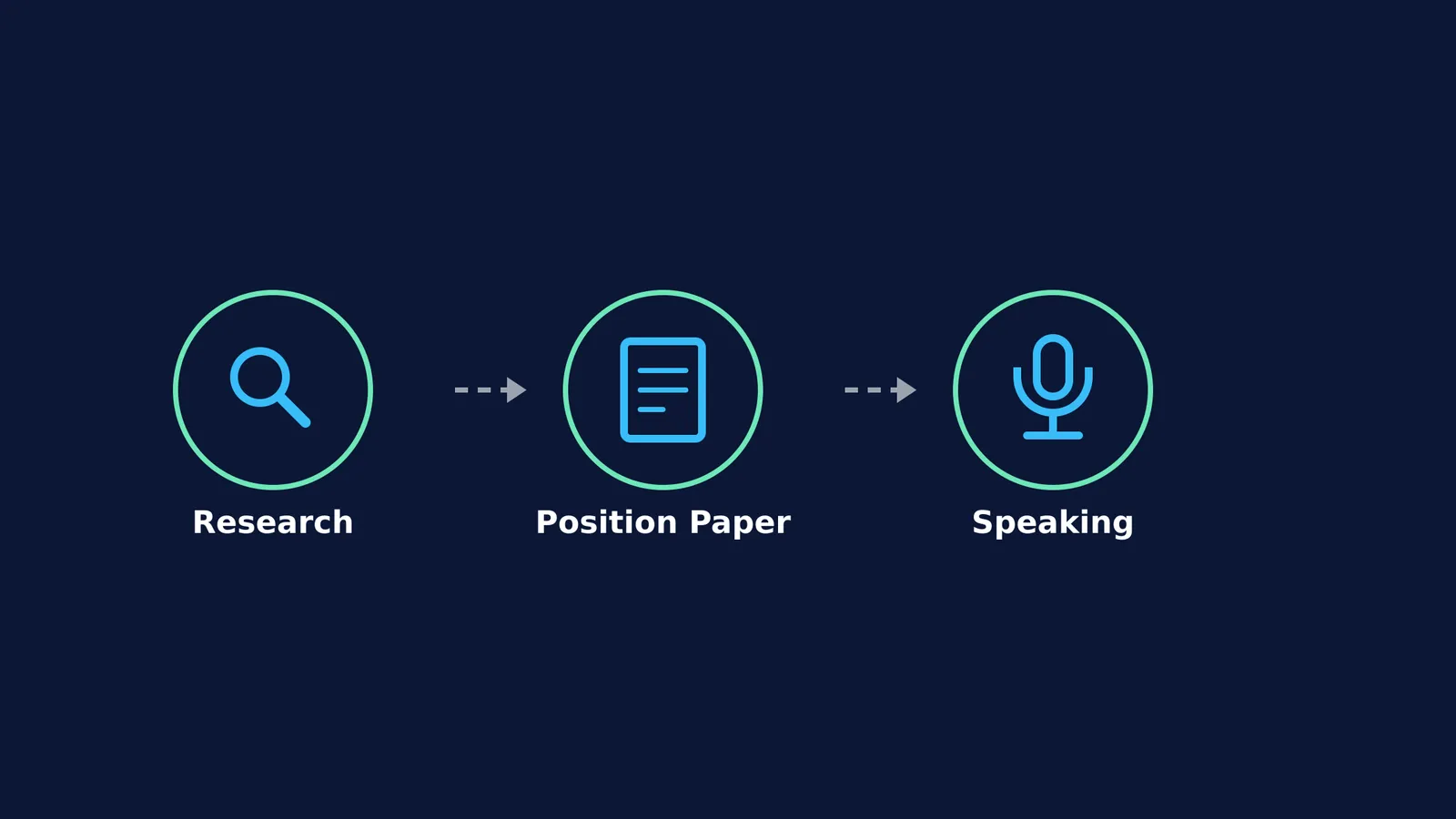
Model United Nations (MUN) is an educational simulation where students role-play as delegates to the United Nations and debate global issues. Preparing for your first conference can feel overwhelming, but it follows a predictable pattern of research, writing and speaking.
The preparation is worth the effort because simulations force you to use knowledge actively. A 2020 study of high school students found that those participating in Model UN achieved an average score of 82.58 in critical thinking skills. The same study reported an average score of 84.45 in communication skills among MUN participants. Unsurprisingly, in a survey of those students, 92% wanted Model UN simulations applied to their regular learning.
How do you research your assigned country?
Your goal is not to learn every detail of a nation's history, but to understand its foreign policy and its specific stake in the committee's topic. You must advocate for your assigned country's interests, even if you personally disagree with them.
Start with the background guide provided by the conference organisers. This document explains the problem and outlines what the moderators expect you to discuss. If the topic involves treaties or historical data, approach the guide much like reading a research paper: look for the central argument and the key data points.
Next, research your specific country. Find out who its major trading partners and regional allies are. Look at how it has voted in the past on similar UN resolutions. When researching your country, primary sources are highly reliable. The United Nations Member States portal and the UN Treaty Collection provide exact records of what your assigned country has signed and ratified. Understanding your country's economic status is also critical, as developing and developed nations often approach global problems from completely different angles.
Many UN topics involve technical science, from nuclear non-proliferation to disease control. If you need to understand the science behind a committee topic, the Fermi Concept Library contains every concept in physics, chemistry, biology, mathematics and computing, each with its own lesson and its place in the map.
What is a position paper and how do you write it?
A position paper is a short document that summarises your country's stance on the committee topic. Most conferences require you to submit this before the event begins.
A strong position paper is structured in three sections:
Background: A brief overview of the issue and why it matters globally. You might cite a recent UN report or a key statistic here.
National Position: How the issue affects your specific country and what actions your government has already taken. If your country has passed domestic laws regarding the topic, mention them.
Proposed Solutions: Two or three practical ideas your country wants the committee to adopt as a resolution.
Keep the writing formal and concise. When proposing solutions, make sure they align with your country's resources and alliances. For example, a small island nation might propose an international fund for climate adaptation, while a large industrial nation might focus on technology-sharing agreements.
How do you speak effectively in committee?
Debate in a Model UN committee takes three main forms. The Speakers' List is for formal, general speeches. A Moderated Caucus is a fast-paced debate on a specific sub-topic, where the moderator calls on delegates one by one. An Unmoderated Caucus is informal time where delegates leave their seats to negotiate and draft resolutions together.
For your first speech on the Speakers' List, prepare a short address using the "Hook, Point, Action" framework:
Hook: Grab the committee's attention with a startling statistic or a strong statement about the problem.
Point: State your country's main concern and explain why the committee must act.
Action: Propose one specific solution and invite other nations to collaborate with you.
For instance, if you are representing a country facing water scarcity, your hook might be the percentage of your population lacking clean water. Your point would outline the urgency of the drought, and your action would call for a joint resolution on sustainable irrigation technologies.
During unmoderated caucuses, you will need to find a "bloc" — a group of countries with similar goals. This process is highly collaborative, much like running study groups where everyone contributes a piece of the puzzle. Do not be afraid to speak up; even asking another delegate to clarify their proposed solution is a valid way to participate and build alliances. As you merge your ideas with others, you will write "working papers" that eventually become the formal draft resolutions the committee votes on.