

On this page
The Ministry of Minority Affairs (MoMA) provides financial assistance to students from notified minority communities in India—Muslim, Christian, Sikh, Buddhist, Jain and Parsi. For college and university students, these scholarships can cover tuition fees and provide a maintenance allowance throughout the academic year.
Navigating the application process can feel complicated, especially with recent changes to the central portal. Whether you are in your first semester at college or entering your final year, knowing which scheme fits your course and how to register correctly will save you time.
What are the three minority scholarship schemes?
The central government divides its minority scholarships into several main categories based on the student's level of education and the type of course they are pursuing.
The Post-Matric Scholarship Scheme for Minorities is designed for students studying from Class 11 up to the Ph.D. level. This includes regular undergraduate and postgraduate degrees, as well as technical and vocational courses at the secondary level. It covers admission fees, tuition fees and a monthly maintenance allowance.
The Merit-cum-Means (MCM) Scholarship Scheme is specifically for students enrolled in technical or professional courses at the undergraduate or postgraduate level. This scheme generally offers higher fee reimbursement—up to ₹20,000 per annum for the course fee, or full reimbursement for students in listed 'Top Class' institutions such as IITs and NITs.
The Pre-Matric Scholarship Scheme is for school students. Following the Right to Education Act, this scheme now primarily focuses on high school students, helping them complete their secondary education before they move on to the post-matric level.
What are the eligibility criteria?
To be eligible for the Post-Matric or Merit-cum-Means schemes, you must belong to one of the notified minority communities. You must also have secured at least 50% marks or an equivalent grade in your previous final examination.
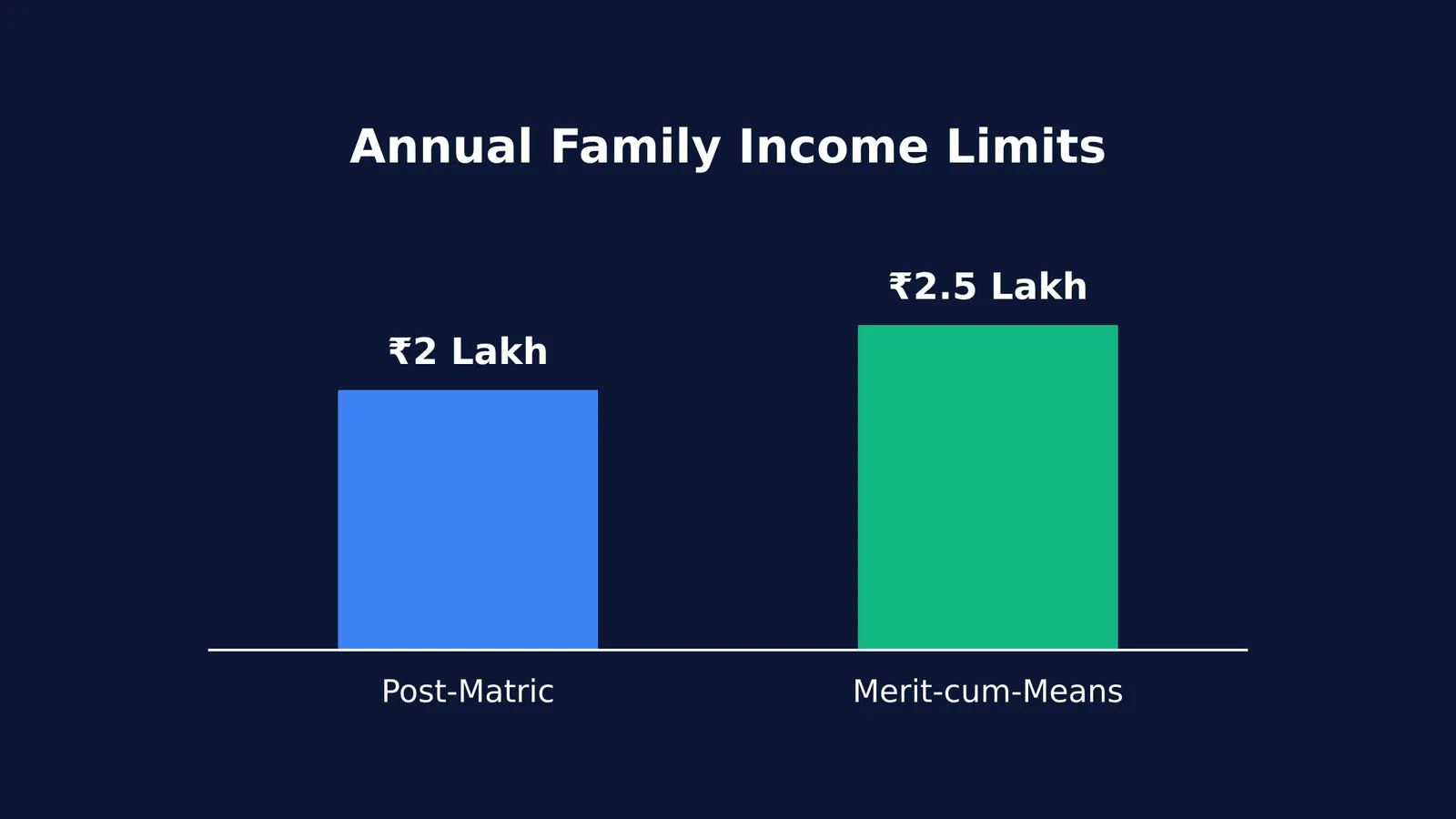
Financial need is a core requirement, and the income ceilings differ by scheme. To qualify for the Post-Matric scheme, your family's annual income from all sources must not exceed ₹2,00,000 (2 Lakhs). For the Merit-cum-Means scheme, the annual family income limit is slightly higher, capped at ₹2,50,000 (2.5 Lakhs).
If you are starting a demanding new degree and find the transition difficult, academic support is just as important as financial support. Fermi's AI tutor can work out what you already know and build a plan for the session, so you sit down to a clear next step when studying complex science topics.
Which documents are required for the scholarship?
Having your paperwork ready before the portal opens will prevent last-minute delays. You will need to upload or verify the following documents during the application process:
Aadhaar Card: Mandatory for identity verification and direct bank transfers.
Income Certificate: Issued by the designated state or union territory authority, proving your family income is below the scheme's limit.
Community Certificate: A self-certified declaration of your minority community if you are an adult, or certified by a parent if you are a minor.
Marksheet: A self-attested copy of your previous qualifying examination showing the required 50% marks.
Fee Receipt: Proof of fee payment for your current course year.
Bank Account Details: A copy of your bank passbook. The account should ideally be seeded with your Aadhaar for Direct Benefit Transfer (DBT).
Institution Verification Form: Proof that you are currently enrolled in the specified course.
Domicile Certificate: Proof of residence in your state or union territory.
How do you apply for minority scholarships on the NSP?
Starting with the 2024-25 academic year, the National Scholarship Portal (NSP) has changed how students apply. You can no longer create a new application directly; you must first generate a permanent One-Time Registration (OTR) number.
Generate your OTR: Visit the NSP website and look for the One-Time Registration link. You will need your Aadhaar number and a mobile number linked to your Aadhaar to receive OTPs.
Complete Face Authentication: The NSP now uses face authentication for eKYC. You must download the NSP OTR App and the Aadhaar Face RD App on an Android smartphone to verify your identity. Once verified, you will receive a 14-digit OTR ID via SMS.
Apply for the Scheme: Log in to the NSP using your new OTR ID. Fill out the application form, select the appropriate scheme (Post-Matric or Merit-cum-Means) based on your course, and upload your documents.
Track Verification: After submission, your application will go to your college or institute for verification, followed by state and central level checks. You can track this progress on your NSP dashboard.
A plan for getting your documents ready
Applying for financial aid shouldn't disrupt your studies. Just as you might create a study routine that lasts or a structured holiday study plan, you should tackle this paperwork systematically.
Start by checking your Aadhaar linkage. Many students face rejections because their mobile number or bank account is not properly linked to their Aadhaar. Fix this at your bank or a local Aadhaar centre first.
Next, apply for your official Income Certificate, as government offices can take some time to issue this document. Finally, gather your previous marksheets and current fee receipts. Once your file is complete, the online registration will take only a short time.


