

On this page
Many school students assume that working in weather forecasting requires an undergraduate degree called meteorology. In India, the academic pathway is grounded in foundational physical sciences. The atmosphere is a turbulent, rotating fluid governed by thermodynamic cycles, differential equations, and radiative energy transfer. Ever since Vilhelm Bjerknes framed weather forecasting as an initial-value problem in physics, operational atmospheric science has demanded rigorous mathematics and fluid mechanics rather than qualitative observation.
What degrees do you need to study weather?
To enter the field, you should complete your 10+2 higher secondary education with physics, chemistry, and mathematics. At the undergraduate level, the most versatile foundation is a Bachelor of Science (B.Sc.) in Physics or Mathematics, or a Bachelor of Technology (B.E./B.Tech) in mechanical, civil, computer science, or environmental engineering.
Undergraduate coursework in vector calculus, differential equations, and thermodynamics provides the essential mathematical framework for atmospheric fluid dynamics. For students building their core understanding across mechanics and wave motion, the Fermi Concept Library covers every concept in physics, chemistry, biology, mathematics and computing, each with its own lesson and its place in the map.
Which postgraduate programmes lead to atmospheric science?
Specialisation begins at the master's level. Premier Indian universities and technical institutes offer dedicated postgraduate degrees in atmospheric science, meteorology, and climate dynamics. Candidates usually need a strong undergraduate foundation in physics, mathematics, or engineering before qualifying through institutional admission tests. Key institutions include:
Cochin University of Science and Technology (CUSAT): Offers a two-year M.Sc. in Meteorology through its Department of Atmospheric Sciences, requiring a B.Sc. in Physics or Mathematics with at least 55% aggregate marks via the CUSAT Common Admission Test.
Indian Institute of Technology Delhi (IIT Delhi): Offers an interdisciplinary M.Tech in Atmospheric-Oceanic Science and Technology through its Centre for Atmospheric Sciences, requiring at least 60% marks or a 6.0 CGPA on a 10-point scale in engineering or relevant master's degrees, alongside a valid GATE score according to IIT Delhi CAS.
Andhra University, Visakhapatnam: Offers an M.Sc. in Meteorology and an M.Tech in Atmospheric Sciences through its pioneering Department of Meteorology and Oceanography.
Savitribai Phule Pune University (SPPU): Offers a two-year M.Sc. in Atmospheric Sciences through its Department of Atmospheric and Space Sciences.
Banaras Hindu University (BHU) and Central University of Rajasthan: Offer specialized postgraduate programmes in geophysics and atmospheric physics.
Postgraduate curricula cover geophysical fluid dynamics, atmospheric thermodynamics, boundary layer meteorology, and numerical modelling. Students moving from textbook formulas to real atmospheric motions must master fluid dynamics while avoiding common buoyancy and Bernoulli equation errors. Because rotating fluids and convective clouds are difficult to picture from equations alone, the Fermi Simulation Lab provides interactive simulations for ideas that are easier to see than to read.
How do you get recruited as a meteorologist in government bodies?
The primary employer for weather scientists in India is the India Meteorological Department (IMD), established in 1875 under the Ministry of Earth Sciences. Career entry occurs at two major tiers:
Scientist 'B' (Group 'A' Gazetted): Recruited through the Union Public Service Commission or direct ministry recruitment drives. Candidates require a Master's degree in Physics, Mathematics, Atmospheric Science, or Meteorology, or a Bachelor's degree in relevant engineering fields, with at least 60% marks according to the India Meteorological Department. The position sits in Level 10 of the 7th Central Pay Commission matrix, offering a basic pay scale of ₹56,100 to ₹1,77,500, with an upper age limit of 35 years for unreserved candidates.
Scientific Assistant (Group 'B' Non-Gazetted): Recruited by the Staff Selection Commission. This entry route requires a three-year Bachelor's degree in Science with Physics as a subject, Computer Science, Information Technology, or an Electronics Diploma, completed with at least 60% marks or 6.75 CGPA, plus 10+2 in Physics and Mathematics, with an upper age limit of 30 years as notified by the Staff Selection Commission. Scientific Assistants operate in Pay Level 6 (₹35,400 to ₹1,12,400).
Beyond IMD, the Indian Air Force recruits weather officers for its Meteorology Branch via the Air Force Common Admission Test for science and mathematics postgraduates. Research careers also thrive across autonomous institutions under the Ministry of Earth Sciences, including the Indian Institute of Tropical Meteorology in Pune and the National Centre for Medium Range Weather Forecasting in Noida. This rich tradition traces back to Indian pioneers such as Anna Mani's work on indigenous weather instruments, which enabled India to manufacture its own ozonesondes and radiometers.
What exams and technical skills separate top candidates?
Securing competitive admissions and research fellowships depends on two national gateway examinations:
GATE (Graduate Aptitude Test in Engineering): Candidates can appear in Engineering Sciences (XE), selecting Section H (Atmospheric and Oceanic Sciences) along with compulsory Engineering Mathematics, or take papers in Physics (PH) or Mathematics (MA) via the GATE Official Portal.
Joint CSIR-UGC NET: For research fellowships and doctoral admissions, candidates appear for the Earth, Atmospheric, Ocean and Planetary Sciences paper, requiring at least 55% marks in their master's degree, with Junior Research Fellowship eligibility capped at 30 years according to the Joint CSIR-UGC NET Portal.
Modern meteorologists spend far more time running Python scripts and supercomputing clusters than looking out of windows. Building competence in Fortran, Linux, shell scripting, and climate data formats gives candidates an advantage in research labs. When preparing for technical screening tests, Fermi's AI tutor can work out what you already know and build a plan for the session, while the Fermi Problem Library provides worked problems with a step-by-step solver that explains the reasoning rather than printing an answer.
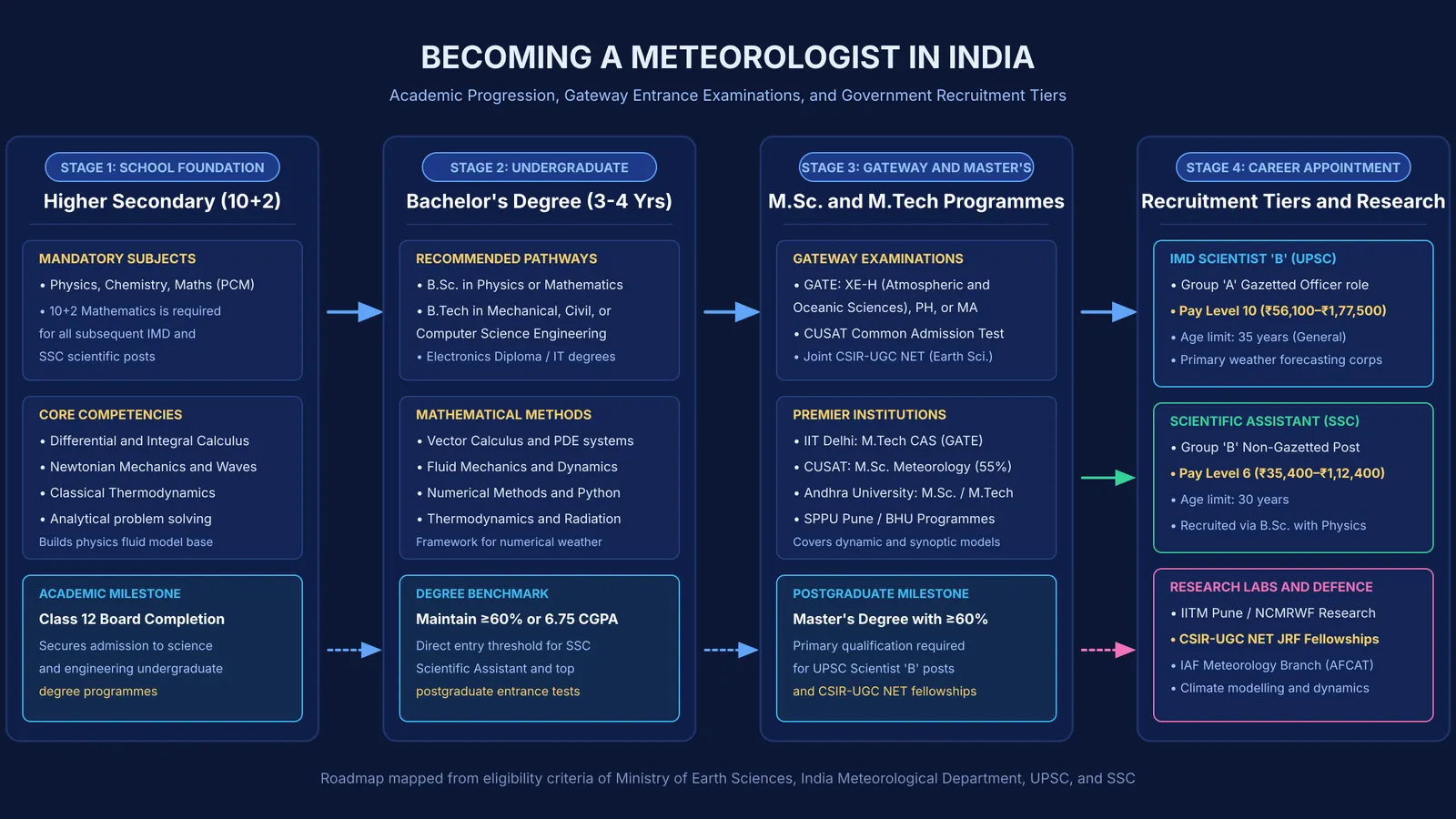
To plan your preparation from school to a career in weather science, use this progression:
Higher Secondary (10+2): Focus on physics and mathematics, aiming for strong problem-solving fundamentals in calculus and mechanics.
Bachelor's Degree (Years 1-3/4): Complete a B.Sc. in Physics or Mathematics, or a B.Tech in an engineering branch, maintaining an aggregate above 60% marks.
Gateway Exams & Master's (Years 4-5): Prepare for GATE (XE-H, PH, or MA) or university entrance tests such as CUSAT CAT, entering an M.Sc. or M.Tech atmospheric science programme.
Professional Recruitment (Post-M.Sc./M.Tech): Apply for UPSC Scientist 'B' vacancies, SSC IMD Scientific Assistant exams, or join doctoral research through CSIR-UGC NET JRF.


