

On this page
Going to college is a major milestone, but the cost of higher education can sometimes be a barrier. In India, both central and state governments have introduced scholarship schemes designed specifically to support girls through their degree programs. These initiatives are already making a visible difference in classrooms across the country.
What is the state of female enrollment in Indian colleges?
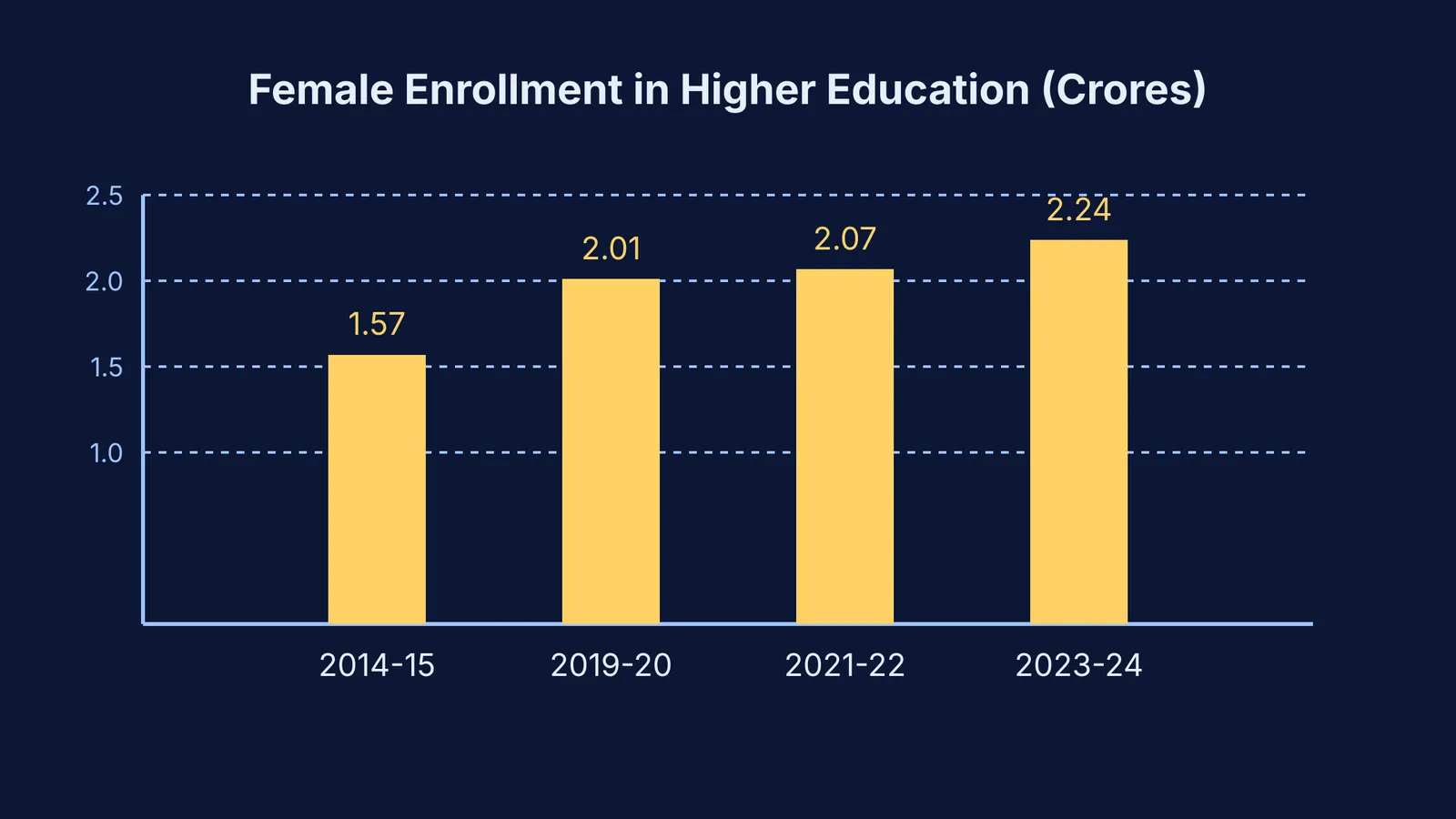
The landscape of higher education in India is changing rapidly. According to the All India Survey on Higher Education (AISHE) 2023-24 report released by the Ministry of Education, female enrollment has reached a historic 2.24 crore students. This means that women now constitute 49.7% of the total student enrollment in higher education. The progress is even clearer when looking at the Gross Enrolment Ratio (GER), which for females has increased to 31.2, slightly higher than the male GER of 28.9. In Science, Technology, Engineering, and Mathematics (STEM) programs, women now account for 44% of the total enrollment.
Which states offer merit scholarships for college girls?
While national schemes exist, many state governments run dedicated welfare programs to support girls entering and completing college.
Bihar: The Mukhyamantri Kanya Utthan Yojana is a flagship scheme aimed at promoting higher education and preventing child marriage. Under its graduation component (Mukhyamantri Balika Snatak Protsahan Yojana), eligible female students receive a one-time financial incentive of ₹50,000. To qualify, a student must be a resident of Bihar and have completed a Bachelor’s degree from a recognized university within the state. The application is processed entirely online through the MedhaSoft portal.
Tamil Nadu: The Pudhumai Penn Scheme (Moovalur Ramamirtham Ammaiyar Higher Education Assurance Scheme) provides a steady monthly stipend. It offers ₹1,000 per month to girl students who studied in government or government-aided schools from Class 6 to 12. This direct benefit transfer continues until the completion of their undergraduate degree, diploma, or ITI course, and can be received alongside other scholarships.
Other states have similar initiatives, such as Uttarakhand's Nanda Gaura Yojana and West Bengal's Kanyashree Prakalpa (for postgraduate stipends), each with specific eligibility criteria usually tied to family income, domicile, and academic performance.
What central scholarships support technical education for girls?
For students pursuing engineering or technical diplomas, the AICTE Pragati Scholarship is a major national scheme. Managed through the National Scholarship Portal, it aims to empower women with the technical skills needed for the modern workforce.
It awards ₹50,000 per annum for every year of study (up to four years for a degree and three years for a diploma).
It is open to girls admitted to the first year of an AICTE-approved degree or diploma course.
The total annual family income must not exceed ₹8 lakh, and the benefit is limited to a maximum of two girls per family.
There is also the UGC Post-Graduate Indira Gandhi Scholarship for Single Girl Child, applied through the National Scholarship Portal, which offers financial support to single girl children pursuing a regular Master's degree.
How to prepare a scholarship application?
Applying for a state or central scholarship requires careful planning and the right documents. Most applications for government schemes open between July and October for the academic year.
Ensure that your bank account is active and seeded with your Aadhaar number; a mismatch here is the most common reason for delayed or failed payments.
How can girls prepare for professional college entrance exams?
Many of the high-value private scholarships target girls pursuing professional graduation courses like Engineering, MBBS, or Law. Getting into these elite institutes requires clearing rigorous competitive exams.
Preparing for these exams means mastering core concepts across the science syllabus. For instance, if you are revising chemistry, making sure you can handle problems like Mixing and diluting solutions: finding the final molarity is essential. In mathematics, understanding the difference in scenarios such as With and without replacement: probability problems compared can secure crucial marks.
When tackling difficult subjects, having the right study tools makes a difference. The Fermi Problem Library has worked problems with a step-by-step solver that explains the reasoning rather than printing an answer. If you find yourself stuck on a tricky physics concept or unsure of how to structure your revision, Fermi's AI tutor can work out what you already know and build a plan for the session, helping you stay on track for college admission.


