

On this page
A career in the Merchant Navy offers the chance to navigate massive ships across the world. For students leaving school, the deck department—responsible for navigation, cargo, and the safety of the vessel—is the most direct route to eventually becoming a Captain.
The journey starts with pre-sea training and ends with a Certificate of Competency (CoC), but there are two different ways to get there.
B.Sc. Nautical Science or DNS: Which route is better?
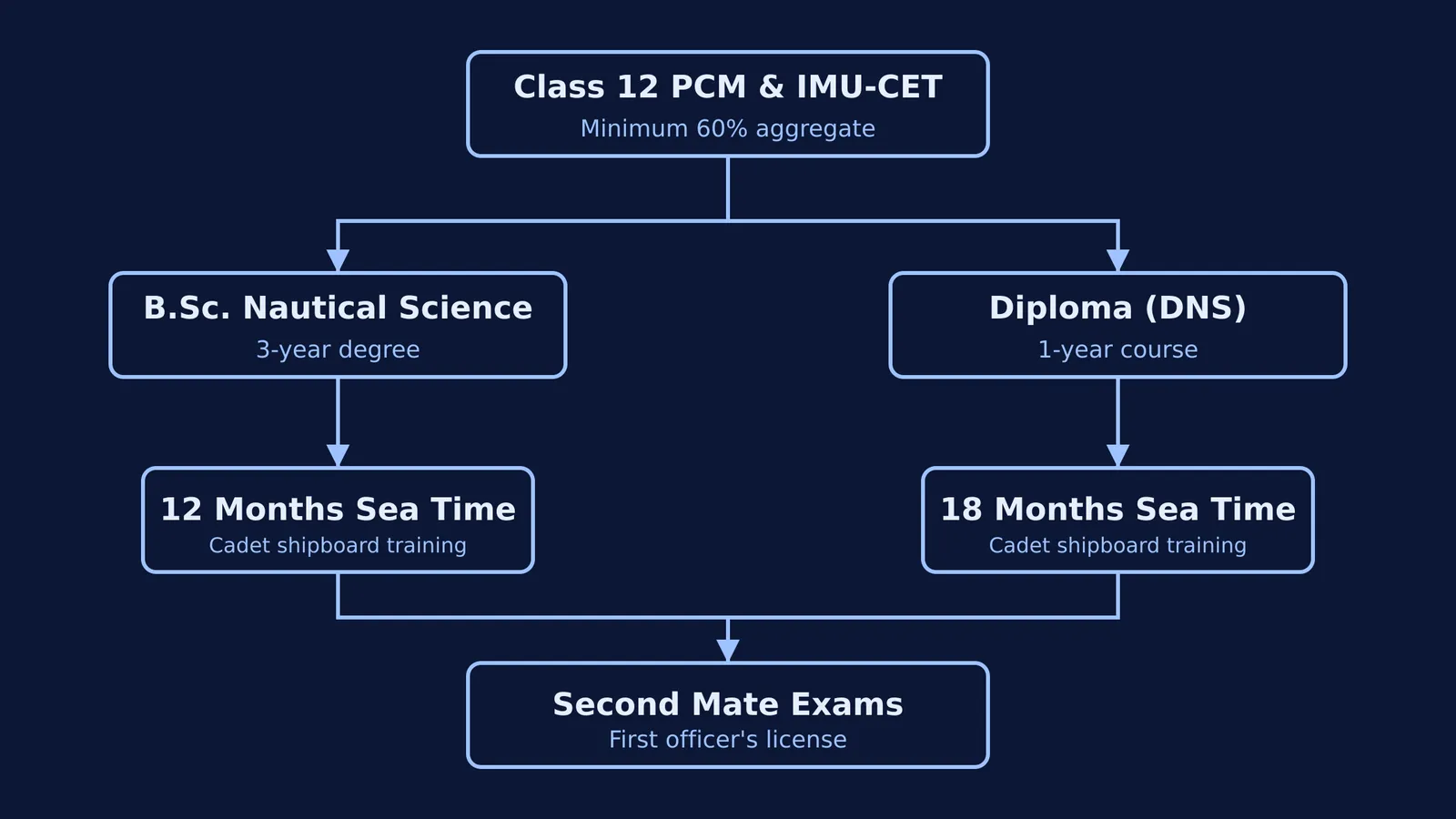
You have two primary academic pathways to reach the Second Mate exams, which grant your first officer's license.
Diploma in Nautical Science (DNS): This route involves 1 year of academic training followed by 18 months of mandatory sea time source. It is a faster way to get on a ship and start earning a stipend. However, for most top colleges, you must secure a sponsorship from a shipping company before you can even join the course.
B.Sc. Nautical Science: This is a full 3-year degree programme, after which you only need 12 months of sea training. It provides a stronger academic foundation and guarantees you hold a degree before you ever step foot on a ship. Sponsorship is helpful but usually not mandatory for admission.
What are the eligibility criteria after 12th PCM?
The Directorate General of Shipping (DGS) sets strict standards for both routes. To apply to an approved maritime training institute or the Indian Maritime University (IMU), you must meet these minimums source:
Academics: At least 60% aggregate marks in Physics, Chemistry, and Mathematics (PCM) in Class 12.
English: A minimum of 50% in English, scored in either Class 10 or Class 12.
Age: Between 17 and 25 years old on the day the course starts (relaxations apply for SC/ST and female candidates).
Medical: You must pass a medical exam by a DGS-approved doctor, which includes a strict requirement for 6/6 vision in each eye without glasses and normal colour vision.
How do you clear the IMU-CET and get sponsored?
The Indian Maritime University Common Entrance Test (IMU-CET) is the mandatory national exam, usually held in May or June. A good rank is required for both the B.Sc. and DNS routes. Building sustainable study routines early in your Class 12 year is the best way to handle both the board exams and the IMU-CET.
Because the exam tests both speed and accuracy, mastering the fundamentals is far more effective than rote memorisation. Practicing past papers and simulated mock tests will give you the confidence needed to score well against nationwide competition.
The syllabus covers Class 11 and 12 physics and mathematics. If you find yourself stuck on relative motion problems or vector algebra during your preparation, you can load them into the Fermi Problem Library. Instead of just printing an answer, Fermi's step-by-step solver explains the reasoning, helping you fix the actual gap in your method.
To secure a sponsorship for the DNS route, companies like Anglo-Eastern or Synergy will put you through their own selection process, which includes a written test, a psychometric evaluation, and a personal interview.
Here is a quick checklist for your application:
Verify you meet the academic and medical limits.
Register for the IMU-CET in early spring.
Apply directly to shipping companies for DNS sponsorship.
Complete the company written tests and interviews.
Undergo the DGS-approved medical examination.
What does a merchant navy deck cadet do?
Once you finish your pre-sea academics, you join a ship as a trainee. Your daily routine is split between learning to navigate and maintaining the physical ship. A typical day might involve:
Bridge watchkeeping: Spending your watch hours on the bridge with a senior officer, learning to plot positions on charts, monitor the radar, and steer the vessel.
Deck maintenance: Working with the crew to chip away rust, paint the deck, grease hinges, and inspect lifeboats and fire extinguishers.
Cargo operations: In port, cadets monitor the loading and unloading of cargo, check moorings, and ensure the ship remains stable as weight shifts.
Throughout these months, you must document every task in your Training Record Book. After completing your sea time and getting your book approved, you will attend post-sea modular courses covering advanced firefighting, survival craft, and medical first aid. The DNS cadets must also complete a mandatory Second Mate Function Course before their written and oral exams at the Mercantile Marine Department.
Once you pass these rigorous exams, you are awarded your Certificate of Competency. This allows you to step up from cadet to Third Officer or Second Officer, taking charge of a navigational watch independently anywhere in the world and officially beginning your career as a fully qualified Merchant Navy officer.


