On this page
Around age 12, something shifts in the classroom. Mathematics changes from counting physical objects to balancing abstract equations. Suddenly, a child who used to enjoy the subject starts dreading it. Many parents see their children breezing through primary school arithmetic, only to hit a sudden and distressing wall.
You are not imagining this shift. A 2021 Cuemath survey of students across India found that 82% of students in Classes 7 to 10 fear mathematics. Internationally, the OECD PISA 2022 report notes that 39% of 15-year-old students feel "very nervous" when doing maths problems.
Why does the fear start now? Class 7 introduces rational numbers, algebraic expressions, and abstract geometry rules. The mental jump from whole numbers to number play with fractions and variables is steep. It requires a shift from simply following a rote arithmetic rule to actually understanding the logic of a mathematical sentence. Without the right approach, a temporary struggle can harden into a permanent mental block. The stakes feel higher, and students begin to tie their self-worth to their test scores.
How does cognitive load make anxiety worse?
When a student looks at a confusing maths problem, they experience cognitive load—the mental effort required to hold and process information in their working memory. A typical 12-year-old can only hold a few new pieces of information in their mind at once.
Maths anxiety acts as a secondary, entirely unnecessary cognitive load. When a student's working memory is busy worrying about poor marks, fearing a scolding, or feeling inadequate, there is physically less space available in the brain to actually solve the equation. John Sweller's research in "The worked example effect and human cognition" demonstrates that asking a novice to solve problems without guidance overwhelms their working memory.
If you hand an anxious 12-year-old a blank sheet of paper and ten algebra questions, they are likely to panic. The fear of making a mistake overrides their ability to learn. They resort to guessing or give up entirely, reinforcing their belief that they are "just not a maths person."
What is the "faded worked example" method?
To rebuild confidence, we need to reduce the cognitive load. You can do this by using a well-researched educational framework called the "faded worked example". Instead of asking a student to solve a problem from scratch, you provide the solution and slowly remove parts of it. This prevents the working memory from becoming overwhelmed.
Here is how you can use this method at home:
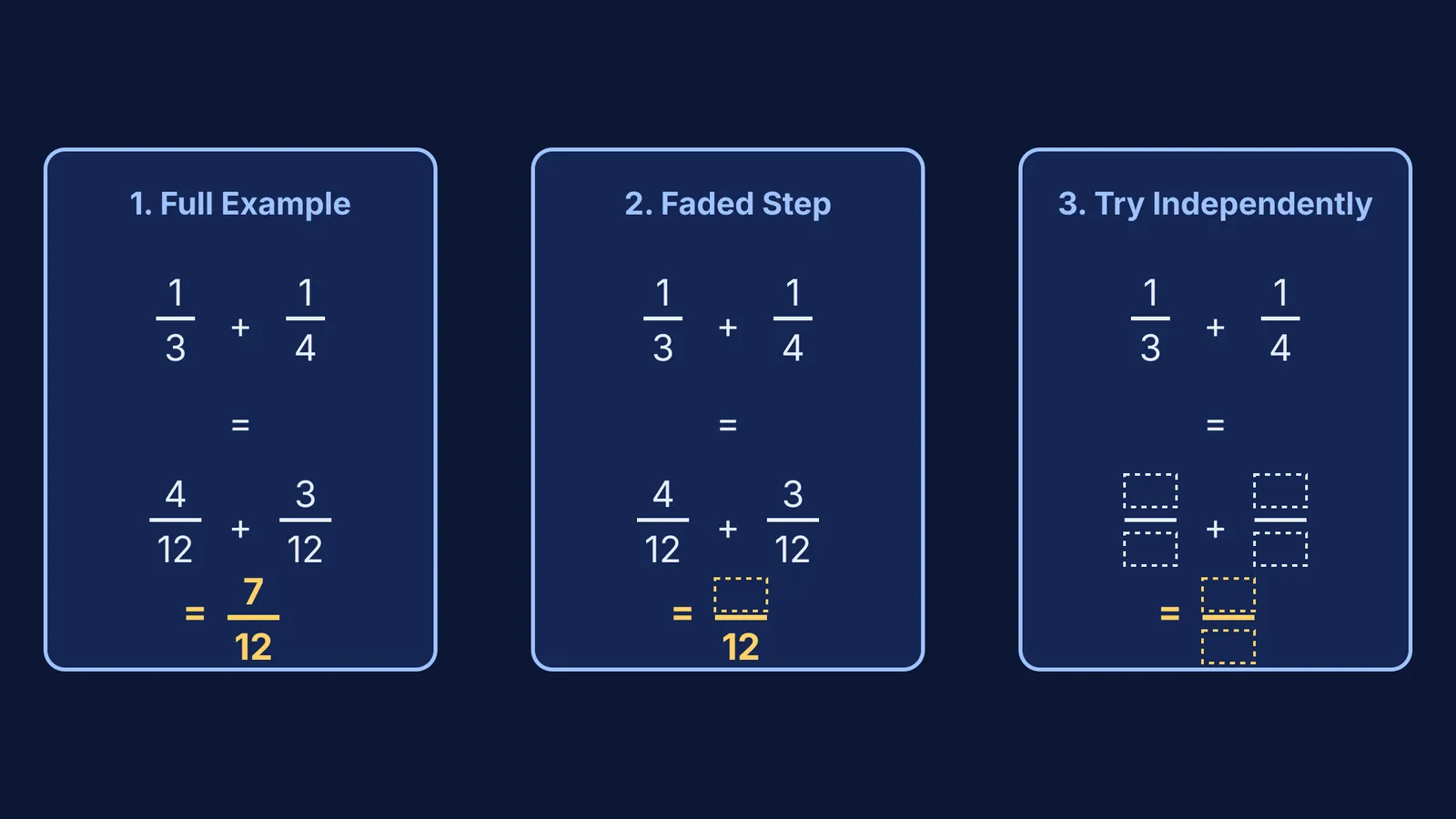
Provide a fully worked example: Show them a completed problem. Ask them to read through it and explain what happened in each step. There is no pressure to solve anything, which turns off the anxiety response.
Fade one step: Give them a similar problem, but leave only the final step blank. They only need to perform the very last calculation, such as adding the final numerators.
Fade two steps: Give another similar problem, leaving the last two steps blank. Now they are doing a bit more of the heavy lifting.
Try it independently: Only after they have succeeded at the partial steps do you give them a completely blank problem.
This method guarantees small wins. Each time they fill in a blank correctly, their confidence grows and their anxiety shrinks. They learn the underlying structure of the maths without the fear of a blank page. As they move toward harder topics like quadratic word problems in Class 10, having a method to break down panic is invaluable.
How can you use AI to build small wins?
Finding the right worked examples and identifying exactly where a student is stuck can be difficult for parents who haven't looked at middle school maths in decades. If you are not sure how to break a problem down, Fermi's AI tutor can work out what you already know and build a plan for the session, so you sit down to a clear next step instead of a blank page. The tutor holds a line of reasoning across the whole session, noticing where a student is stuck and deciding whether to explain, ask, or show.
When traditional unguided homework causes frustration, the Fermi Problem Library provides worked problems with a step-by-step solver that explains the reasoning rather than printing an answer. And if you discover that the anxiety stems from a missing foundational idea, the Fermi Concept Library covers every concept in physics, chemistry, biology, mathematics and computing, each with its own lesson and its place in the map.