

On this page
Walking into a new lecture hall means facing a sea of unfamiliar faces. Within minutes, you hear a dozen new names, and almost instantly, they vanish from your mind.
It is easy to assume you just have a terrible memory. However, the problem is not your brain's capacity, but rather how it stores different types of information.
Why do we forget names so quickly?
In a classic 1987 study on human memory, psychologists demonstrated a phenomenon now known as the Baker-baker paradox (McWeeny et al., 1987). Researchers showed participants a photograph of a man. Half the participants were told his surname was Baker, while the other half were told his profession was a baker.
When tested later, the people who were told his profession remembered it far better than those who were told his name.
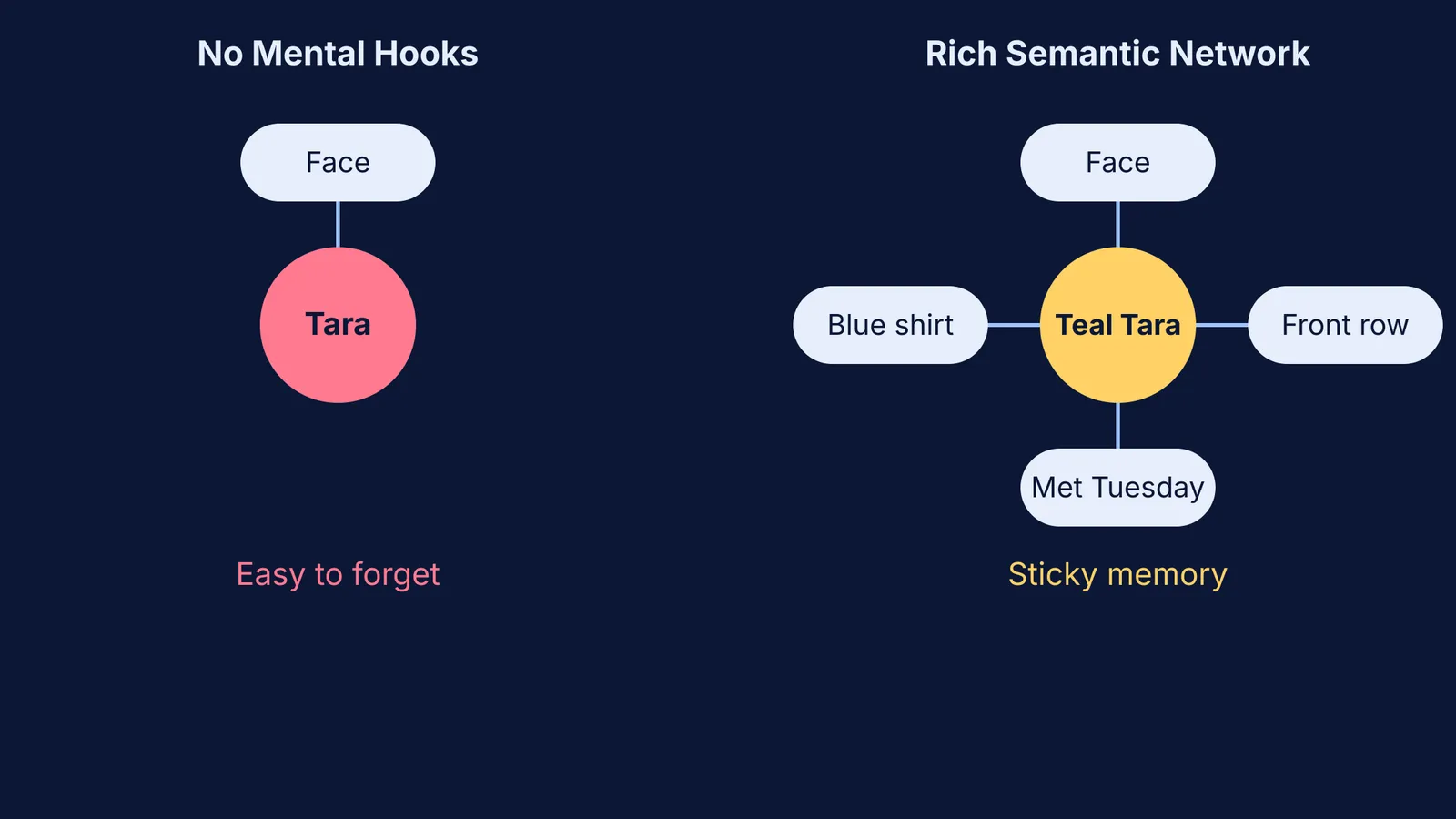
The reason comes down to mental hooks. When you hear that someone is a baker, your brain lights up a rich associative network of concepts: bread, ovens, early mornings, and flour. If you forget the exact word, you can still follow these conceptual clues back to the answer. A surname like Baker, on the other hand, is an arbitrary label with no built-in meaning. It attaches to the person's face by a single, fragile mental thread. If that one link breaks, the name is lost.
Your brain needs these semantic hooks to store information deeply. Just as rereading notes creates an illusion of fluency without building real understanding, simply hearing a name does not mean you have learned it. You have to build connections. The Fermi Concept Library uses this same cognitive principle, giving every concept in physics, chemistry, biology, mathematics and computing its own lesson and its place in the map so you have the necessary mental hooks to recall it.
Are we really better at faces than names?
We often say, "I am great with faces, but terrible with names." This feeling is so common that it seems like an undisputed fact of human biology. But cognitive scientists have found that it is actually a trick our brains play on us.
In a fair test where participants were asked to recognise both names and faces they had seen before, they consistently scored higher on names. A 2018 study at the University of York found that participants recognised up to 83% of names, but only 64% of faces (Burton et al., 2018).
The illusion happens because of how we notice our mistakes. When you spot a familiar face but cannot recall the name, the failure is obvious and frustrating. But when you forget both the face and the name, you simply do not notice the person at all. We only register the times when our name recall fails, leading to an unfair double standard.
How can you remember new classmates' names?
Since names lack natural associative links, you have to build those links artificially. Here is a practical framework to make sure a new name sticks during your first week of classes.
The Meet and Repeat Script: Do not just nod when someone introduces themselves. Force your brain to process the audio by saying the name out loud immediately. If they say, "Hi, I'm Rohan," reply with, "Nice to meet you, Rohan." This forces your working memory to engage with the word rather than just letting it wash over you.
Turn the Name into a "Baker": Give the arbitrary name a conceptual hook. Find a rhyming word, an alliteration, or a vivid mental image. If you meet a girl named Tara who is wearing a blue shirt, think of "Teal Tara." If you meet a boy named Kabir, picture him sitting in a cab. The sillier the image, the stronger the associative link will be.
Spaced Retrieval Practice: Memory fades on a predictable curve, much like how changing where you study forces your brain to work harder to recall information in new contexts. To interrupt this forgetting curve, you must actively recall the name at spaced intervals. Immediately use their name in your greeting. Five minutes later, look across the room and silently test yourself. At the end of the day, on your way home, try to list as many new classmates as you can.
By turning an arbitrary label into a rich mental image and testing yourself over time, you can hack your brain's associative network and never dread the first day of class again.


