

On this page
Every year, thousands of NEET-UG candidates find themselves with a rank that guarantees a Bachelor of Dental Surgery (BDS) seat but leaves them on the borderline for a Bachelor of Medicine, Bachelor of Surgery (MBBS) seat. The choice is difficult: secure a career in dentistry now, or hold out for a chance at medicine in the final counselling rounds or a subsequent attempt.
Before you make a decision, you need to understand the Medical Counselling Committee (MCC) rules that govern seat allocation and the real numbers behind the competition.
Should I take a BDS seat or wait for MBBS?
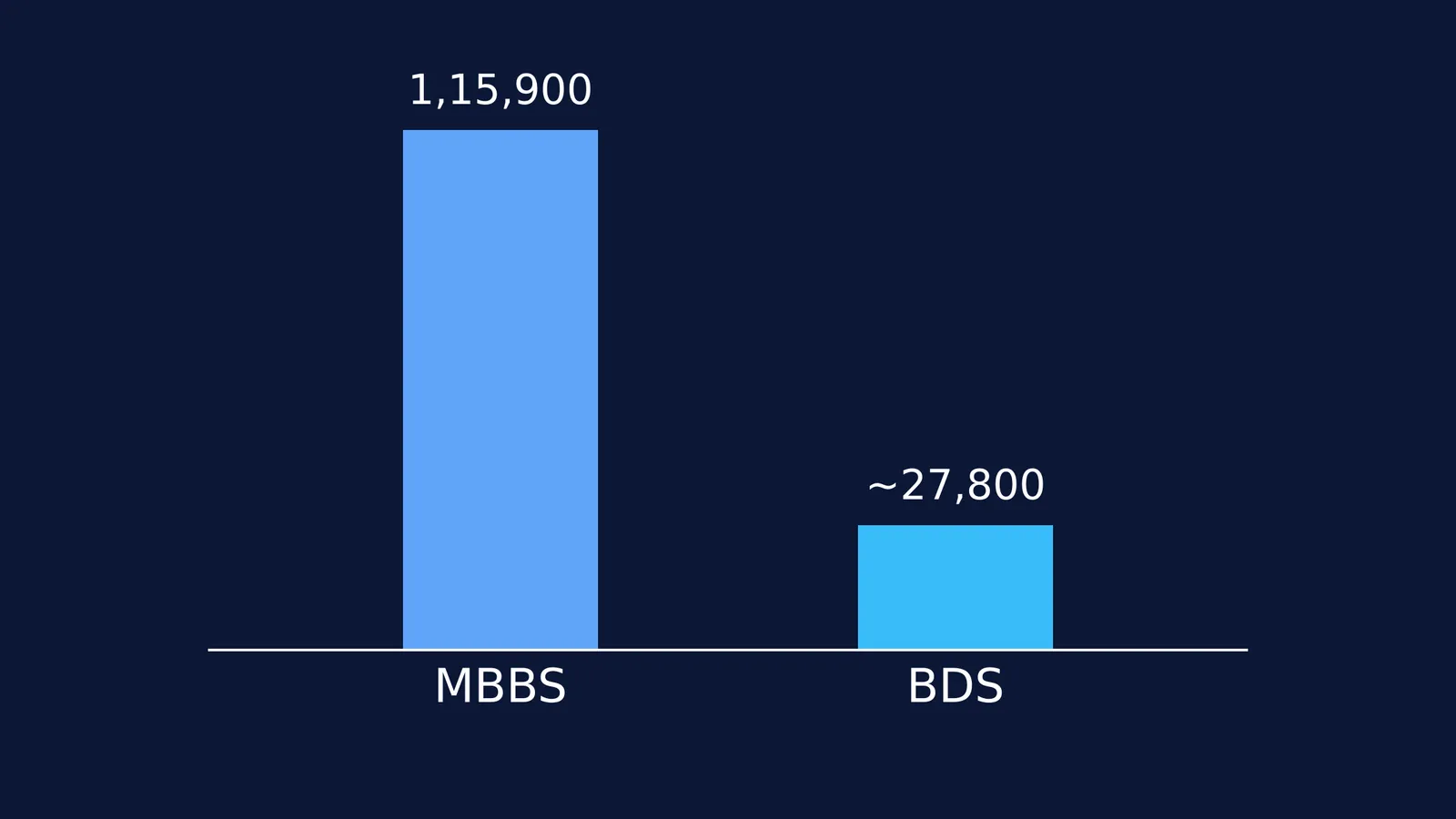
The first step is to look at the sheer numbers. In August 2024, the Ministry of Health and Family Welfare informed the Lok Sabha that India has a total of 1,15,900 MBBS seats across medical colleges. In contrast, there are roughly 27,800 BDS seats available nationwide.
While MBBS has significantly more seats, the demand is proportionately higher. If you take a BDS seat early in the counselling process, you secure a professional degree and a clear career path. If you wait, you risk losing out entirely if the MBBS cut-offs do not drop to your rank.
What are the MCC exit rules for Round 1 and Round 2?
The MCC counselling process is designed to prevent seat blocking. The early rounds offer some flexibility:
Round 1: Offers a "Free Exit". If you are allotted a BDS seat in Round 1 and choose not to join, there is no penalty. Your security deposit remains safe, and you can participate in Round 2.
Round 2: If you are allotted a seat and do not join, you exit with forfeiture, meaning you lose your security deposit. You can still participate in Round 3, but you must register and pay the deposit again.
If you join a BDS seat in Round 1 or Round 2, you are allowed to opt for upgradation to the next round. This makes accepting an early BDS seat a relatively safe backup plan while you wait to see if an MBBS seat opens up.
Is it worth waiting for an MBBS seat in Round 3?
Round 3 is where the rules become strict. In 2024, Round 3 (formerly the Mop-up Round) effectively became a dead end for candidates trying to keep their options open.
If you are allotted a seat in Round 3 but fail to join, you will exit with forfeiture of your security deposit and will be entirely eliminated from the subsequent Stray Vacancy round. Furthermore, if you join a seat allotted in Round 3, you cannot resign from it under any circumstances, and you are barred from participating in any further rounds.
What happens if you wait for the Stray Vacancy round?
The Stray Vacancy round is the final stage of counselling, aimed at filling any remaining empty seats. To be eligible for the Stray Vacancy round, you must not hold any seat (MBBS or BDS) in either the All India Quota (AIQ) or State Quota, and you must not have rejected a seat allotted to you in Round 3.
Waiting for the Stray Vacancy round is an extreme risk. Government MBBS seats rarely reach this stage. The few vacancies that do appear are often in Deemed Universities or private colleges with exceptionally high tuition fees. If you are allotted a seat in the Stray Vacancy round and do not join, the penalty is severe: you forfeit your deposit and are debarred from taking the NEET-UG exam for the following year.
Taking a drop year vs taking a BDS seat
If the final rounds pass and you have not secured an MBBS seat, the decision narrows down to accepting dentistry or taking a drop year to try again.
If your heart is set strictly on medicine and you cannot see yourself practicing dentistry, taking a BDS seat out of panic is a mistake. However, a drop year requires immense discipline and a willingness to confront the subjects that held your score back, whether that means revising primary and secondary metabolites or drilling down into the formed elements of blood.
If you choose to study for another year and find yourself not knowing where to start, Fermi's AI tutor can work out what you already know and build a plan for the session, so you sit down to a clear next step rather than a blank page.
Make your decision based on your financial capacity for private colleges, your genuine interest in the courses, and your readiness to face the competition again.


