On this page
Undergraduates studying mathematics were once told their only choices were school teaching or pure academic research. That landscape has shifted. Because artificial intelligence, quantitative finance, and predictive risk systems rely on linear algebra, multivariable calculus, and probability theory, mathematical training has become a powerful springboard. When talking about STEM careers beyond engineering and medicine, quantitative graduates find their analytical depth provides an immediate edge.
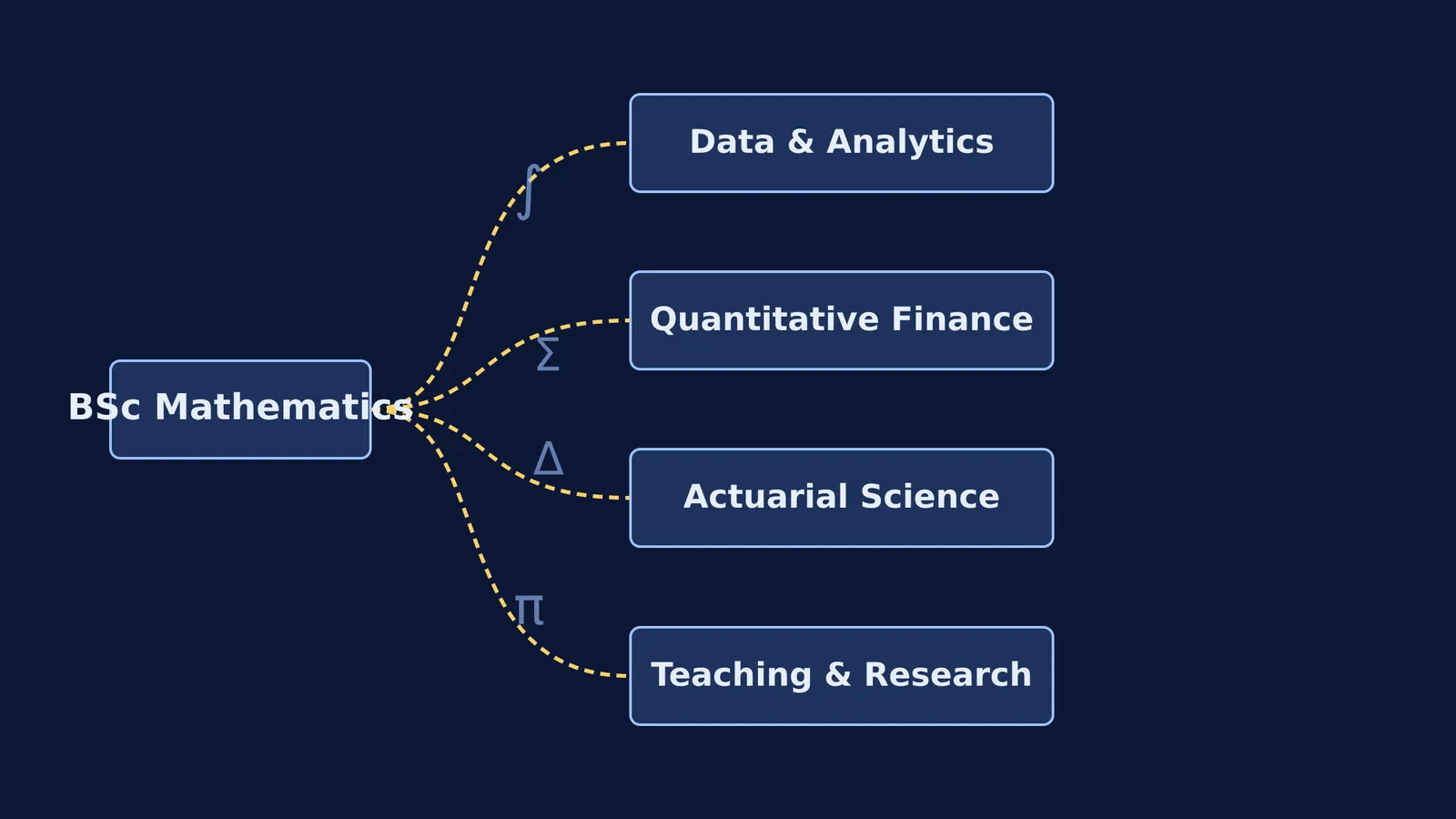
What roles can you enter directly in data and analytics?
Data science and analytics represent direct destinations for mathematics graduates because machine learning algorithms operate as transformations in high-dimensional vector spaces. According to the U.S. Bureau of Labor Statistics, data scientist employment is projected to expand 35% from 2025 to 2035, creating about 24,800 annual openings, with a bachelor's degree in mathematics or statistics serving as the primary entry route.
In roles like junior data analyst or business intelligence associate, graduates clean datasets, run regressions, and test hypotheses. Mathematics graduates already understand matrix algebra and conditional probability and Bayes' theorem. Learning Python (NumPy, pandas) and SQL quickly bridges the gap from abstract theory to production data pipelines.
How do mathematics graduates break into quantitative finance?
Investment banks, asset managers, and fintech firms rely on mathematical modeling to price contracts, assess credit risk, and manage portfolio volatility. Roles range from risk analysts monitoring market exposure to quantitative researchers structuring trading models.
According to the CFA Institute, Quantitative Methods forms 11% to 14% of the Level I curriculum and 5% to 10% of Level II, focusing on return distributions, hypothesis testing, and regression analysis. Mathematics graduates grasp these concepts quickly, clearing professional certifications faster than non-quantitative peers. When connecting multivariable calculus to computational algorithms, the Fermi Concept Library has every concept in physics, chemistry, biology, mathematics and computing, each with its own lesson and its place in the map.
What does the actuarial science route look like in India?
Actuaries calculate financial risk and set legal reserves for life insurers, pensions, and healthcare funds. According to the Institute of Actuaries of India, becoming a Fellow involves passing 13 examinations across Core Principles, Core Practices, Specialist Principles, and Specialist Advanced stages. Early papers like CS1 (Actuarial Statistics) and CM1 (Actuarial Mathematics) focus on probability models and compound interest calculus.
The U.S. Bureau of Labor Statistics projects 9% employment growth for actuaries through 2035. Students can sit for entrance examinations like ACET during college, often securing paid entry-level analyst roles after clearing two initial papers.
Which master's degrees build the strongest technical foundation?
Many senior quantitative research and machine learning positions require postgraduate study. In India, several competitive entrance routes lead directly into advanced quantitative programs:
IIT JAM: Organised by the IITs, JAM offers Mathematics (MA) and Mathematical Statistics (MS) papers. Qualifying grants admission to M.Sc. programs in Mathematics and Computing at IIT Guwahati, or Applied Statistics at IIT Bombay and IIT Kanpur. Candidates must have studied mathematics for at least two years or four semesters in their degree.
ISI and CMI Entrances: The ISI and CMI entrance exams open doors to premier courses like M.Stat at the Indian Statistical Institute and the M.Sc. in Data Science at Chennai Mathematical Institute.
GATE DA: The Data Science and Artificial Intelligence paper allows science graduates to enter M.Tech programs in AI at leading engineering institutes.
For undergraduates tackling complex multivariable calculus and distribution problems, the Fermi Problem Library has worked problems with a step-by-step solver that explains the reasoning rather than printing an answer.
How can you enter teaching and academic research?
For students drawn to fundamental theory or teaching, structured national pathways exist:
Higher Education and Research: The Joint CSIR-UGC NET conducted by the National Testing Agency awards the Junior Research Fellowship (JRF) for funded Ph.D. study and qualifies candidates for Assistant Professor positions in colleges.
School Teaching: Completing a Bachelor of Education (B.Ed) qualifies graduates for Post Graduate Teacher (PGT) positions in schools, where mathematics educators remain in high demand.
What is a practical transition plan for undergraduate students?
Building an industry-ready profile during a three- or four-year degree requires deliberate milestones:
Year 2 (Core Tooling): Learn Python, Git, and SQL. Code statistical estimators from first principles instead of relying solely on pre-built libraries.
Year 3 (Applied Projects): Connect linear algebra to dimensionality reduction techniques like Principal Component Analysis. If preparing for entrance tests, Fermi's AI tutor works out what you already know and builds a plan for the session, so you sit down to a clear next step.
Final Year (Credentials): Clear one actuarial paper (such as CS1), sit for IIT JAM, or build a public GitHub repository showcasing empirical financial backtests or machine learning models.