On this page
Most maths clubs focus on speed and competition, drilling students for the next Olympiad or board exam. A maths circle takes a different approach. It is a space for the "joyful struggle" of mathematics, where students work together on deep, open-ended puzzles.
The number of maths circles in the United States grew from a handful in the 1990s to nearly 300 in 2016 (Education Week). This expansion reflects a growing recognition that collaborative problem-solving builds mathematical identity and reduces anxiety far better than rote memorisation.
If you are a teacher or a parent wanting to foster a love for mathematics, starting a circle is one of the best interventions you can make. Here is how to build one.
What makes a maths circle different?
A standard classroom often asks for quick answers to familiar problems. A maths circle asks questions that might take an entire hour to unpack. The goal is not just finding the answer, but constructing a proof, arguing mathematically with peers, and exploring extensions.
The circle model originated in Eastern Europe over 100 years ago (MathCircles.org), but it has evolved into a broader form of enrichment for all grade levels. In a maths circle, the facilitator's job is not to lecture. The focus shifts entirely to the students and their ideas. In fact, many educators join Math Teacher Circles to increase their own mathematical knowledge and bring inquiry-oriented practices back to their regular classrooms.
How to choose the right problems?
The heart of a successful circle is the "low-threshold, high-ceiling" problem. This is a task that a ten-year-old can begin by drawing pictures, but a university student could use to explore advanced algebra.
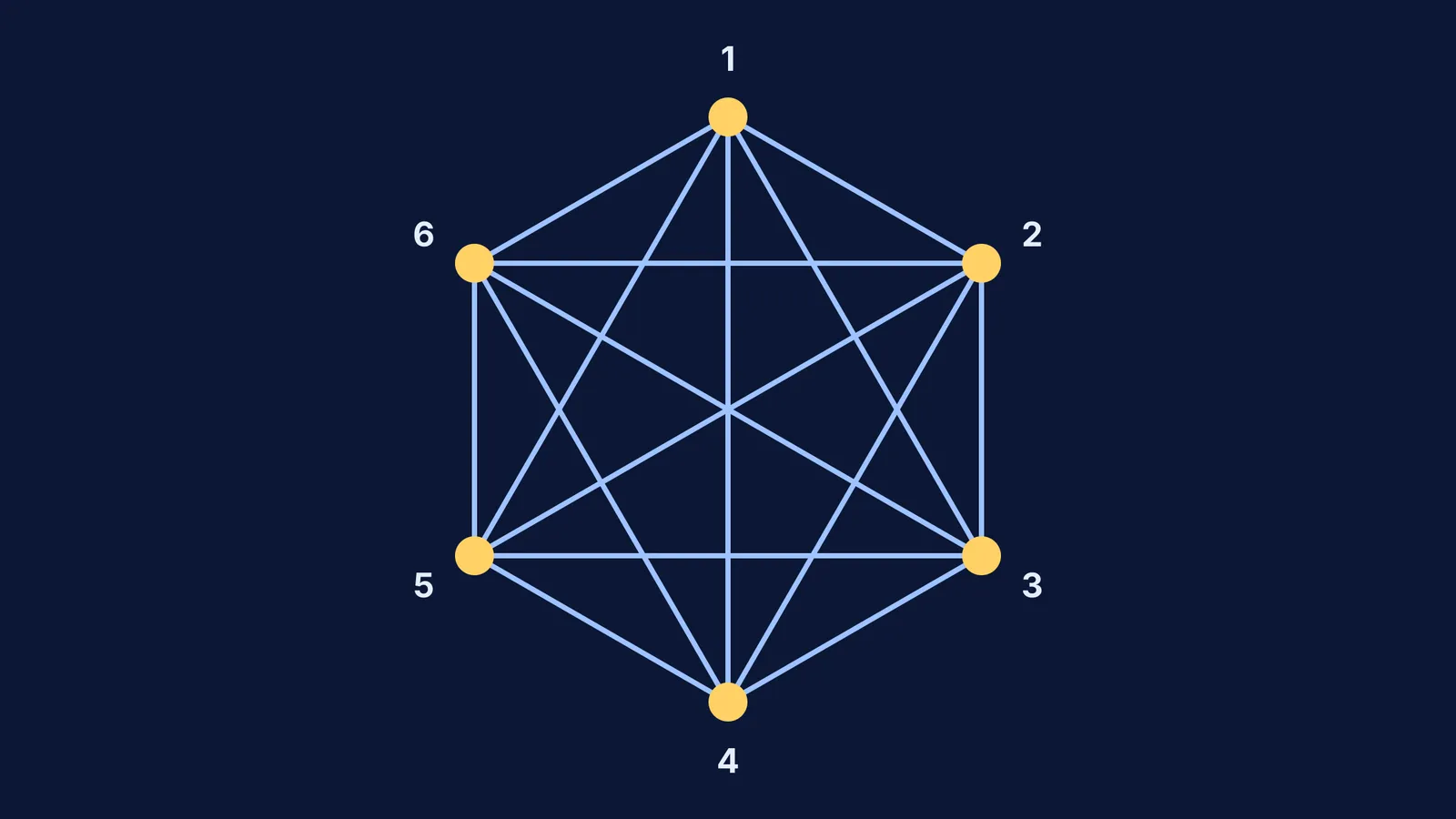
Consider the classic Handshake Problem: *If there are six people in a room and everyone shakes hands with everyone else exactly once, how many handshakes occur?*
Students can start by acting it out or drawing dots and lines, creating a six-pointed star with all its internal connections. They can count the lines one by one. But the ceiling is high. What if there are 100 people? This pushes them to discover the formula for triangular numbers, or to explore probability problems with and without replacement using similar combinatorics.
Another favourite is the Locker Problem, where 100 students walk down a hall of 100 closed lockers. The first student opens every locker. The second student closes every second locker. The third student changes the state of every third locker, and so on. It begins as a simple simulation that students can act out with cards, but it ends with a deep dive into the properties of perfect squares and divisibility. When you are looking for fresh material, the Fermi Problem Library has worked problems with a step-by-step solver that explains the reasoning rather than printing an answer.
How to run a session?
The facilitator is a guide, not an answer key. When a group gets stuck, offer a hint rather than a solution.
Start with a hook: Present the problem verbally or on a single slide. Let the mystery hang in the air for a moment.
Break into groups: Divide students into teams of three or four. Mathematics is a social activity, a principle embodied by the collaborative mathematics of Paul Erdős, and arguing over a solution is where the real learning happens.
Be less helpful: If a group asks, "Is the answer 15?", do not say yes. Ask them, "Can you prove to me that it cannot be 16?" If they do not know where to start, you can suggest a smaller case, like three people shaking hands. Fermi's AI tutor can work out what you already know and build a plan for the session, a strategy you can mimic when asking students guiding questions.
Presentations: In the last 15 minutes, have different groups present their approaches. Emphasise that two different valid paths to the same answer are worth celebrating.
How do you plan the first term?
You do not need a grand budget or a PhD in mathematics to get started.
The venue: Secure a regular space, like a library or a classroom, for 60 to 90 minutes a week.
The invitation: Do not call it "extra help" or "test prep". Frame it as a puzzle club or a mathematical research group. Put a seductive problem on a poster in the hallway.
The culture: Establish on day one that being stuck is normal. Praise the struggle, the wild guesses, and the elegant mistakes.
Start gathering your first open-ended puzzles today, and give your students the space to become creators of mathematics.