On this page
Teaching mathematics is a career that balances rigorous subject knowledge with the daily reward of helping students understand the world. The demand for qualified educators remains high; the UNESCO *State of the Education Report for India 2021* estimated a need for over 1 million new teachers to meet the requirements of the Right to Education Act.
If you want to teach maths in India, the route involves specific university degrees and national or state eligibility tests. The specific qualifications you need depend on the age group you wish to teach, from primary school up to senior secondary classes.
Which degree do you need?
In the Indian school system, teachers are broadly grouped into Primary Teachers (PRT), Trained Graduate Teachers (TGT) and Post Graduate Teachers (PGT). To teach middle or secondary school mathematics (Classes VI to X), you must be a TGT. To teach higher secondary classes (Classes XI and XII), you will need to become a PGT, which requires a master's degree in mathematics in addition to your B.Ed.
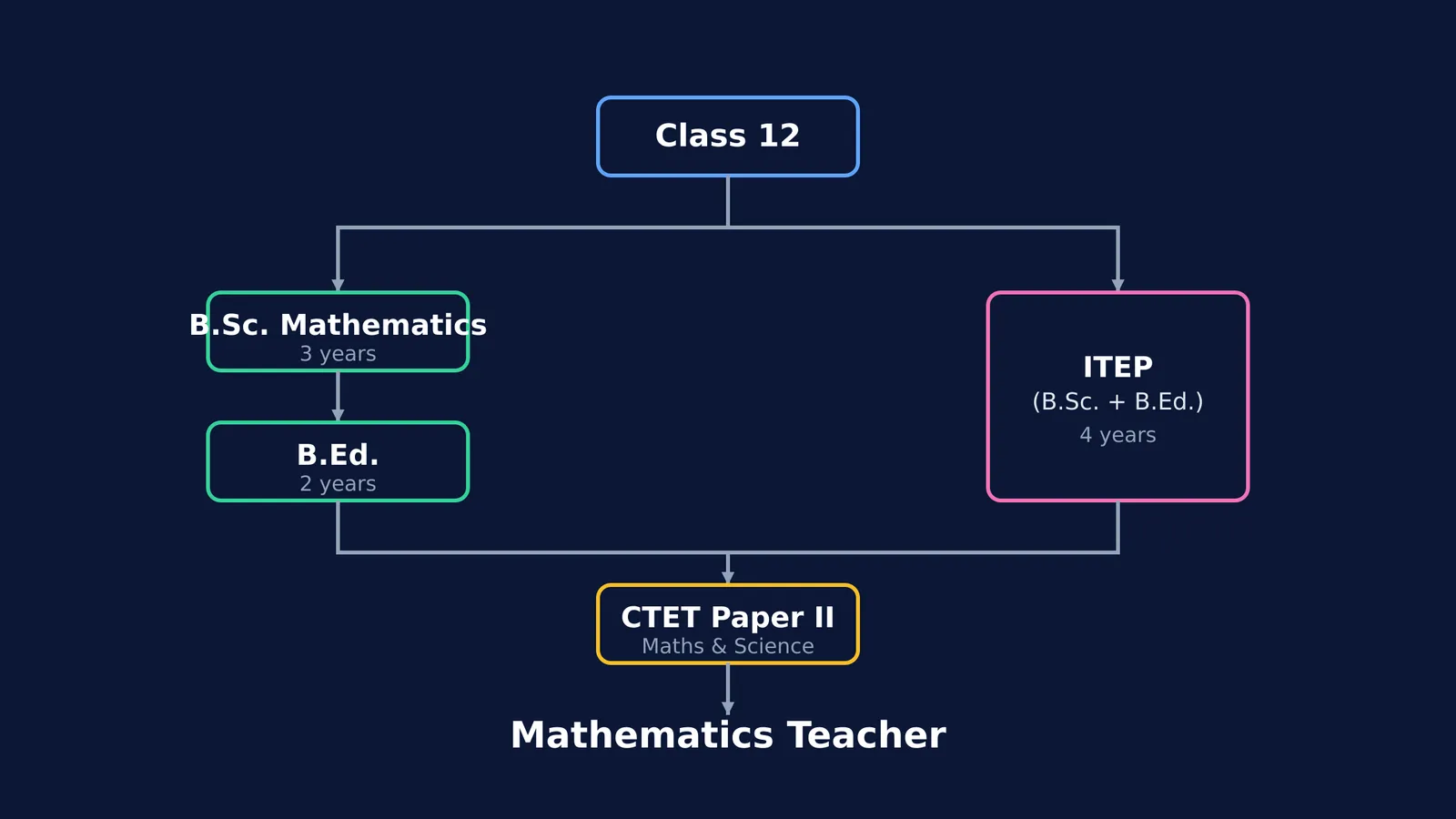
There are two main academic routes to reach the TGT stage:
The traditional route (B.Sc. + B.Ed.): You complete a three-year Bachelor of Science (B.Sc.), studying mathematics in all three years. After graduating, you complete a two-year Bachelor of Education (B.Ed.) programme.
The new route (ITEP): Introduced under the National Education Policy 2020, the Integrated Teacher Education Programme (ITEP) is a four-year dual-major undergraduate degree. You can join it immediately after Class 12. It combines a disciplinary degree (such as a B.Sc. in Mathematics) with a B.Ed., saving you one year compared to the traditional route.
What is the CTET exam?
Having a teaching degree allows you to apply for jobs, but to teach in central government schools (like Kendriya Vidyalayas and Navodaya Vidyalayas) and many private institutions, you must pass the Central Teacher Eligibility Test (CTET).
To teach mathematics to Classes VI to VIII, you must take CTET Paper II. The mathematics and science section of this paper carries 60 marks, out of which 30 marks are dedicated purely to mathematics. These 30 questions are split between content (like number systems, algebra, geometry and mensuration) and pedagogical issues (how to teach maths effectively, design fair assessments, and address common misconceptions).
The qualifying mark for general category candidates is 60% (90 out of 150 marks across the whole paper), while reserved categories require 55%. Once you pass, the CTET qualifying certificate is valid for a lifetime, and there is no upper age limit for appearing in the exam. State schools have similar requirements, usually assessed through state-level Teacher Eligibility Tests (TETs), such as UPTET or KTET, which follow a very similar syllabus and pattern.
What is teaching maths like?
The life of a mathematics teacher involves planning lessons, marking assignments, and breaking down abstract concepts into ideas that a 13-year-old can grasp. Beyond the classroom, teachers often organise maths clubs, prepare students for olympiads, and work to alleviate the common fear of mathematics among younger students. Recent research into teacher job satisfaction in India notes that while workload and administrative tasks can be challenging, teachers often experience moderate to high satisfaction driven by the intrinsic rewards of student interaction and seeing their pupils finally grasp difficult ideas.
Technology is also changing how teachers work. While you plan tomorrow's lesson or mark papers, your students can use Fermi's AI tutor for extra practice on topics like quadratic word problems in Class 10 or finding the distance in the nth second. A student brings a problem set, and Fermi works out what they already know, builds a plan for the session, and teaches through it—writing on a board, drawing the figure, and checking understanding as it goes. This frees up your time to focus on the classroom interactions that make teaching rewarding.