

On this page
What is the Mathematics and Computing branch?
During engineering counselling, students scanning opening and closing ranks notice a clear pattern: immediately behind Computer Science and Engineering (CSE), Mathematics and Computing (MnC) claims the top percentiles. In the 2024 Joint Seat Allocation Authority counselling, documented through the official JEE Advanced portal, the four-year B.Tech in Mathematics and Computing closed at rank 332 at IIT Delhi, while IIT Guwahati closed at rank 1,076 and the four-year Bachelor of Science programme at IIT Kanpur closed at rank 990.
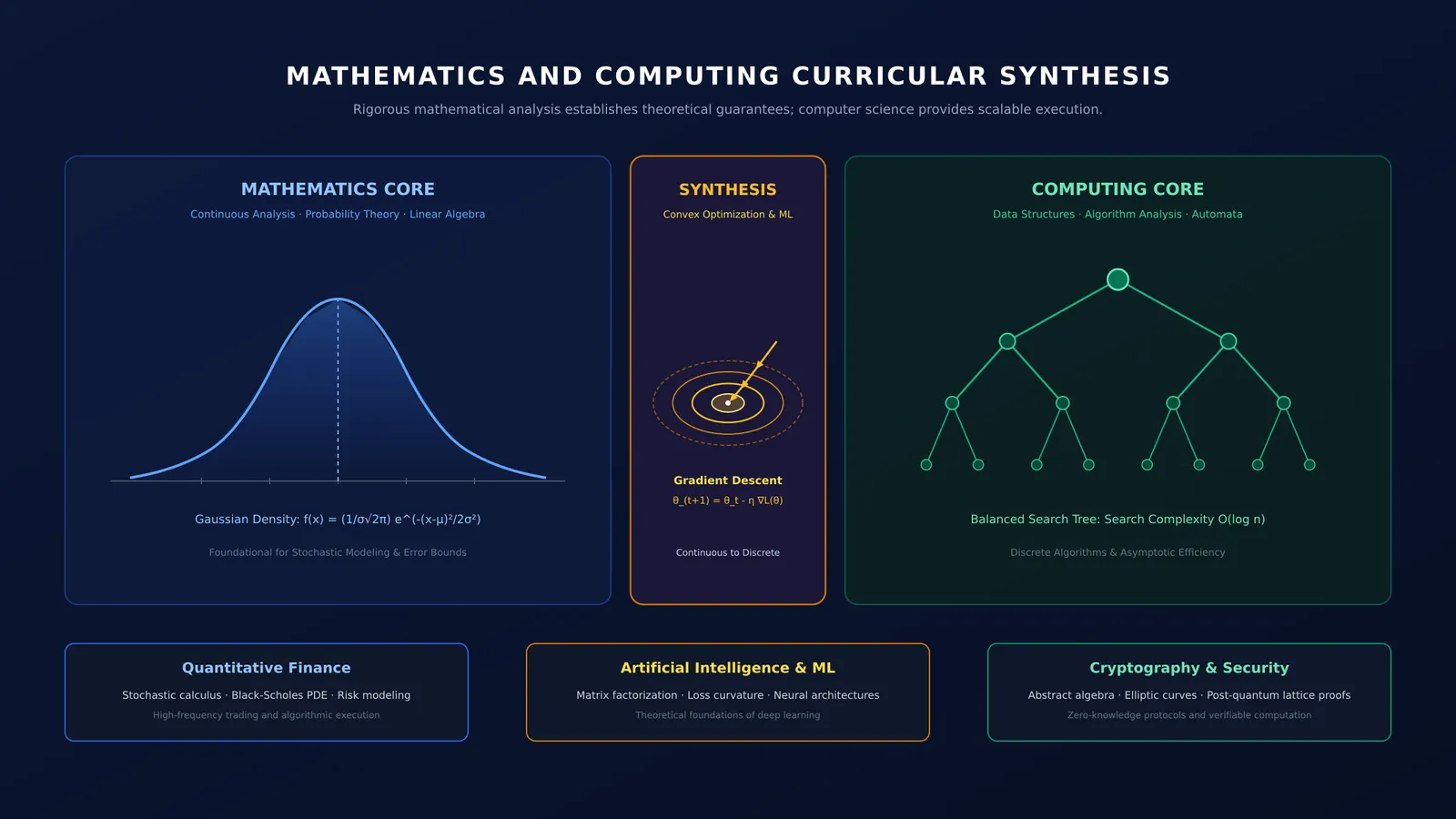
Mathematics and Computing is not standard computer science with extra calculus, nor is it a traditional mathematics degree with basic programming. It is an integrated discipline that treats computational problems through mathematical principles. You study how algorithms operate, but you spend equal effort proving why they converge, establishing their bounds, and modeling complex systems. If CSE asks how to build a software system that scales reliably, MnC asks what mathematical structure makes the algorithm optimal and secure.
How does MnC differ from Computer Science and Engineering?
While both branches share foundational coursework, their core curricula diverge significantly:
Hardware versus pure mathematics: CSE requires extensive credits in digital hardware, microprocessors, and computer architecture. In MnC, hardware requirements are minimal, shifting academic focus toward real analysis, abstract algebra, and probability.
Proofs versus implementation: CSE assignments often evaluate whether code compiles, passes unit tests, and satisfies time limits. MnC coursework requires formal proofs alongside code, evaluating whether you can mathematically verify an algorithm's correctness.
Foundational perspective on machine learning: A computer systems engineer often focuses on data pipelines and distributed hardware deployment. An MnC graduate analyzes the loss surface as a non-convex optimization problem, assesses convergence using matrix eigenvalues, and quantifies error bounds using probability theory.
What does the undergraduate curriculum look like?
Curriculum structures vary slightly by campus, but core requirements follow a clear architecture. At IIT Delhi, the undergraduate degree requires approximately 144 to 156 graded credits, allocating roughly 50% to 60% of departmental course credits to mathematics and 30% to 40% to computer science. At IIT Guwahati, which launched the country's first dedicated B.Tech in the discipline in 2006, major discipline coursework accounts for roughly 60.38% of total degree credits.
The syllabus spans four pillars:
Pure and applied mathematics: Multivariable calculus, linear algebra, differential equations, real analysis, and numerical computation.
Core computing: Object-oriented programming, data structures, algorithm design, and operating systems. You can explore how foundational algorithm analysis developed in our feature on Donald Knuth and the analysis of algorithms.
Discrete mathematics: Graph theory, combinatorics, and the theory of computation.
Advanced applied electives: Stochastic processes, convex optimization, machine learning, cryptography, and financial engineering.
Many students feel challenged when shifting from high school formula drilling to university proof writing, as explored in our guide on your first semester at science or engineering college. To preview these structures before university lectures begin, the Fermi Concept Library maps concepts across mathematics and computing, providing lessons that show how pure theory connects to computation.
Where do Mathematics and Computing graduates work?
Graduates possess both mathematical modeling skills and software engineering proficiency, opening three high-growth career tracks:
Quantitative finance: Investment banks, asset managers, and trading firms recruit MnC graduates as quantitative researchers and algorithmic traders. These roles rely on stochastic calculus, probability distributions, and numerical optimization to price derivatives and model risk.
Artificial intelligence and data science: Research labs and technology firms seek graduates who understand gradient descent, matrix factorisation, and Bayesian inference to design new neural network architectures from scratch.
Cryptography and security: Public-key cryptography, post-quantum protocols, and zero-knowledge proofs rest on number theory and abstract algebra.
When tackling advanced problem sets in discrete mathematics or probability, the Fermi Problem Library provides worked problems with a step-by-step solver that explains the reasoning rather than printing an answer. For guided revision, Fermi's AI tutor works out what you already know, builds a plan for the session, and checks understanding as you go.
How should you decide if MnC is right for you?
When filling choices during engineering counselling, as covered in our guide on JoSAA counselling for parents, evaluate your fit with this four-point framework:
Proof-writing interest: Do you enjoy discovering why a mathematical theorem holds? If formal proofs like epsilon-delta continuity or abstract group theory feel frustrating, the mathematics curriculum will prove demanding.
Target career path: If your goal is web development, app development, or computer hardware, CSE is the direct route. If you want quantitative finance, algorithmic research, or machine learning, MnC provides an ideal background.
Comfort with dual demands: You must balance the abstract rigor of a mathematics department with the coding assignments of a computer science department.
Value for foundational permanence: Software frameworks evolve rapidly, but linear algebra, probability, and optimization remain permanent foundations.


