

On this page
If you picture a scientist at work, you probably see them holding a pipette, peering into a microscope, or soldering wires in a lab. But today, the most important tool on a researcher’s bench is often a computer.
Machine learning is changing how we discover new materials, drugs, and chemicals. By predicting how atoms will behave before anyone synthesises them, artificial intelligence is shifting science from slow trial and error to rapid, data-driven discovery. This intersection of AI and physical science is called materials informatics, and it is reshaping what a career in research looks like.
What is materials informatics?
Historically, discovering a new material—whether a better solid-state battery, a stronger aerospace alloy, or a targeted drug—took decades. Scientists had to mix, bake, and test vast numbers of combinations manually. Ramprasad et al. (2017) point out that machine learning allows researchers to bypass this trial-and-error process, predicting properties based purely on past data.
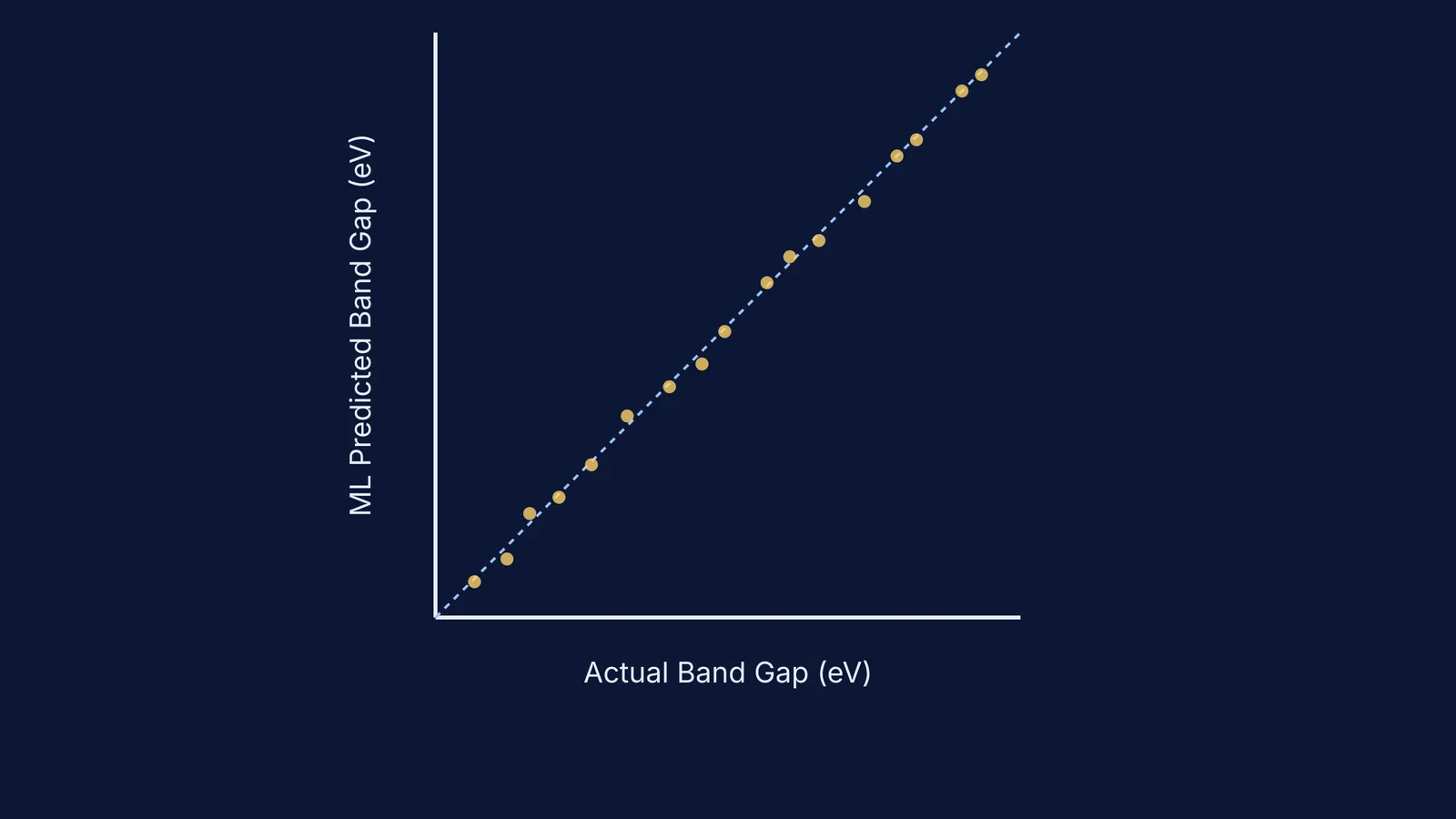
Materials informatics uses algorithms to learn the patterns hidden in existing experimental data. Instead of running a physical experiment, a computer model can predict a new compound's stability, melting point, or band gap in seconds. Researchers only synthesise the top few candidates, saving years of bench work and drastically reducing the cost of discovery.
How is machine learning changing the lab?
In physics and chemistry labs today, AI is an active participant. The days of simply recording data in a notebook are over. Machine learning models are now used to:
Predict properties: Algorithms can look at a molecular structure and estimate how well it conducts electricity or absorbs light. For example, screening vast libraries of potential polymers for energy storage can now be done computationally before a single one is made.
Design inverse molecules: Instead of testing a known molecule to see what it does, scientists specify the properties they want, and the AI generates the molecular structure to match.
Run autonomous labs: In some advanced facilities, AI orchestrates robotic arms that mix chemicals, test the results, and feed the data back into the algorithm to improve the next batch without human intervention.
This shift mirrors how biology was transformed by bioinformatics. Just as Margaret Dayhoff and the first protein sequence database turned biology into a data science, materials informatics is doing the same for chemistry and physics.
Why are hybrid research careers growing?
Because machine learning is now central to discovery, the demand for researchers who understand both the science and the code is surging. The U.S. Bureau of Labor Statistics projects a 22% growth in computer and information research scientist roles from 2025 to 2035, much faster than the average for all occupations.
However, writing code is not enough. The most secure and high-impact careers belong to "hybrid" scientists. These researchers have deep domain knowledge in physics or chemistry, but they also know how to train a neural network. An algorithm is only as good as the physical laws it respects, and it takes a trained scientist to know when an AI’s prediction makes sense in the real world. A computer scientist might not know why a proposed molecule would instantly oxidise in the air, but a hybrid chemist-coder will.
How can science students prepare?
If you are a student aiming for a research career, you do not need to drop your chemistry or physics major to become a software engineer. Instead, build computational skills alongside your core science subjects.
A 4-Step Plan to Build a Hybrid Profile
Master the physical laws: Do not skip your core science classes. Build a strong foundation in physical chemistry, quantum mechanics, or molecular biology. The AI relies on the constraints of physics, so you must understand them.
Learn Python: Python is the default language for scientific computing. Learn to use libraries like NumPy, Pandas, and scikit-learn.
Understand the algorithms: Read up on the history of computing—from John McCarthy and the birth of AI to modern deep learning—to understand how these tools actually work.
Work with messy data: In class, data is perfect. In a lab, data is incomplete and noisy. Practise cleaning datasets, as data preparation is often the most time-consuming part of a researcher's computational work.
If you are unsure where to start combining these fields, Fermi's AI tutor works out what you already know and builds a plan for the session, so you sit down to a clear next step. You can also explore Courses to find university-level courses taught by working scientists, keeping you connected to the real-world applications of the algorithms you learn.


