

On this page
A sea sponge, a cone snail and a sea squirt have each led to a medicine that doctors use today. Marine biotechnology is the field that finds useful molecules and processes in sea life and turns them into medicines, food and materials. If you enjoy biology and chemistry and want lab-heavy work, it is a small field worth knowing about.
What does marine biotechnology actually make?
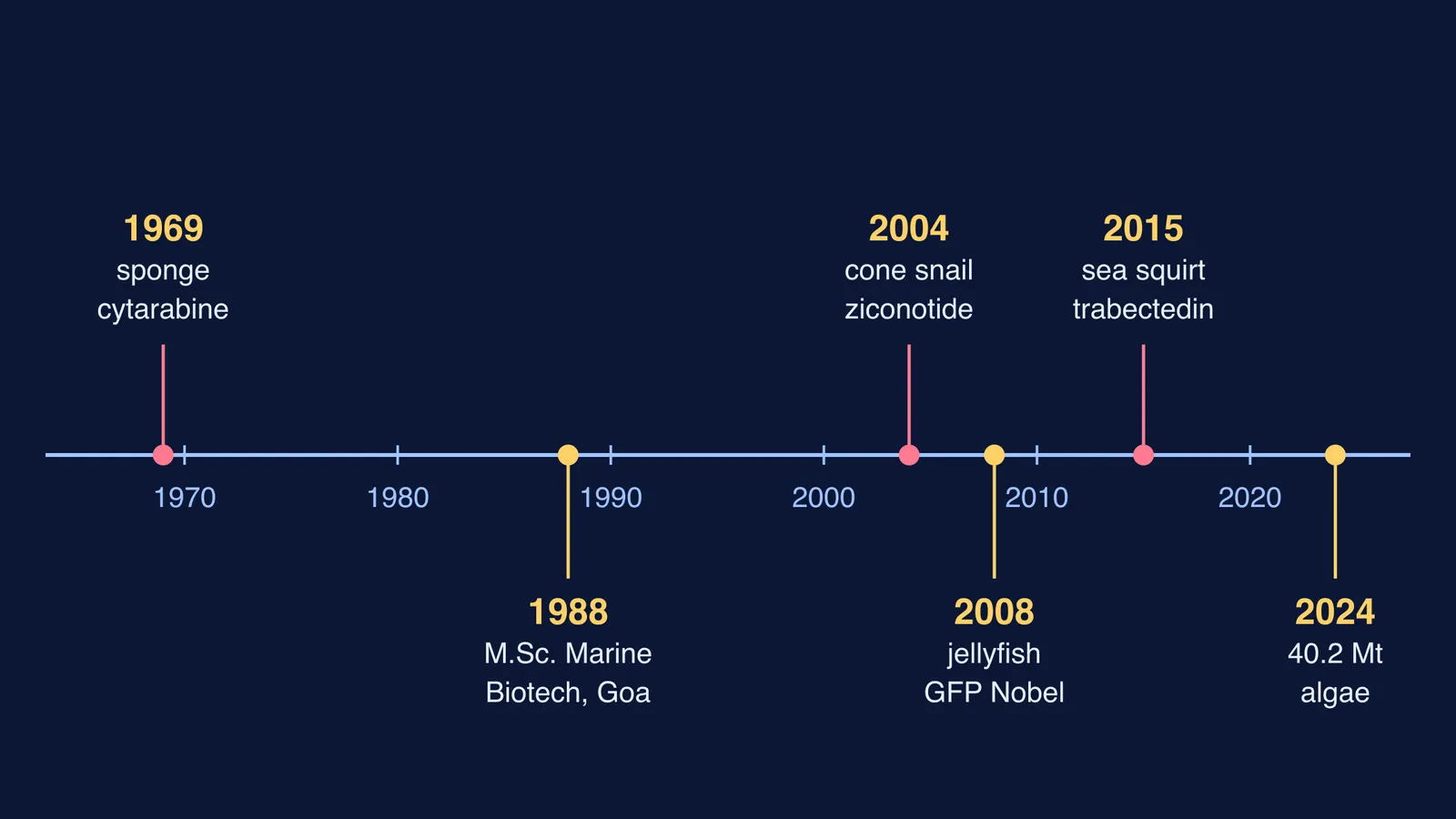
Medicines are the best-known example. A 2021 review in Marine Drugs counted 17 clinically available drugs based on marine natural products or their derivatives. The same review describes cytarabine, which grew out of a lead compound from a marine sponge, as the first marine anticancer drug approved by the US Food and Drug Administration, in 1969. Eribulin is a derivative of halichondrin B, a compound first isolated from the sponge Halichondria okadai, and was approved by the FDA for breast cancer in 2010. Trabectedin, a cancer drug the FDA approved in 2015, is isolated from extracts of the sea squirt Ecteinascidia turbinata.
Pain medicine has a marine drug too. Ziconotide is a synthetic copy of a peptide in the venom of a fish-eating cone snail, and the FDA approved it for severe chronic pain on 28 December 2004, according to a 2009 review by Smith and Deer.
Food and farming are the other big use. The world produced 40.2 million tonnes of aquatic algae in 2024, and 96.8 percent of it came from seaweed farming and microalgae cultivation, according to the FAO's State of World Fisheries and Aquaculture 2026. In India, the Marine Biotechnology, Fish Nutrition and Health Division of ICAR-CMFRI developed a seaweed-based nutraceutical, Cadalmin Immunalgin, and released it on 16 July 2023, as ICAR reported.
Sea life also gives labs their tools. Green fluorescent protein (GFP), first found in the jellyfish Aequorea victoria, earned Osamu Shimomura, Martin Chalfie and Roger Tsien the 2008 Nobel Prize in Chemistry, and the Royal Swedish Academy of Sciences calls it one of the most important tools in contemporary bioscience.
Which marine biotechnology courses can you study in India?
Most routes are postgraduate, so you do a life-science BSc first. Two examples:
Goa University: the School of Biological Sciences and Biotechnology says the DBT chose Goa University in 1988 as the first institution to run the nationally sponsored M.Sc. in Marine Biotechnology. Students are enrolled through the DBT's national selection process.
Nitte (NUCSER): the two-year M.Sc. Marine Biotechnology has 10 DBT-sponsored seats and 5 regular seats. You need a BSc in a life science (biotechnology, microbiology, fisheries science, pharmacy and others) with at least 50% aggregate. DBT scholars are selected through GAT-B and receive a fellowship.
GAT-B (Graduate Aptitude Test-Biotechnology) is the national test for DBT-supported master's seats. Its dates, syllabus and stipends change yearly, so read the current bulletin and each university's admission notice.
Where does the research happen?
An M.Sc. project or a later PhD will often take you to a national institute. CSIR-NIO in Goa was set up on 1 January 1966. Its research areas include marine biotechnology, and it runs a School of Oceanography under AcSIR. ICAR-CMFRI does the nutraceutical work described above. CSIR-CSMCRI in Bhavnagar runs skill-training programmes on growing and processing seaweed. Lab work in this field can include collecting samples, growing marine microbes, and extracting and testing compounds.
What is the scope after a marine biotechnology course?
Be honest with yourself: this is a niche. The usual paths are research (project posts at CSIR and ICAR labs, then a PhD) and industry jobs in pharmaceuticals, nutraceuticals, aquaculture and seaweed processing. Goa University's department says a good percentage of its postgraduates qualify for CSIR/UGC, DBT or ICMR fellowships, a sign that many of its graduates head towards research. The skills also carry over to general biotechnology.
A five-step plan from Class 11 to an M.Sc. seat
Class 11-12: take PCB and do not neglect organic chemistry. Marine drugs are molecules, and much of the lab work is about extracting and testing them.
Pick a BSc on the eligible list, such as biotechnology, microbiology, biochemistry or fisheries science. Check the M.Sc. pages above before you choose.
Get lab hours early. Ask your college about summer training at a CSIR or ICAR institute near the coast.
Second year of BSc: download the current GAT-B bulletin and start preparing.
Before you accept a seat, ask the department the questions below.
If the biochemistry behind all this feels shaky, the Fermi Concept Library has every concept in physics, chemistry, biology, mathematics and computing, each with its own lesson. If you don't know where to start, Fermi's AI tutor can work out what you already know and build a plan for the session.
Start with the two programme pages above, and read one syllabus this week.


