

On this page
A low percentile after Session 1 feels like a verdict. It isn't one. Under NTA's JEE Main 2027 Information Bulletin, candidates who appear in both sessions are ranked on the better of their two total NTA scores, not the best score in each subject. Session 1 runs from 20 to 28 January 2027 and Session 2 from 2 to 7 April 2027, which leaves about nine weeks between the two. The Session 2 application is separate: the same bulletin gives its window as 5 January to 3 February 2027, or 7 February with a late fee, so apply early if you might need it.
What should you do first after a low Session 1 percentile?
Get your response sheet. The NTA bulletin says the question papers and recorded responses are likely to be displayed for two to three days before the result, and asks candidates to download them because they will not be provided later.
Then audit it. Paper 1 has 75 questions for 300 marks, with +4 for a correct answer and -1 for a wrong one in both the MCQ and numerical sections. Put every question you did not get right into one of four buckets:
Concept gap: you did not know the idea.
Method or slip: you knew the idea but chose the wrong approach or made an arithmetic or unit error.
Time: you never reached it or abandoned it.
Bad guess: you marked an answer you were not sure of, and it cost you a mark.
A made-up example: a student scores 102, with Maths 6 right and 5 wrong (19), Physics 10 right and 3 wrong (37), Chemistry 12 right and 2 wrong (46). The audit shows 6 of the 10 wrong answers were guesses, worth 6 marks if left blank, and 9 unattempted Maths questions came from two unfinished chapters. Those two chapters and the guessing habit become the plan, not "study everything again".
Which chapters should you fix before Session 2?
List every chapter from your concept-gap and method buckets. Next to each, write roughly how many marks it cost you and how long it would take to fix: days for a chapter you half-know, weeks for one you never started.
Fix in this order:
High cost, quick fix: do these first.
High cost, slow fix: take one or two, only if the quick ones are done.
Low cost: leave them for now.
Six to eight chapters is a realistic list for five weeks. If you are much further behind, our triage plan for a chapter backlog shows how to choose.
When you practise, mix chapters rather than doing 40 questions from one. In a study of 126 seventh-graders by Doug Rohrer, Robert Dedrick and Sandra Stershic, interleaved practice produced higher scores than blocked practice of the same problems on a surprise test given 1 or 30 days later.
For method errors, the Fermi Problem Library has worked problems with a step-by-step solver that explains the reasoning rather than printing an answer. For concept gaps, the Fermi Concept Library gives each concept its own lesson.
How many mock tests should you take before Session 2?
Mocks are not only measurement. Henry Roediger and Jeffrey Karpicke found that students who took recall tests remembered more a week later than students who restudied, even though restudying made them feel more confident. But a mock you do not review teaches little.
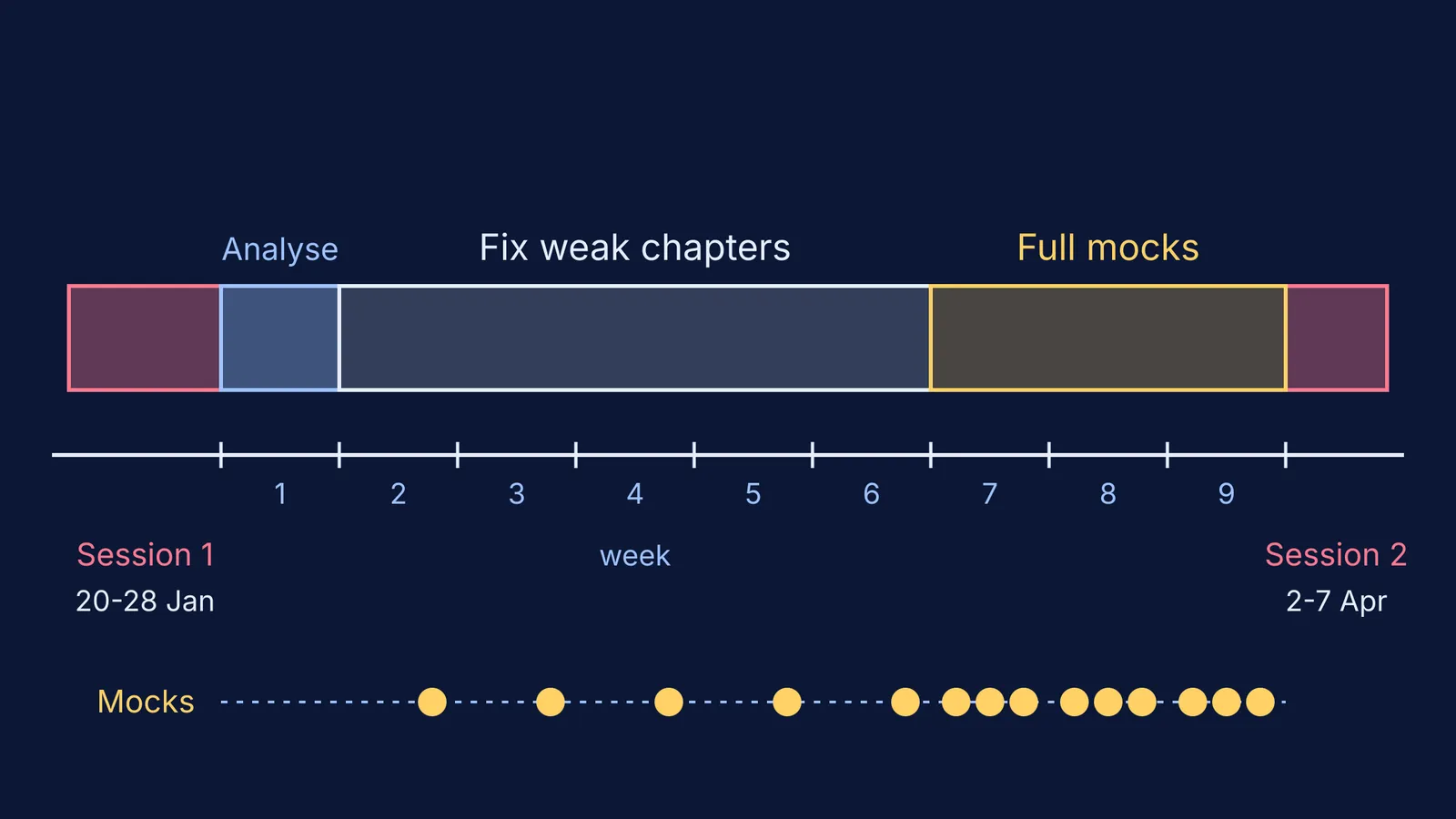
A workable number is about 14 full mocks: one each weekend in weeks 2 to 6 while you fix chapters, then about three a week in weeks 7 to 9. Each paper is three hours long, according to the NTA bulletin, so plan a review slot for every one. Our 60-minute mock review routine is a good minimum.
What does the nine-week plan look like?
The dates below come from the JEE Main 2027 bulletin; the split is our suggestion.
Week 1: response sheet audit, chapter list, Session 2 application if not yet done (deadline 3 February).
Weeks 2 to 6: two or three chapters at a time, a mixed problem set most evenings, one full mock each weekend, reviewed the next day.
Weeks 7 to 9: about three full mocks a week, at your shift time (9 am to 12 noon or 3 pm to 6 pm), each reviewed and fed back into your chapter list.
Last four or five days: no new chapters. Formula sheets, your error log, normal sleep.
If you do not know where to begin on a chapter, Fermi's AI tutor works out what you already know and builds a plan for the session.
How can parents help after a low score?
Ask about the plan, not the percentile: "Which chapters are you fixing this week, and what do you need from us?" Protect sleep and meals in the mock weeks.
If low mood, sleeplessness or panic last for weeks, talk to a doctor or counsellor. Tele MANAS, the government's 24x7 toll-free mental health service, answers at 14416.
For the bigger picture, read how to plan your year around JEE Main's two sessions.


