On this page
Learning SQL (Structured Query Language) often looks easy at first glance. The keywords—SELECT, FROM, WHERE—read exactly like English. But many students quickly hit a wall when they have to combine multiple tables or group data to answer a complex question.
According to the 2024 Stack Overflow Developer Survey, 51.0% of all developers use SQL, making it tied with Python as the third most popular language in the world after JavaScript and HTML/CSS. Whether you plan to build apps, analyse scientific data, or design machine learning models, you will eventually need to pull data from a database.
So, how do you learn it effectively? The secret is to stop reading syntax guides and start querying a very small database.
Why do students struggle to learn SQL?
When you first learn SQL, it is tempting to treat the database like a magic box that understands natural language. This is a well-documented trap. A 2021 study by Miedema, Aivaloglou, and Fletcher on novice SQL misconceptions found that students often fail because they apply English language patterns instead of mathematical logic.
For example, if a question asks for "students who are in Class A and Class B," a student might write `WHERE class = 'A' AND class = 'B'`. In English, this makes perfect sense. In SQL, it fails completely, because SQL filters row by row—and a single row cannot simultaneously be Class A and Class B.
The study showed that students who guess their way to a correct query often still hold fundamental misunderstandings about how data is processed. They struggle to realise that SQL is based on relational algebra and set theory, not conversational English.
Why does a small practice database work?
The fastest way to fix these misconceptions is to practice on a database so small that you can hold the entire thing in your head.
When you use a small schema, you can predict exactly what a query *should* return before you run it. If your `JOIN` returns 15 rows instead of the 5 you expected, you can look at the raw data and see exactly where the duplicates came from. This builds a robust mental model.
This approach is an example of what cognitive scientists call desirable difficulties. It is harder to think through the relational logic on paper than to copy-paste a tutorial query, but the learning sticks much longer.
How do you start with a 3-table framework?
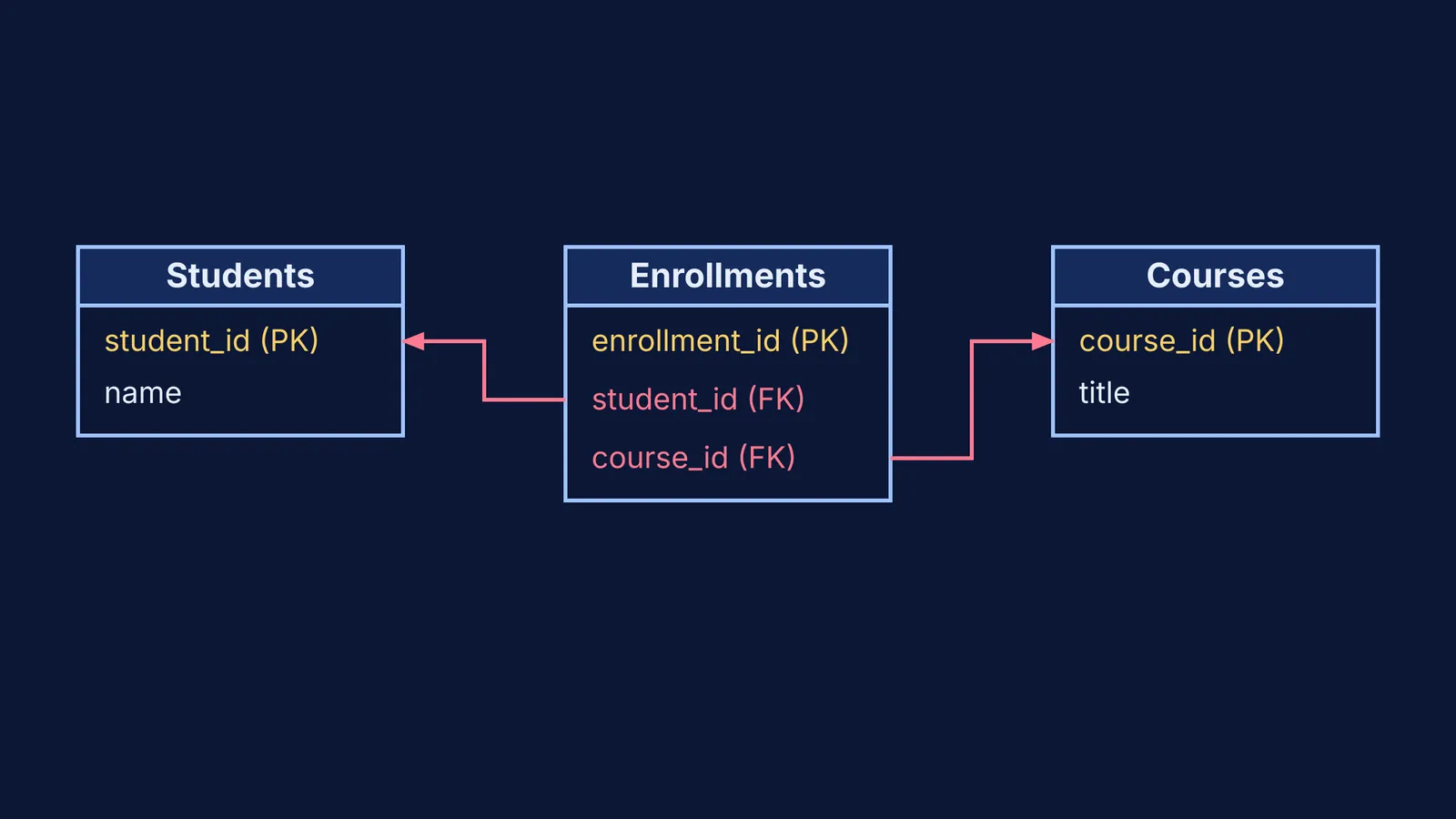
To begin, you do not need to install a massive database server. You can use an online SQLite editor and a simple three-table setup:
Students: `student_id` (Primary Key), `name`
Courses: `course_id` (Primary Key), `title`
Enrollments: `enrollment_id` (Primary Key), `student_id` (Foreign Key), `course_id` (Foreign Key), `grade`
With just this small framework, you can practice the three hardest concepts in SQL:
Filtering (WHERE): Find all students who got an 'A'.
Joining (JOIN): Combine `Students` and `Enrollments` to print the student's actual name next to their grade, instead of just their ID.
Grouping (GROUP BY): Count how many students are enrolled in each course by grouping the `Enrollments` table by `course_id`.
How should you test and debug your queries?
As you experiment, you will inevitably write queries that fail or return the wrong numbers. When this happens, do not just guess and add random keywords.
Instead, trace the logic step-by-step. If you get stuck on a computing concept like relational logic or primary keys, the Fermi Concept Library maps out the underlying ideas clearly. When you need help debugging a query you have written, Fermi's AI tutor can work through the logic alongside you, explaining *why* your join duplicated rows rather than just handing you the correct answer.
Learning SQL is one of the skills that matter most for modern technical careers. By shrinking the database down to a manageable size, you can stop guessing and start understanding the powerful logic beneath the code.