

On this page
Coding is a good skill, but a poor use of your most stressed hours. Whether to learn it during JEE preparation depends on what it costs, what it gives back, and whether you can keep it small.
Does coding help you in JEE?
Not directly. The JEE (Advanced) 2026 Information Brochure sets out syllabi for chemistry, mathematics and physics only, plus an architecture aptitude test for B.Arch applicants. The exam is two compulsory papers of three hours each, and no part of it asks you to write a program.
The indirect gains are modest. Writing a program forces you to spell out every step of a method, and a few lines of code can check a formula you derived by hand. Treat these as side benefits, not a reason to drop a physics session.
What does learning to code actually cost a JEE aspirant?
Time is the obvious cost. Sleep is the hidden one, because added hobbies tend to happen late at night. The American Academy of Sleep Medicine recommends that teenagers aged 13 to 18 sleep 8 to 10 hours in every 24. It links regularly sleeping less to attention, behaviour and learning problems. If coding pushes you below that, it is taking more than it gives.
The second cost is attention: "just fixing one bug" can eat a whole evening. That is why the plan below uses fixed blocks with a hard stop.
When does learning coding make sense during JEE prep?
If at least four of these are true for you, a small weekly habit is reasonable.
You take Computer Science at school. The CBSE Class XI Computer Science syllabus for 2025-26 gives 45 of its 70 theory marks to Computational Thinking and Programming, taught in Python, and the practical asks for a report file of at least 20 Python programs, so coding doubles as board preparation.
You sleep at least 8 hours on most nights, the low end of the AASM range for teenagers.
Your mock scores are steady or rising, and you have no large chapter backlog.
JEE Main is more than a couple of months away.
You have a real reason, such as a branch or project you are curious about.
You and a parent have agreed the time limit in advance.
If fewer than four are true, park it: a list of "things I'll learn after JEE" is a plan, not a loss. Juggling boards too? Our guide to balancing Class 12 board exams with JEE preparation helps you set priorities.
A 90-minute weekly coding plan that doesn't hurt preparation
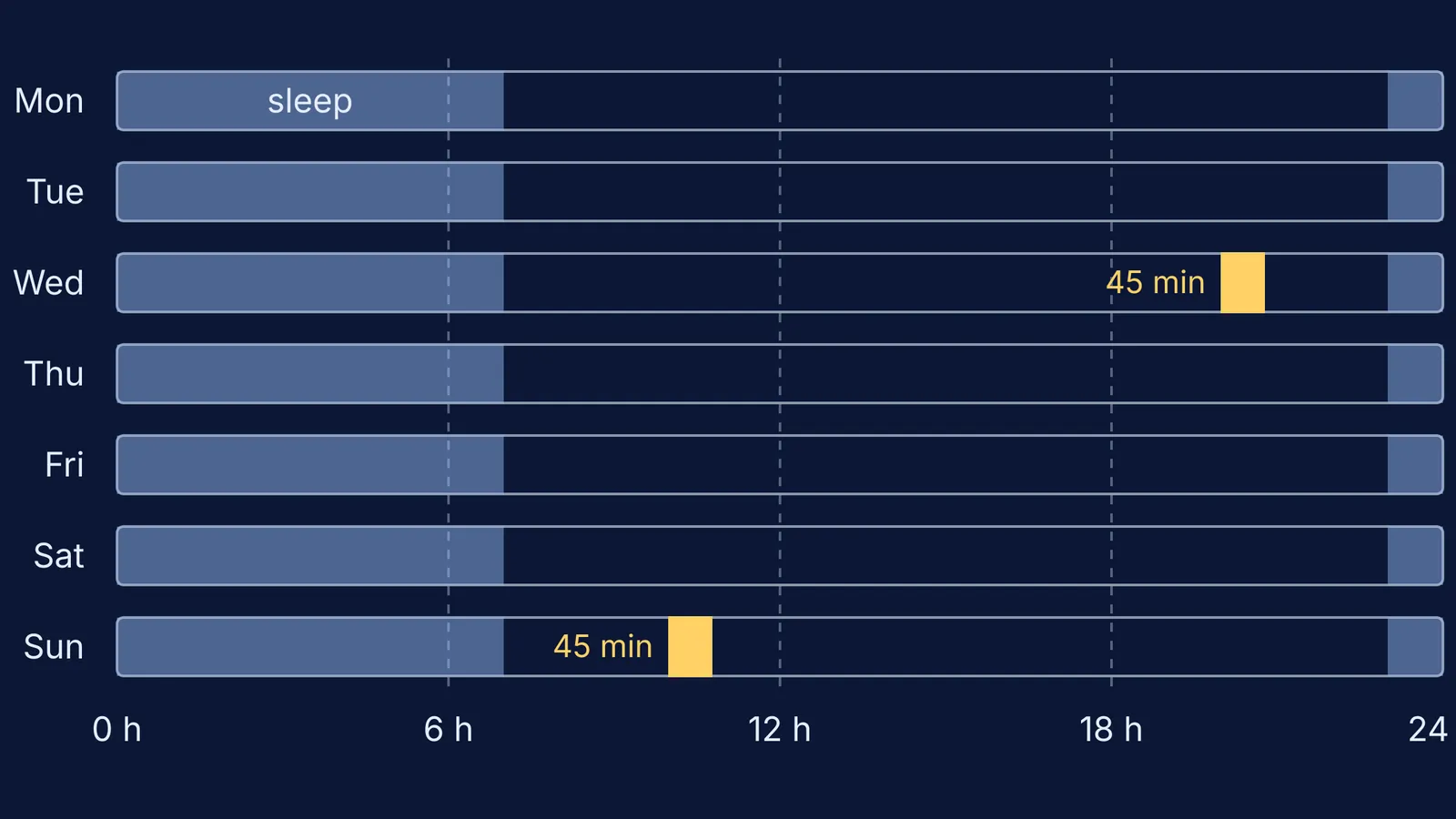
Two timed 45-minute sessions on your lightest days:
Session A, a midweek evening: learn one Python idea (loops, lists or functions) and write two tiny programs with it.
Session B, a weekend morning: one small project built on JEE content.
Hard rules: no coding after bedtime, none the night before a mock test, and a full pause in the last weeks before JEE Main.
Spacing fits memory research. A 2006 meta-analysis by Cepeda and colleagues pooled 317 experiments on spaced practice in verbal memory tasks and found that the best gap between sessions grows the longer you need to remember. It did not test coding, but a weekly rhythm fits that idea. Our time blocking guide for students juggling school and coaching shows how to fit the two blocks in.
A worked first project: check the range formula
A projectile launched at speed u and angle θ lands at range R = u² sin 2θ / g. For week one, write a program that:
Sets u = 20 m/s and g = 9.8 m/s².
Loops over the angles 15°, 30°, 45°, 60° and 75°.
Prints the range for each angle using the formula.
Simulates each flight in small time steps, cutting the vertical speed by g × step each time, until the ball lands, and prints that range alongside.
The formula column should read about 20.4 m, 35.3 m, 40.8 m, 35.3 m and 20.4 m, and your simulated column should come close, getting closer as you shrink the time step. You will see the longest range at 45°, and equal ranges for angles that add up to 90°, useful for JEE. Our guide to writing a projectile simulation in Python builds a similar program. The Fermi Simulation Lab has interactive simulations for ideas that are easier to see than to read.
How can parents tell whether it's helping or hurting?
It is working if your child sticks to the two blocks unprompted and talks about what they built. It is not working if nights get later or mock scores slide. A calm script: "I'm glad you're coding. Let's keep it to two 45-minute slots, and if mocks drop two weeks running, we'll pause it together."
When a loop or a physics idea refuses to click, the Fermi Concept Library covers every concept in physics, chemistry, biology, mathematics and computing, each with its own lesson. If exam pressure feels like more than everyday stress, call Tele MANAS on 14416.
Start this week with one 45-minute block and the range program.


