On this page
Why is Kaggle the best place to start?
When you first study data science or machine learning, theory can often feel disconnected from practice. Kaggle bridges this gap. It has grown from a simple competition site to a massive, collaborative ecosystem for learners and professionals alike. As of April 2025, the platform has over 23 million registered accounts, although the elite Grandmaster status is so difficult to reach that only 612 users have achieved it.
The scale of available data is immense. Kaggle hosts a vast library of public datasets, and users can upload individual datasets up to 200GB in size. For a student, this solves the two biggest hurdles in data science: finding clean, interesting data, and getting access to the computing power needed to process it. Because Kaggle provides free cloud-based GPUs and TPUs, you can train complex models entirely in your browser without buying an expensive computer.
How should a beginner start on Kaggle?
The most common mistake new students make is jumping straight into active, high-stakes prediction competitions. These challenges often feature messy data and seasoned professionals competing for cash prizes. Instead, your first step should be a Getting Started competition, which offers a low-stakes environment.
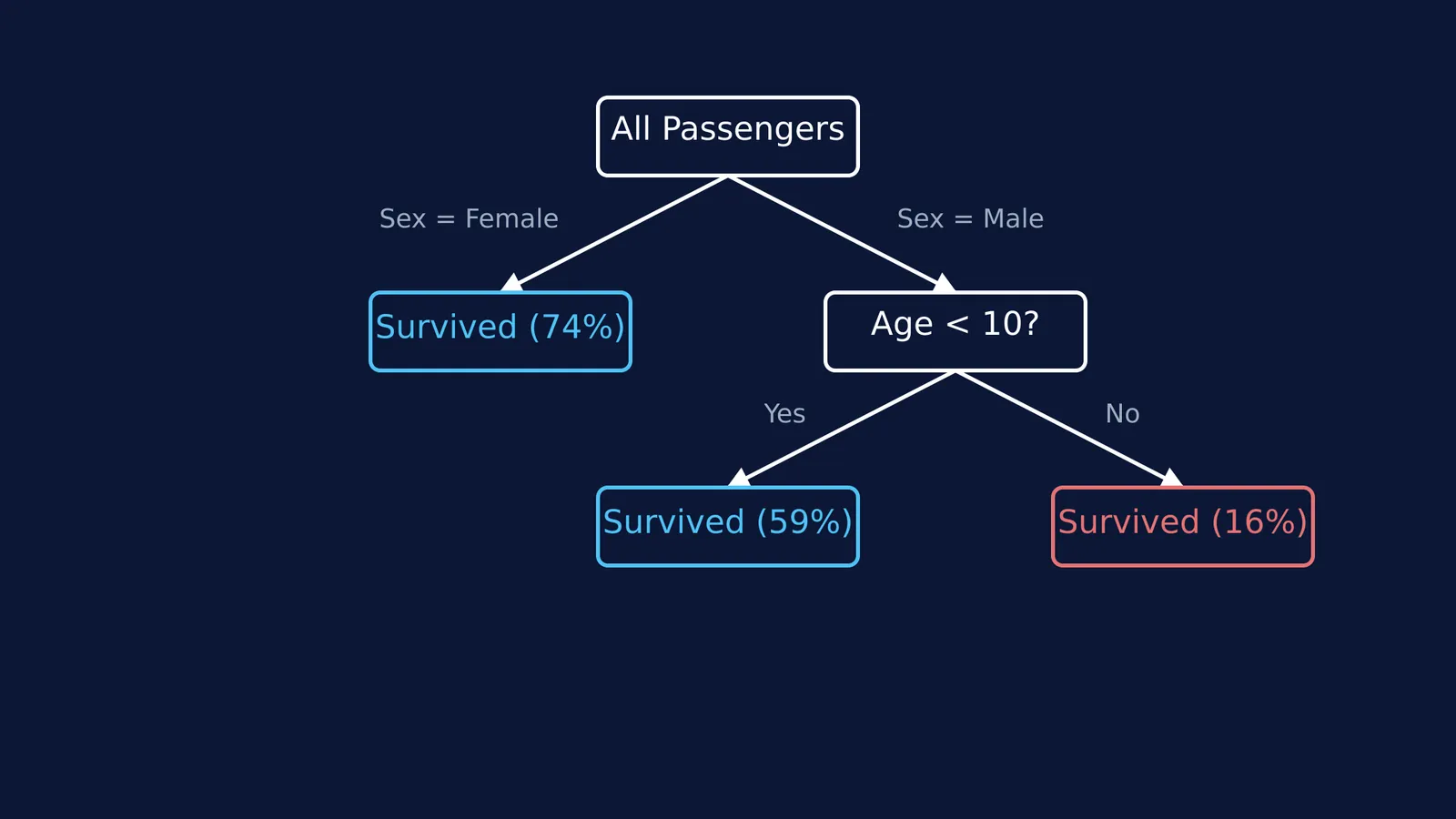
The "Titanic: Machine Learning from Disaster" challenge is considered the "Hello World" of Kaggle. In it, you use passenger data to predict who survived the shipwreck, teaching you the fundamentals of binary classification. Another excellent starting point is the Housing Prices competition, which introduces advanced regression techniques. These beginner competitions use a rolling leaderboard where submissions older than two months are removed, so you are always competing against other current learners. Taking this approach is a great way to help children learn without pressure as they explore data science.
Before you dive in, you might find that you need to brush up on the underlying maths. If you are struggling with the probability, statistics or linear algebra that makes these models work, you can review every concept in physics, chemistry, biology, mathematics and computing, each with its own lesson and its place in the map, in the Fermi Concept Library.
What is the best way to learn from notebooks?
Kaggle Notebooks are cloud environments where you can write and execute Python code. They are completely free and integrated directly into the platform. When you look at a competition, do not try to build a perfect model from scratch on day one.
Instead, use the community. Click on the "Code" tab and sort the public notebooks by "Most Upvoted". Top competitors frequently publish detailed tutorials and exploratory data analysis scripts. When you find a good one, click "Copy and Edit" to fork the notebook into your own private workspace.
This iterative process is how real learning happens. You start by reproducing someone else's baseline, and then you gradually experiment with feature engineering to improve the model. If you get stuck on a difficult error message or do not understand why a particular line of Pandas code works, Fermi's AI tutor teaches rather than answers. It holds a line of reasoning across a whole session, notices where a student is stuck, and decides whether to explain, ask, or show.
How can you build a portfolio with Kaggle?
Over time, your Kaggle profile becomes a living, interactive resume. Recruiters and universities look closely at your tier progression. While reaching Grandmaster is rare, progressing to the "Expert" tier in Notebooks or Datasets is an achievable goal for dedicated students. This tier shows that your peers value your contributions and that you can write clean code.
To build a strong portfolio, focus on publishing clean, well-documented code that tells a clear story about the data. When you do a science project or apply for research internships, a link to a thoughtful Kaggle notebook proves that you can handle real-world datasets and communicate your findings clearly.
Here is a four-week plan to get your portfolio started:
Complete Kaggle's free Python and Intro to Machine Learning micro-courses to understand the basics.
Fork a popular Titanic notebook, submit the baseline, and understand the workflow.
Pick a public dataset on a topic you love and perform your own exploratory data analysis.
Publish your notebook, ask for feedback in the discussion forums, and start tweaking your models.