On this page
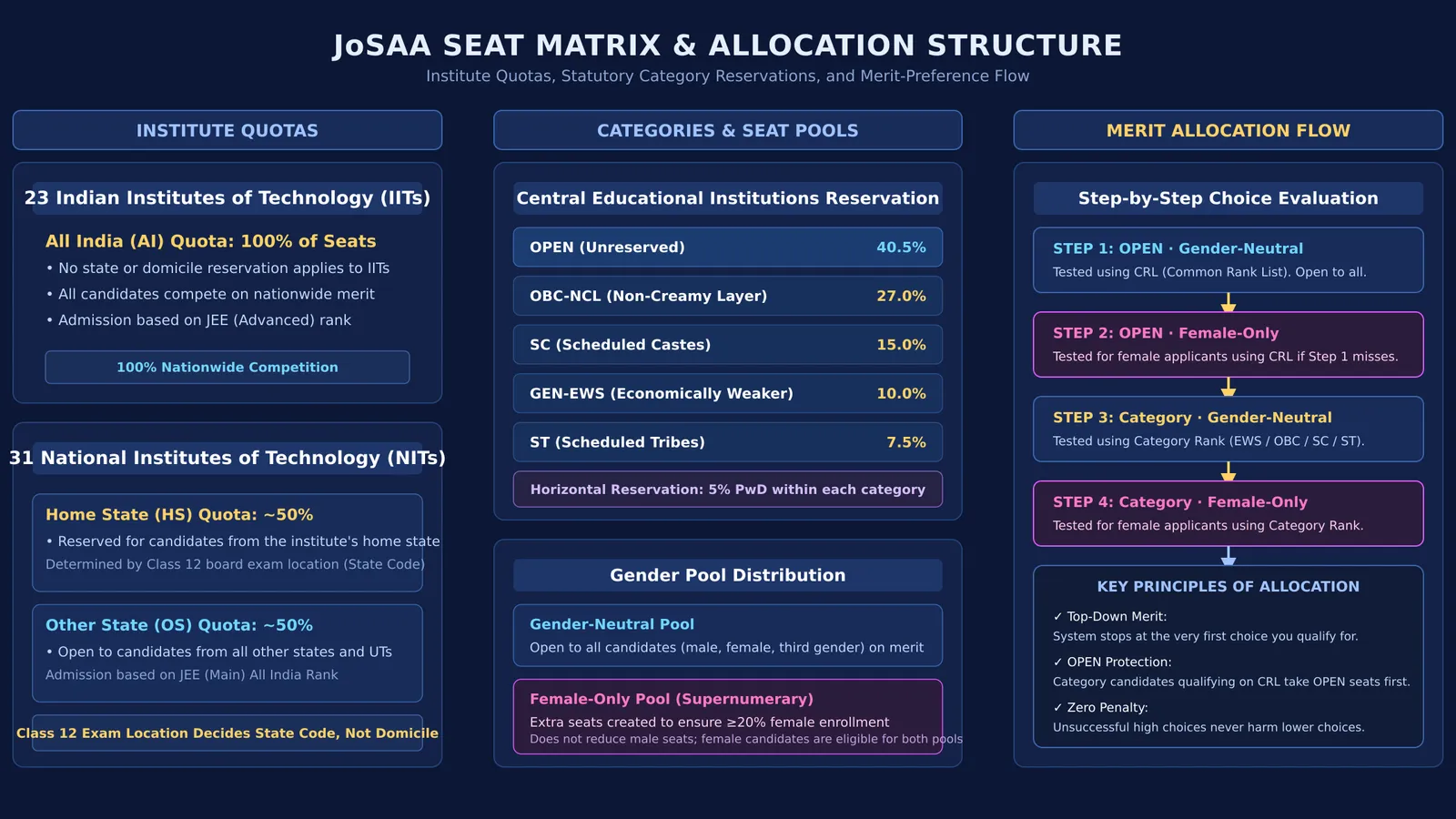
When you download the seat matrix from the Joint Seat Allocation Authority portal, every engineering branch is divided into quotas, categories, and seat pools. The 23 Indian Institutes of Technology offer seats exclusively under the All India (AI) quota, meaning candidates from across India compete on nationwide merit.
In contrast, the 31 National Institutes of Technology split undergraduate seats into two equal streams under JoSAA business rules. Roughly 50% of seats are reserved under the Home State (HS) quota, while the remaining 50% fall under the Other State (OS) quota. Your eligibility for the Home State quota depends on where you passed your Class 12 (or equivalent) qualifying examination from a recognized board, such as CBSE or a state board, rather than your permanent home address. The National Testing Agency records this State Code of Eligibility during the JEE Main application, which JoSAA uses to determine quota rights.
Vertical reservation follows Ministry of Education guidelines: 15% for Scheduled Castes (SC), 7.5% for Scheduled Tribes (ST), 27% for Other Backward Classes Non-Creamy Layer (OBC-NCL), and 10% for General Economically Weaker Sections (GEN-EWS). The remaining seats form the unreserved OPEN category. Across every category, a 5% horizontal reservation applies for Persons with Disabilities (PwD).
Each category is further split into two seat pools: Gender-Neutral and Female-Only. Female-Only seats are supernumerary additions introduced following the Timothy Gonsalves Committee recommendations under Ministry of Education policy to reach at least 20% female enrollment across technical campuses without cutting male seats. Female candidates are eligible for seats in both pools.
How does JoSAA allocate seats across categories?
JoSAA uses a centralized merit-preference algorithm to process choice lists from top to bottom, as documented on the Joint Seat Allocation Authority portal. When the system examines any choice on your list, it tests the program against multiple seat tiers in a fixed hierarchy.
For any reserved-category candidate, the algorithm first checks whether their Common Rank List (CRL) score earns an unreserved OPEN seat. If it does, they receive an OPEN seat, leaving reserved seats untouched for lower-ranking peers in their category. If they miss the OPEN cutoff, the algorithm then checks their Category Rank against the reserved quota.
For female applicants, the system evaluates the Gender-Neutral pool first before testing the Female-Only supernumerary pool. The evaluation sequence tests OPEN (Gender-Neutral), then OPEN (Female-Only), followed by Reserved Category (Gender-Neutral), and finally Reserved Category (Female-Only). Having a category certificate never restricts you to reserved seats; it simply provides an additional safety tier beneath the open merit line.
Why should seat counts not dictate your choice order?
According to JoSAA business rules, choice evaluation depends strictly on your preference order, yet applicants often rearrange their choices based on raw seat counts. If Branch A has 10 seats in your category and Branch B has 60 seats, students often mistakenly rank Branch B higher, believing it offers a higher probability of admission.
This strategy misjudges the deferred-acceptance mechanism defined in JoSAA business rules. You are never penalised for placing an ambitious or smaller-seat program ahead of a larger one. If you miss Choice 1, JoSAA considers your application for Choice 2 with zero disadvantage compared to someone who placed Choice 2 at the top. For step-by-step guidance on round mechanics, read our guide to JoSAA counselling for parents: rounds, choices and documents.
If you place Branch B above Branch A simply because Branch B has more seats, the algorithm assigns Branch B as soon as you clear its cutoff. Because JoSAA permanently deletes choices listed below an allotted seat, you lose any chance of receiving Branch A in subsequent rounds.
How should you structure your choice list?
Instead of letting seat numbers dictate your preference order, use the seat matrix alongside official opening and closing ranks from JEE Advanced and JoSAA to organize choices into three balanced tiers:
Ambitious tier (top 20% to 30% of your list): Programs and campuses where previous closing cutoffs were slightly higher than your rank. List your genuine dream branches here regardless of how few seats they offer.
Realistic tier (middle 40% to 50% of your list): Programs where past closing cutoffs match your rank closely. These represent your primary landing zone.
Safe tier (bottom 20% to 30% of your list): Dependable options with larger seat matrices and closing ranks comfortably below yours. If regular counselling leaves you unplaced, you can still participate in CSAB special rounds after JoSAA.
As you prepare for your first semester at engineering college, exploring academic branch subjects helps confirm your preferences. The Fermi Concept Library covers every concept in physics, chemistry, biology, mathematics and computing, each with its own lesson and its place in the map. For students strengthening their analytical foundations before university classes begin, the Fermi Problem Library provides worked problems with a step-by-step solver that explains the reasoning rather than printing an answer.