

On this page
It is the night before a unit test. You need the page where your teacher explained banking of roads, and you are flipping through a physics notebook from front to back. What is missing is an address system: page numbers, an index, a formula list, and links between related pages.
Why can't I find anything in my notes?
You write notes in date order, but you search for them by topic. Friction is taught in July, a doubt class fixes your mistake in August, and a related problem turns up in September. Without numbers on the pages, the only way to search is to flip.
The sociologist Niklas Luhmann kept about 90,000 handwritten cards, starting in 1951, according to Johannes Schmidt's 2018 study of the collection. Each card had a number that gave it a fixed place in the file, so it could always be found again. A later card that added to card 1/1 became 1/1a and was filed between 1/1 and 1/2. His keyword index for the second collection grew to 3,200 entries, but each entry typically listed only one to four places, because links written on the cards led to the rest. Schmidt also describes the risk: a note that is not linked to the others "becomes lost irretrievably in the bulk of notes." Your notebook needs the same idea.
How do I set up an indexed notebook?
Use one notebook per subject, each with its own index and formula list.
Number every page now, in the bottom outer corner, including the blank ones. A page number never changes.
Keep the first two pages for the index. Write "Index" at the top.
Keep the last four pages for the formula list, and fill it from the back.
Start each new topic on a fresh page and give it a title on the top line.
Add the topic and its page number to the index on the day you write it.
Write index entries in the words you would search for later: "friction", "banking of roads", "projectile range", not "Lecture 14". Like Luhmann, list only a few starting pages for each entry. The links on the pages do the rest.
If you already use colours, this fits alongside a four-colour system for your notes: colours tell you what kind of note it is, and numbers tell you where it is.
How do I link related pages?
Ryder Carroll, who created the Bullet Journal, calls this "threading": next to the page number, you write the number of the previous or next page on the same topic, so you can move between them without going back to the index (Bullet Journal: Threading).
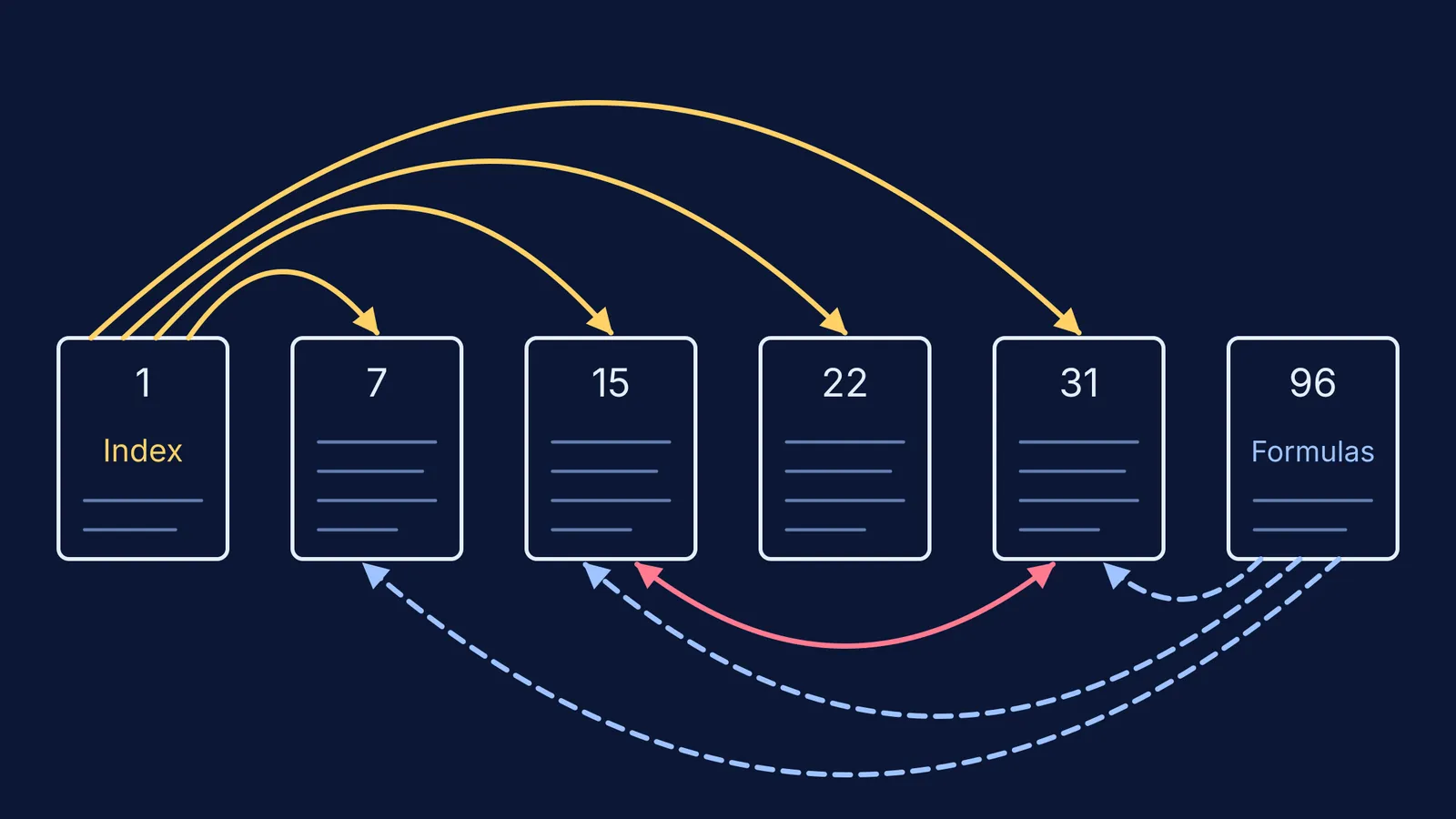
A worked example from a Class 11 physics notebook:
Index: Kinematics 7 · Laws of motion 15 · Friction 15, 31 · Work and energy 22 · Circular motion 31
Page 15, friction: at the bottom, "→ 31 banking with friction"
Page 31, circular motion: at the top, "← 15 friction"
Formula list, page 96: "v² = u² + 2as (7)", "f ≤ μN (15)", "tan θ = v²/rg, no friction (31)"
Now a question on a banked road with friction takes three moves: index to page 31, the arrow back to page 15, and the formula list to check both equations.
Why keep a formula list at the back?
A formula list puts every result in one place, and the page numbers lead back to where each one was derived. It doubles as a self-test: cover the formulas, write them from memory, then check.
That habit is retrieval practice. In two 2006 experiments, Henry Roediger and Jeffrey Karpicke found that students who took recall tests on a prose passage remembered more of it two days and one week later than students who restudied it, even though restudying made students more confident (Psychological Science). After five minutes, restudying did better; the benefit of testing showed up later.
If a formula on your list no longer makes sense when you look it up, the Fermi Concept Library has every concept in physics, chemistry, biology and mathematics, each with its own lesson. If you keep getting a problem wrong even with the right page open, the Fermi Problem Library has worked problems with a step-by-step solver that explains the reasoning rather than printing an answer.
What should I check each week?
Every Sunday, check:
Is every new page numbered and listed in the index?
Does every topic that continues later have its → and ← links?
Is every new formula on the list with its page number?
Are loose coaching sheets stuck in and numbered like Luhmann's cards (15a, 15b), so the old numbers stay the same?
The same index is what makes preparing for an open-book exam with tabs and an index work. Parents can help with one question: "Show me where friction is." If your teen finds it in seconds, the system is working. If they don't, here is how to help them organise messy coaching notes.
Start tonight with the notebook you use most: number the pages, then write its first five index entries.


