

On this page
Many students believe that scientific writing requires a special, complicated vocabulary. When you sit down to write a physics lab report or a biology assignment, you might be tempted to use phrases like "due to the fact that" instead of "because," or "it was observed by us" instead of "we saw." But the true goal of scientific writing is the exact opposite of complexity. It is to get out of the way so the reader can focus entirely on the data and the logic.
Whether you are aiming for a better grade in school or preparing for university-level research, clear English is a powerful tool. When you write simply, you show your teachers that you truly understand the material. If you are studying science in English when you think in another language, focusing on short, direct sentences is the most effective way to communicate your ideas without getting tangled in advanced grammar.
Why do short sentences matter in science?
The most common mistake in student science writing is stringing too many ideas into one sentence. When a sentence drags on, the reader's brain has to work harder to hold the beginning of the sentence in working memory while finally reaching the end.
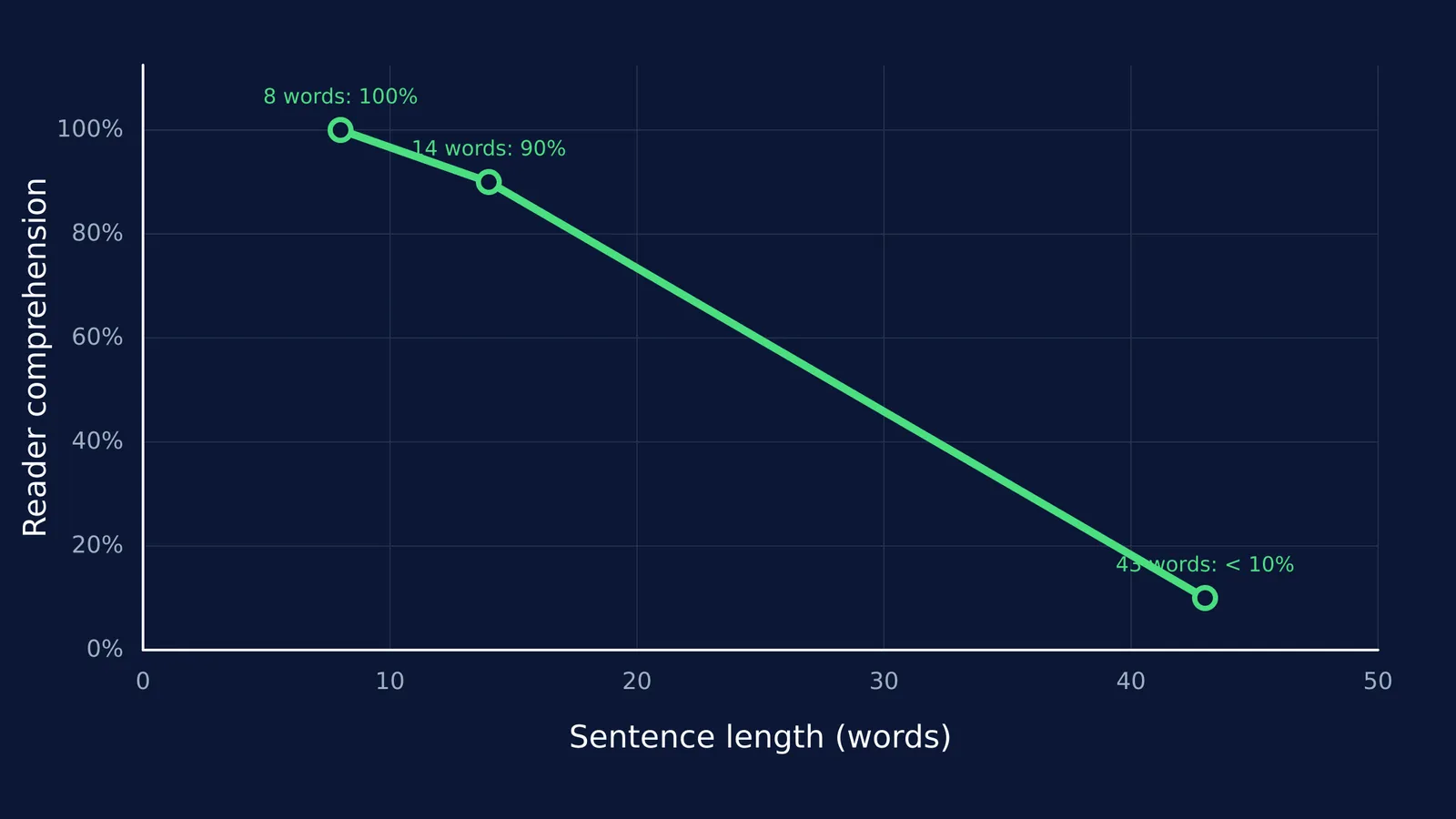
A classic study by the American Press Institute analysed how sentence length affects reading comprehension. They found a steep, predictable drop-off as word counts rise:
8 words: 100% comprehension.
14 words: 90% comprehension.
43 words: less than 10% comprehension.
In a science assignment, where the concepts themselves are already difficult to grasp, you cannot afford to lose your reader in a maze of words. If a sentence takes up more than three lines on your page, you are asking too much of your reader. Find the "and" or "which" in the middle of the block and break it into two separate, punchy sentences.
Active vs passive voice: what do journals want?
For decades, students were taught to write science in the passive voice to sound objective. You might have learned to write, "The solution was heated to 50 °C" rather than "We heated the solution to 50 °C." However, modern scientific standards have changed significantly.
The world's top scientific journals now explicitly ask scientists to be direct. For example, *Nature*'s official formatting guide for authors states: "Nature journals prefer authors to write in the active voice ('we performed the experiment...') as experience has shown that readers find concepts and results to be conveyed more clearly if they are written directly."
Using the active voice cuts out unnecessary filler words and makes it instantly clear who did what. While your teacher might still prefer the passive voice specifically for the Methods section of a report—where the procedure is more important than the person doing it—you should use the active voice in your Introduction and Discussion sections to explain your reasoning clearly.
How do you write clear English in science assignments?
Writing clearly means being concrete and logical. Instead of using vague adjectives, use specific numbers. Instead of twisting your sentence backwards, state the cause before the effect. Here is what this transformation looks like in practice.
1. Trim the filler words Never use five words when one will do. Complex transitions weaken your main point.
*Before:* Due to the fact that the copper wire was elongated, an increase in resistance was exhibited by the system.
*After:* Stretching the copper wire increased its resistance.
2. Be quantitative, not qualitative Science relies on exact measurements. Vague words like "significant" or "small" leave room for misinterpretation.
*Before:* A small amount of acid caused a significant drop in the pH of the solution.
*After:* Adding 2 mL of acid dropped the pH from 7.0 to 4.2.
3. Use logical, chronological order When describing an event or a process, state the cause before the effect. Your reader should experience the timeline exactly as it happened in the lab.
*Before:* The plant growth was stunted, which was caused by the lack of sunlight during the two-week period.
*After:* The plant received no sunlight for two weeks, so its growth was stunted.
How can you build your understanding first?
Vague writing often comes from a vague understanding of the science itself. When you are not entirely sure why a reaction happened or how a formula works, you naturally tend to hide behind big words and convoluted sentences. If you find yourself doing this, you need to revisit the core idea before you try to explain it on paper.
You can explore the underlying ideas in the Fermi Concept Library, which covers every concept in physics, chemistry, biology, mathematics and computing. If you are stuck on a calculation that you need to include in your report, Fermi's AI tutor can work out what you already know and build a plan for the session, explaining the reasoning step by step.
Writing about science does not have to be a stressful exercise in pretending to sound smart. Just as writing about your worries before a test has been shown to clear your mind, applying straightforward, honest English to your science assignments will make your true understanding shine through.


