

On this page
For a student entering an Indian Institute of Technology (IIT), choosing between a four-year B.Tech and a five-year dual degree (B.Tech + M.Tech) shapes the next half-decade of study. The National Education Policy (NEP) 2020 has prompted IITs to make these programs more flexible, with institutions like IIT Bombay moving away from entry-level dual degrees in favour of a system where you opt in later.
Understanding the differences in course depth, switching rules and career outcomes can help you decide which path fits your goals.
How do the course length and depth differ?
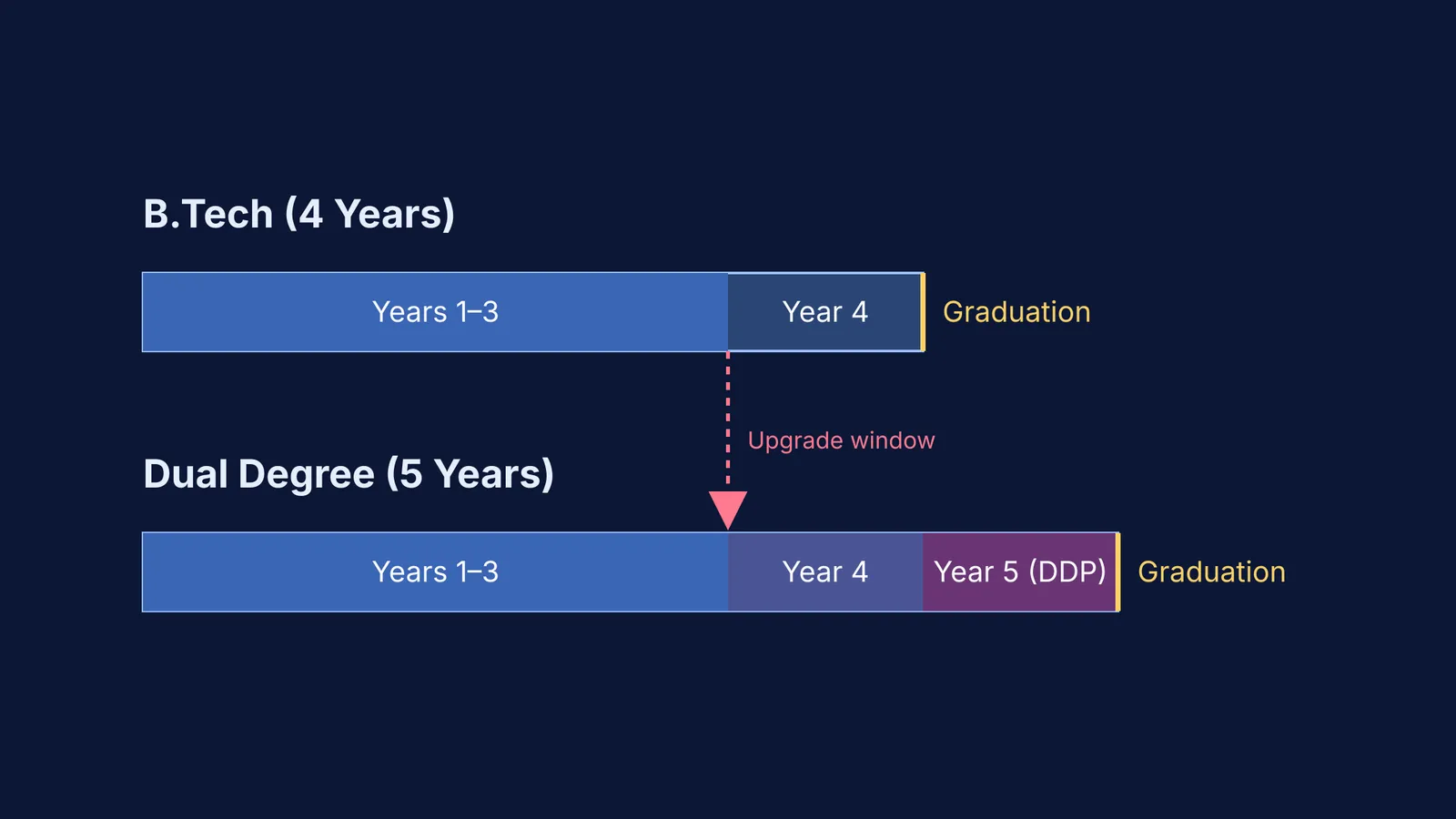
The standard B.Tech is a four-year (eight-semester) undergraduate degree. A dual degree is a five-year (10-semester) integrated programme that awards both a Bachelor of Technology and a Master of Technology upon graduation. This saves you one year compared to pursuing a B.Tech and an M.Tech separately.
For the first three years, the curriculum is nearly identical. You cover core engineering subjects, basic sciences and humanities. The paths diverge in the fourth year:
B.Tech students complete their final electives and an undergraduate project, graduating at the end of year four.
Dual degree students take postgraduate-level electives in year four. Their entire fifth year is dedicated to a Dual Degree Project (DDP) or Master's thesis, adding around 120 extra credits to their workload (IIT Bombay).
If you struggle with foundational topics in those common first three years, Fermi's AI tutor can work out what you already know and build a plan for the session, teaching you the concepts you need to stay on track.
Can you switch between a B.Tech and a dual degree?
Most IITs allow students to change their programme partway through, but the rules are heavily skewed in one direction.
Upgrading from B.Tech to a dual degree is usually permitted at the end of the fifth or sixth semester. This requires a high CGPA—typically between 7.5 and 8.0—and no active backlogs (IIT Bombay). Many institutes also offer an Interdisciplinary Dual Degree (IDDD), where you stay in your parent branch for the B.Tech but earn an M.Tech in a fast-growing field like Data Science or Robotics.
Reverting from a dual degree to a B.Tech is much harder. Institutes like IIT Kharagpur and IIT Madras state that upgrading to a dual degree is strictly one-way. Reverting is rarely allowed, except in cases of academic failure or on medical grounds. IIT Kanpur is a rare exception, allowing students in its Category A (same department) to exit the M.Tech portion at any time, provided they meet the B.Tech graduation requirements (IIT Kanpur).
What are the career options and placement packages?
Your degree choice affects both your immediate job prospects and long-term flexibility.
A four-year B.Tech offers the most flexibility. It leaves you free to pivot immediately into an MBA at an IIM, prepare for the UPSC civil services, or apply for an MS abroad. While B.Tech students are eligible for most entry-level tech and consulting jobs, they miss out on niche roles that require postgraduate research experience.
A dual degree is geared towards core engineering, Research & Development (R&D) and pursuing a Ph.D. Because of this specialisation, dual degree graduates often secure higher salaries in technical roles. In the 2023–24 placement season, IIT Delhi reported a median package of ₹24.30 LPA for dual degree students, compared to ₹19.08 LPA for the four-year B.Tech programme (IIT Delhi). Dual degree students also receive a GATE-equivalent stipend during their ninth and tenth semesters.
Which degree should you choose?
If you are filling out your JoSAA choices or nearing the end of your third year, consider this framework:
Choose B.Tech if you want to keep your options open for an MBA, civil services or non-core jobs, or if you prefer to do your Master's abroad.
Choose a dual degree if you are certain you want a career in core engineering or R&D, or if you want to secure a Master's degree in five years instead of six.
If you are unsure, start with a B.Tech. It is easier to opt into a Master's programme later by maintaining a high CGPA than it is to exit a five-year commitment once you have started.
If you decide to start with a B.Tech and upgrade later, maintaining a CGPA above 8.0 is essential. The Fermi Concept Library contains every concept in mathematics, physics and chemistry, helping you master the coursework required to qualify for that fifth year. If you are deciding whether you are even eligible for these paths, read our guide on who can sit JEE Main. Alternatively, you might consider other pathways like the Indian Navy 10+2 B.Tech entry through JEE Main.


