

On this page
If you are in Class 11 with school six days a week and coaching on some evenings, the useful question is not how many hours you could study. It is how many you can study well, week after week. Here is a realistic budget, three sample days, and a quick check for whether your hours are working.
How many hours should a Class 11 student study daily?
Start with what is fixed. In the sample days below, school with travel takes seven and a half hours and coaching with travel takes four.
Then protect sleep. Teenagers aged 13 to 18 should sleep 8 to 10 hours per 24 hours on a regular basis, according to a consensus statement of the American Academy of Sleep Medicine. The same statement says regularly sleeping fewer than the recommended hours is associated with attention, behaviour and learning problems.
Then move. Adolescents should do at least an average of 60 minutes a day of moderate-to-vigorous, mostly aerobic, physical activity across the week, according to the WHO 2020 guidelines on physical activity.
What is left gives a realistic range for your own study, separate from school and coaching classes:
School-only days: 2.5 to 3 focused hours.
School plus coaching days: 1 to 2 focused hours, mostly on that day's coaching material.
Sunday or a holiday: 4 to 6 focused hours, in blocks with real breaks.
With coaching on three evenings, a week adds up to roughly 15 to 20 hours of self-study. That is plenty if the hours go on problems rather than notes.
Why do focused hours matter more than total hours?
A paper titled Why study time does not predict grade point average across college students, by E. Ashby Plant, K. Anders Ericsson and colleagues at Florida State University, described the amount students study as a poor predictor of their academic performance. Their model added prior knowledge and the quality of study, such as where students worked. These were US college students, but the idea is worth borrowing: two uninterrupted hours with a problem set may do more for you than four hours of rereading.
A 2013 review of ten study techniques by John Dunlosky and colleagues rated practice testing and distributed practice as high utility, and rereading, highlighting and summarising as low utility. So a focused hour means answering questions without the solution open, recalling from memory, and coming back to a topic across several days.
Where your phone sits matters too; read our piece on whether a phone on your desk hurts focus.
What does a realistic Class 11 study timetable look like?
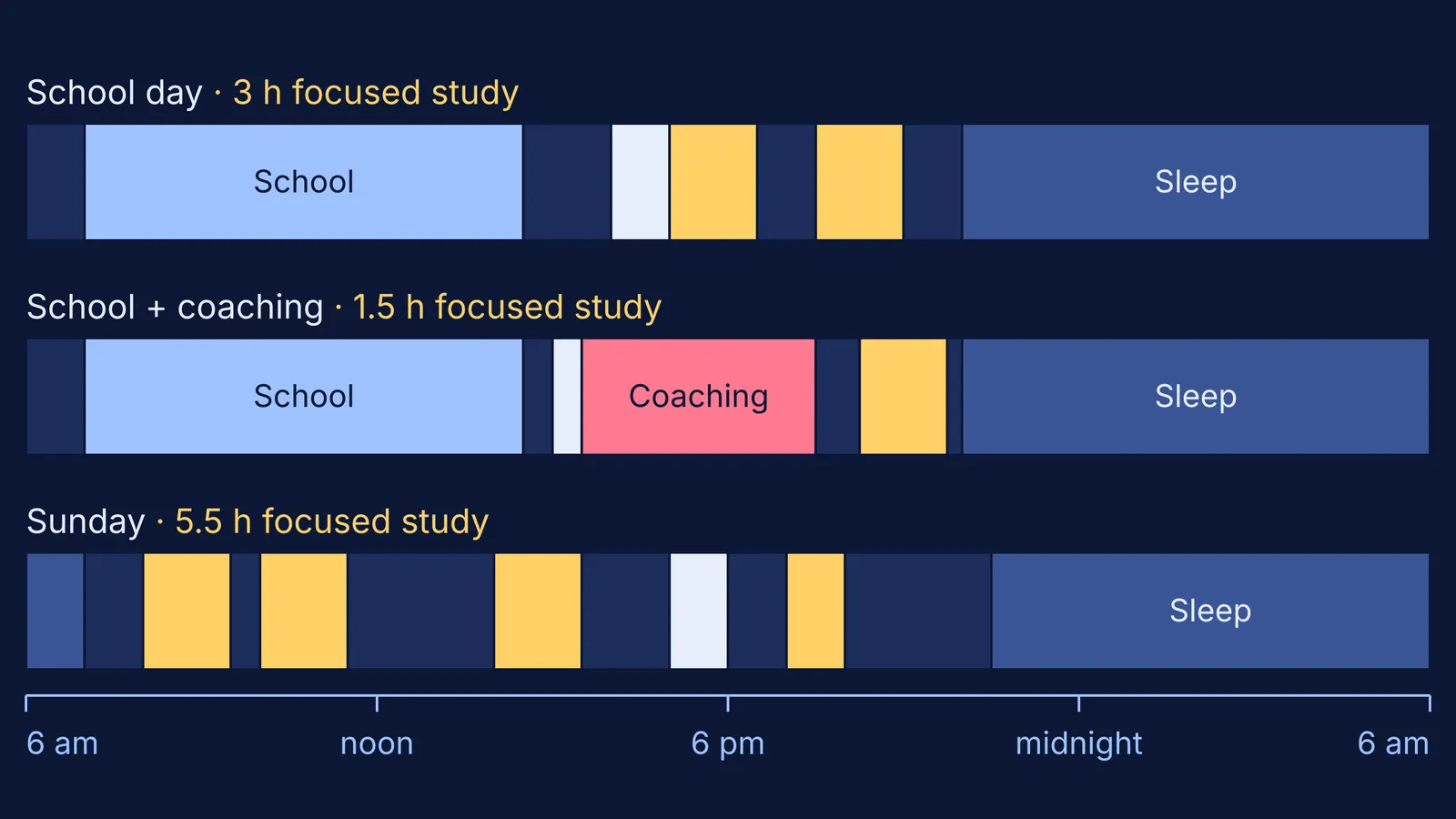
The diagram at the top of this page draws these three days to scale as 24-hour bars.
Day 1: school only, 3 focused hours
7:00 to 2:30: school, with travel.
2:30 to 4:00: lunch and rest.
4:00 to 5:00: sport, cycling or a brisk walk.
5:00 to 6:30: block one. Today's physics or maths, problems first, notes second.
6:30 to 7:30: break, snack, time with family.
7:30 to 9:00: block two. A 15-minute test on last week's chapter, then chemistry or biology.
10:00: lights out, up at 6:00.
Day 2: school plus coaching, 1.5 focused hours
7:00 to 2:30: school.
3:00 to 3:30: walk or cycle.
3:30 to 7:30: coaching, with travel.
8:15 to 9:45: one block. Redo two problems from today's class without notes and mark where you went wrong.
10:00: lights out, up at 6:00.
Day 3: Sunday, 5.5 focused hours
8:00 to 9:30 and 10:00 to 11:30: two blocks on the week's weakest topic.
2:00 to 3:30: a timed practice set, or reviewing a test you already took.
5:00 to 6:00: sport.
7:00 to 8:00: plan the coming week, chapter by chapter.
10:30: lights out, up at 7:00.
How do you know if your study hours are enough?
Count results, not hours, and keep the sleep the American Academy of Sleep Medicine recommends. Your hours are probably enough if:
You can solve this week's problems with the solution closed.
Your backlog is the same size or smaller than last week.
You sleep at least 8 hours on most nights.
If the backlog keeps growing, choose what to drop rather than adding hours. When you sit down and do not know where to start, Fermi's AI tutor can work out what you already know and build a plan for the session. If you keep reaching for the wrong method in numericals, the Fermi Problem Library has worked problems with a step-by-step solver that explains the reasoning rather than printing an answer.
Parents: ask about the backlog and the bedtime, not the hours; see how much sleep teenagers need, and how parents can help. If your child seems exhausted, anxious or low for weeks, talk to a doctor or school counsellor, or call Tele MANAS, the free national mental-health helpline, on 14416.
To make any of these days stick past the first week, read how to build a study routine that lasts.


