

On this page
Moving away for college means late-night study sessions, sudden cravings for Maggi, and endless cups of coffee. It is tempting to pack an electric kettle, but before you do, you should check your hostel's rulebook. Most Indian universities strictly prohibit high-wattage appliances in student rooms.
This is not just a stubborn rule to save on electricity bills; it is a critical fire safety measure rooted in physics.
Can I use an electric kettle in a hostel room?
In most cases, no. Academic institutions across India typically classify electric kettles, room heaters, and iron boxes as prohibited high-voltage appliances.
Hostels enforce these bans with surprise inspections and penalties. For instance, many institutions warn that repeat offenses can lead to confiscation of the appliance or even expulsion from the hostel. Some hostels do provide a middle ground by placing a shared kettle in a common room, but individual use remains banned.
If you are caught cooking inside the room, it is universally treated as a severe violation of safety norms. It is always best to rely on the designated canteen or common areas for your late-night snacks.
Why are electric kettles and iron boxes banned in hostels?
The primary reason for the ban comes down to power ratings and the electrical infrastructure of a typical student room.
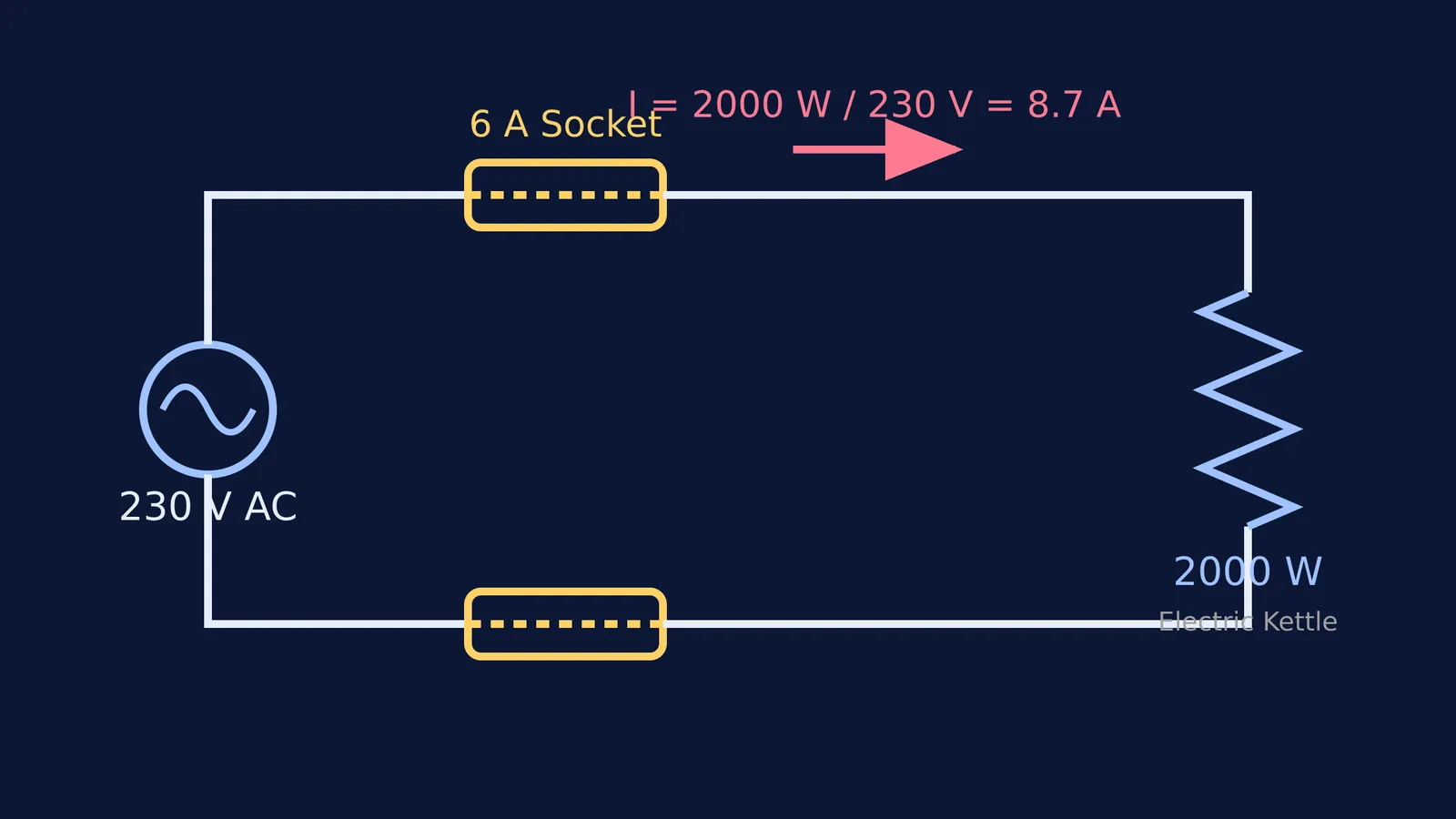
In India, the standard nominal voltage is 230 V. A typical hostel room is wired for low-power devices like laptops, mobile chargers, and table lamps. The sockets provided are usually standard Type D outlets rated for a maximum of 6 A.
An electric kettle typically consumes at least 2000 W of power. We can find the current it draws using the formula I = P / V.
Dividing 2000 W by 230 V gives a current of roughly 8.7 A. This single appliance draws more current than the 6 A socket and its internal wiring were designed to handle. This fundamental mismatch is the core of the danger. You can read more about how power relates to voltage and current in our guide to Electricity in Class 10: Ohm's law, resistors and electric power.
What happens if you overload a socket?
When current passes through a wire, it generates heat. This is due to electrical resistance. Every electrical wire has a safe operating limit, beyond which the generated heat cannot dissipate fast enough into the surrounding air.
If the room has a working MCB, the 8.7 A load will cause the breaker to trip, plunging your room—and sometimes the entire floor—into darkness, which can be incredibly frustrating during exam season. If the breaker fails or if you force a large plug into a weak socket, the excess heat will begin to melt the plastic casing of the socket.
Over time, this melting can expose live wires and start an electrical fire. The insulation around the wires degrades rapidly under high thermal stress, which can lead to short circuits inside the wall long before you notice any visible damage. You can learn more about how fuses and breakers protect circuits in our article on the Heating effect of current: power, energy bills and fuses.
How can I safely manage hostel appliances?
Before taking any electrical device to your hostel, run it through this safety checklist to ensure it matches the standard 6 A socket capacity:
Read the rulebook: Check your specific university's hostel undertaking. Look for lists of "prohibited items" and check if low-wattage kettles are conditionally allowed by your warden.
Check the appliance wattage: Look at the sticker on the bottom of the device. Anything demanding high power is generally unsafe for a standard room socket and should be left at home.
Never use converters blindly: Do not use a converter plug to fit a large appliance into a smaller socket. A converter does not increase the capacity of the wall's internal wiring; it only forces a large plug into a small hole, increasing the fire risk dramatically.
Use common areas: If your hostel provides a pantry or a common room with heavy-duty power sockets designed for cooking, do your boiling and ironing there. These areas are specifically wired to handle high-current appliances safely.
Understanding the physics behind these rules helps keep everyone safe. For ideas that are easier to see than to read, you can explore the Fermi Simulation Lab. If you are solving circuit problems and want to understand how current is distributed, the Fermi Problem Library has a step-by-step solver that explains the reasoning rather than just printing an answer.


