

On this page
After dinner, four of you sit on one bed with books open. By 11:30 pm you have solved two questions and discussed cricket, a teacher and someone's phone. The difference between a group night that clears a doubt and one that eats the evening is usually the format, not the friends.
Are late-night group study sessions in a hostel useful?
They can be, for one specific job. In a 2009 study published in Science, Michelle Smith, Carl Wieman and colleagues had genetics undergraduates answer a concept question alone, discuss it with neighbours, and then answer a new question on the same concept alone. Peer discussion improved understanding even when none of the students in a discussion group originally knew the correct answer.
The key detail is the order: each student committed to an answer first, talked second, and was checked alone third.
Groups are weaker at plain remembering. A meta-analysis by Stéphanie Marion and Craig Thorley in Psychological Bulletin pooled 64 studies and found that groups recall less than their members would working alone, an effect called collaborative inhibition. As ScienceDaily's summary of the review reports, the effect was stronger in larger groups, friends worked together better than strangers, and collaborating boosted later individual recall.
So a group night helps when it sharpens what each person has already tried alone. It hurts when it replaces that effort, or when five people talk over each other's way of remembering.
When does a group night turn into chat?
Watch for these signs:
Nobody tried the questions before sitting down.
More than four people, so two conversations start.
A vague goal like "let's revise organic" instead of named questions.
No end time, so the session ends when someone gets sleepy.
Reading notes aloud together, which feels productive but tests no one.
In Roediger and Karpicke's 2006 experiments, repeated studying made students more confident, yet taking recall tests produced substantially greater retention on final tests given 2 days or 1 week later.
Late sessions also run into sleep. The American Academy of Sleep Medicine consensus statement says teenagers aged 13 to 18 should sleep 8 to 10 hours per 24 hours on a regular basis. If classes start early, a group night that ends at midnight takes that time from you; see our guide to sleeping well before an exam.
What is a good format for a hostel group study night?
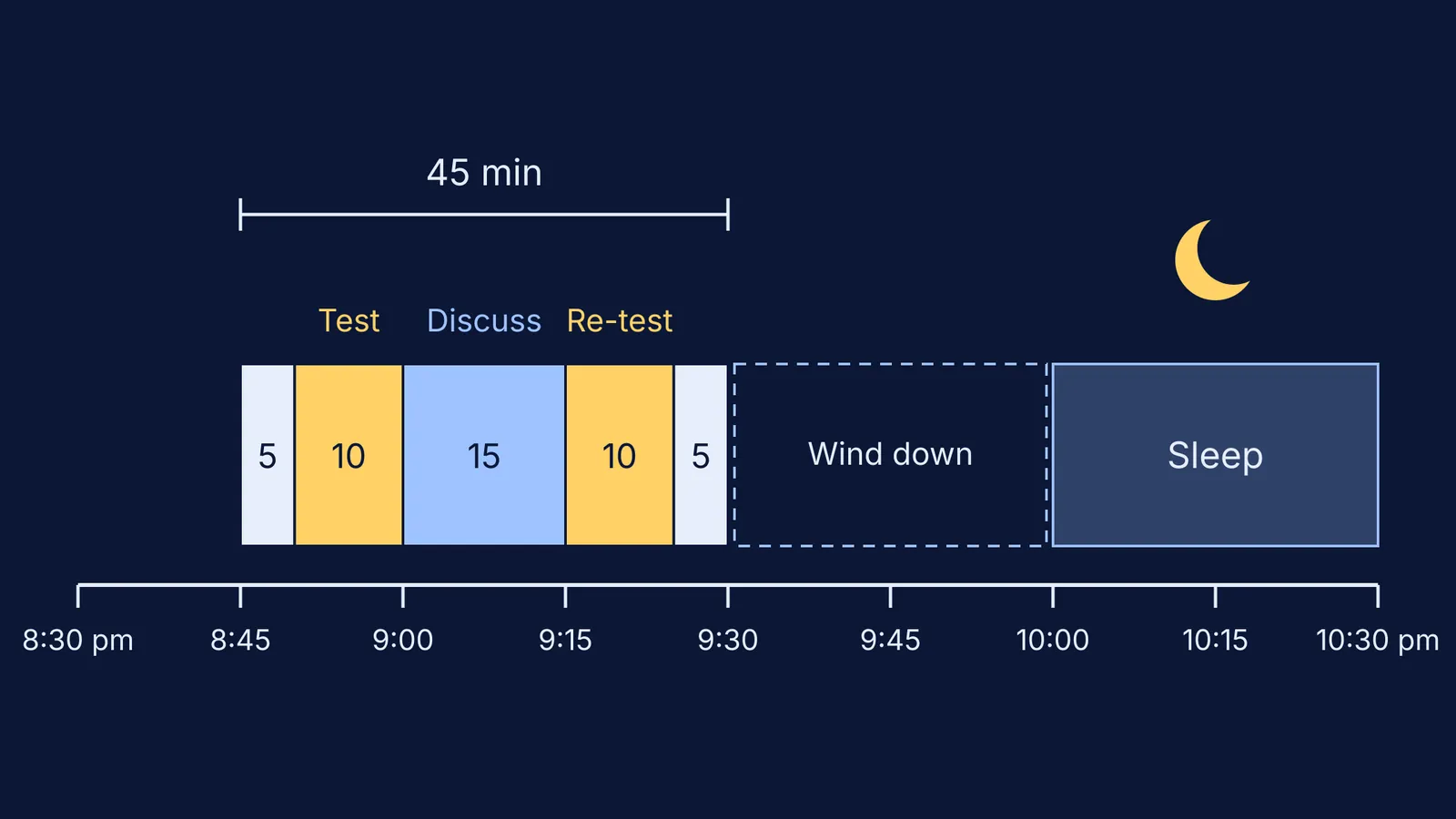
Use a 45-minute, test-first format: three or four people, one subject, and questions agreed before you meet.
Set up (5 minutes): each person names one question that beat them this week. Pick three or four, from the day's worksheet or a past paper.
Solo test (10 minutes): everyone attempts the same questions alone, closed book, in silence. Write an answer even if unsure.
Compare and argue (15 minutes): go question by question. Where answers match, move on. Where they differ, each person explains their method in a minute, and the group finds the step where they split.
Re-test (10 minutes): each person solves one new question on the same idea, alone. This shows whether you understood or just copied the fastest student.
Close (5 minutes): write down what is still unclear, choose the next session's questions, and leave.
If nobody can crack a question in step 3, note the step where everyone got stuck and take it to a teacher the next day, or work through it in the Fermi Problem Library, where a step-by-step solver explains the reasoning rather than printing an answer.
How late is too late for a group session?
Work backwards from your wake-up time, not forwards from dinner.
Say you wake at 6:00 am for a 7:30 am class. Eight hours, the low end of the AASM range for teenagers, means lights out by 10:00 pm. Keep 30 minutes to wash up and put the phone away, so the group finishes by 9:30 pm and starts at 8:45 pm, straight after dinner.
If your mess runs late, meet before dinner, or twice a week instead of nightly.
What can you say to keep it on track?
To start: "Three questions, ten minutes alone, then we compare. We stop at 9:30."
When chat takes over: "Save that story for breakfast? We have one question left."
When someone wants to keep going: "I'm out at 9:30. Let's open with this one on Thursday."
When a friend skips the solo test: "Try it first, even a wrong answer. That's the part that makes the rest work."
For choosing who to study with, read how to build a study group that works, and for the rest of hostel life, see our guide to studying in a hostel.
If late nights are less about study and more about not being able to switch off, or you feel low most days, talk to your warden, a counsellor or someone you trust, or call Tele MANAS, the free 24x7 government helpline, on 14416.
Tonight, pick three questions and agree the end time before anyone sits down.


