On this page
In a hostel or PG, chores arrive in small pieces: a bucket of clothes, a dusty desk, an empty shampoo bottle. None takes long. The trouble is when they happen: usually in the evening, in the time you meant to study.
Why do chores eat study evenings in a hostel?
Because they come as interruptions, not tasks. You stop a chapter to soak clothes, again to rinse them, again to bring them in before it rains. Each stop costs more than its minutes.
Organisational researcher Sophie Leroy called this attention residue: after you switch tasks, part of your attention stays on the one you left (Leroy, 2009, Organizational Behavior and Human Decision Processes). In her experiments, people who finished the first task under a time limit moved on more cleanly (summary in strategy+business). The lesson: give each chore a start, an end and its own slot, outside the study block.
How should you plan a weekly chore routine?
Use if-then plans: if it is Sunday at 9 am, then I start laundry. A meta-analysis of 94 studies by Peter Gollwitzer and Paschal Sheeran found that if-then plans had a medium-to-large effect on reaching goals (d = 0.65) (abstract, University of Konstanz repository). The plan below turns each chore into one.
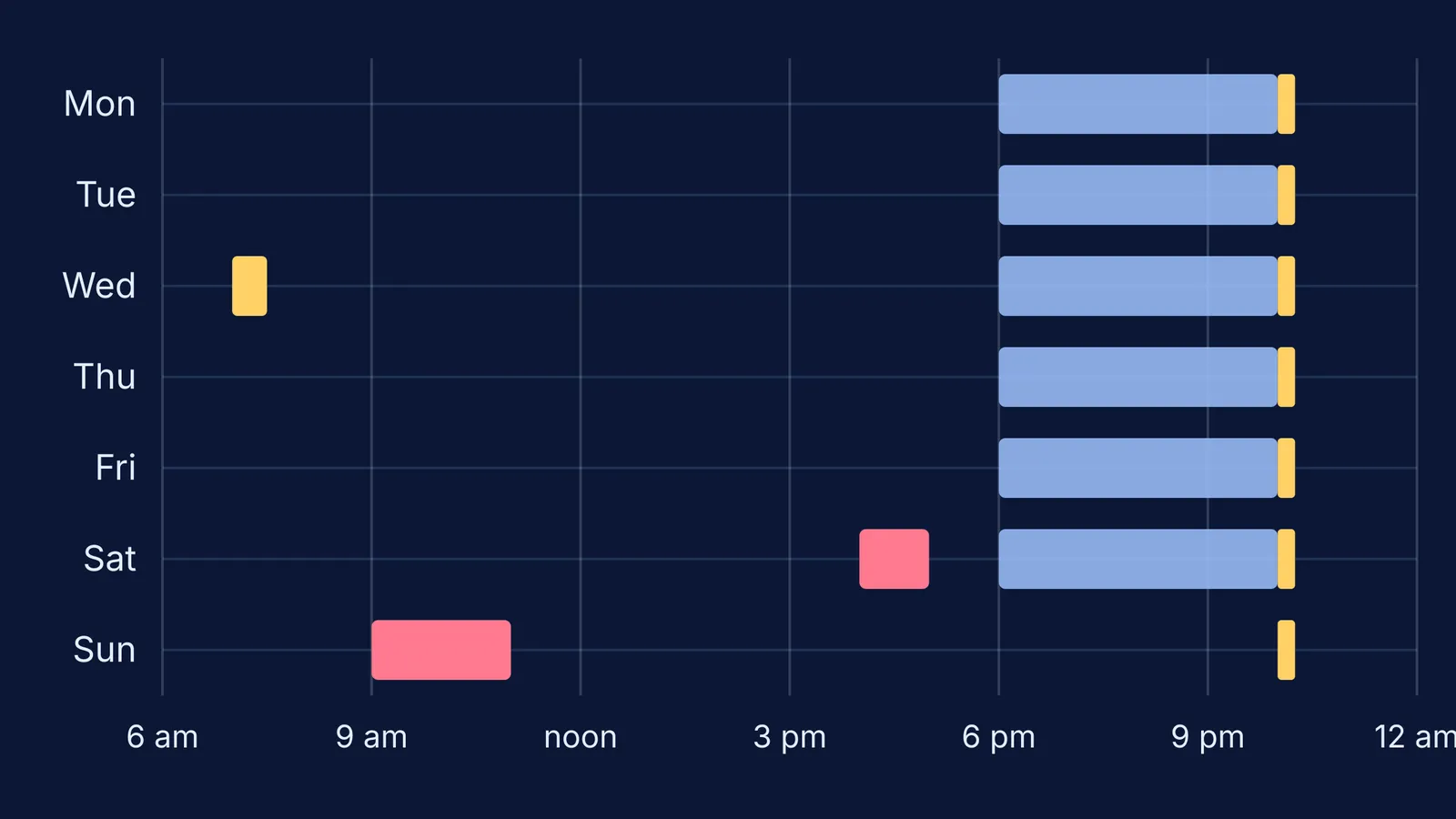
Here is a worked week for a student with school or coaching by day and self-study from 6 to 10 pm, Monday to Saturday. Move the times, keep the shape.
Sunday, 9 to 11 am: the big batch. Wash the week's clothes, change the bedsheet, sweep, wipe the desk and throw out old food.
Wednesday, 7 to 7:30 am: the small wash. Only innerwear, socks and a towel. A morning slot gives the clothes the whole day to dry and keeps the evening free.
Saturday, 4 to 5 pm: fold and restock. Fold or iron the week's clothes, check soap, detergent, toothpaste and snacks, and make one shopping list.
Every night, 10 pm: the 15-minute reset. Clear the desk, pack tomorrow's bag, fill your water bottle and put used clothes in one bag. Set a timer and stop when it rings.
That is about five hours a week, all outside study time. Add these as blocks of their own; our guide to time blocking for students juggling school and coaching shows how to lay out the rest of the week.
A protected evening works best when you know what to do with it. Fermi's AI tutor can work out what you already know and build a plan for the session, so you sit down at 6 pm to a clear next step instead of a blank page.
How do you manage laundry in a hostel without losing study time?
Laundry leaks into evenings most often, so give it extra rules.
Own enough innerwear and socks to last from one wash day to the next. If you keep running out, buy one more set rather than adding a wash.
Keep one bag for dirty clothes. Nothing goes on the chair or bed.
With a shared machine, find its quietest time in the first week and take that slot every week.
With a laundry or dhobi service, drop off on Sunday morning and collect in your Saturday slot.
While clothes soak on Sunday, do something light, like planning the week. Save problem sets for evenings, when nothing is in a bucket.
What if you share a room or a washing machine?
Shared chores cause the most trouble, because nobody owns them. Agree a split in the first week, before anyone is annoyed. You could say:
"Can we fix the room cleaning? I'll sweep on Sundays and take the rubbish out on Wednesdays. Could you take the other two days? And can we keep 6 to 10 pm quiet on weekdays?"
Write the split on a sheet and stick it on the door. For making the room itself work for study, from noise to lighting, read our guide to studying in a hostel or PG.
How long until the routine feels automatic?
Often longer than a few weeks, and that is normal. In a study of 96 volunteers who repeated one daily behaviour in the same context, the time participants took to reach 95% of their peak automaticity ranged from 18 to 254 days (Lally and colleagues, European Journal of Social Psychology). The same study found that missing one opportunity did not materially affect habit formation. So if you skip a Wednesday wash in exam week, pick it up next week instead of dropping the whole plan.
If chores are really a way of avoiding study, read why procrastination is about feelings, not laziness. If living away from home feels heavy for days, talk to your warden, a counsellor or someone you trust, or call Tele MANAS, the free 24x7 national mental-health helpline, on 14416 or 1800-891-4416 (details from IIT Kanpur's counselling service).