

On this page
The transition to college is a profound shift, and it is entirely normal to find yourself wanting to pack a bag and head home by Friday afternoon. The urge to return to familiar food, your own bed, and the comfort of family is strong. But how often should you actually make that trip?
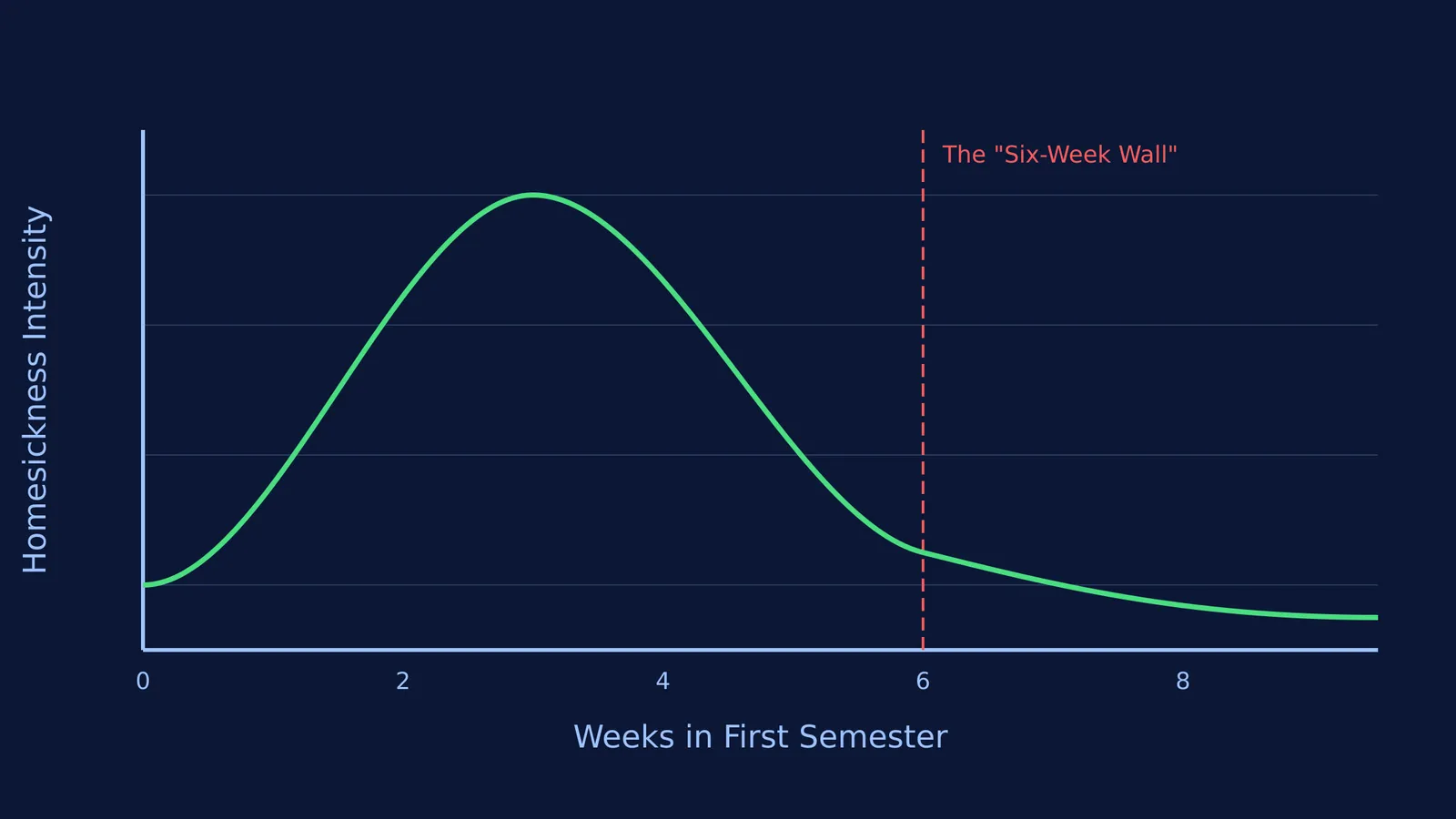
Why does homesickness peak around week three?
If you feel fine during orientation week but suddenly overwhelmed a month later, you are not alone. According to a 2017 study by English et al. published in the journal *Emotion*, a staggering 94% of college students experience homesickness during their first ten weeks on campus (Emotion).
The initial days of college are filled with the adrenaline of moving in and meeting new people. It is usually around weeks three to four that the reality of the separation sets in. The newness wears off, academic pressures begin to build, and the absence of your usual support system becomes starkly apparent. The study noted that while this distress is nearly universal, it typically begins to decline naturally if students remain engaged with their new environment.
Does homesickness affect your grades?
You might worry that missing home will ruin your academic performance, but research suggests otherwise. The same 2017 study in *Emotion* tracked students' academic outcomes alongside their emotional state. The researchers found no significant adverse impact on grade point averages (GPA) for students experiencing homesickness.
Instead, the primary cost of homesickness is social. Students with higher levels of homesickness struggled more with overall university adjustment and found it significantly harder to form new relationships. You are likely to keep performing well in your classes even if you feel lonely, but the distress makes it difficult to build the support network you need to thrive.
How often should you go home during a college semester?
If you are struggling to find a balance, university advisors often suggest following the "six-week rule." This guideline recommends that first-year students stay on campus for the first six weeks of the semester without returning home. The goal is to break the cycle of constant travel and give yourself a genuine chance to settle into your new environment.
When you go home every weekend, you experience re-separation distress every Sunday night or Monday morning. More importantly, leaving campus prevents you from having the repeated, ordinary experiences that eventually make the university feel like home. If you are never in the dining hall on a quiet Sunday morning, or never stick around for an impromptu movie night in the dorms, you miss the micro-interactions that build lasting friendships. You remain a visitor in your own college life.
To successfully navigate this period, consider these strategies:
Protect your weekends: Commit to staying on campus for at least a month before planning your first trip back. This forces you to navigate the discomfort and build a new social circle.
Schedule your calls: Plan two long phone calls home per week rather than texting constantly. This makes contact predictable and stops a wave of loneliness from triggering an immediate trip home.
Build one ritual: Establish a recurring weekend activity, such as studying at a specific local coffee shop or sitting in the same part of the dining hall every Saturday morning. Belonging follows repetition, so returning to the same spots helps you become a familiar face on campus.
Attend events multiple times: Try going to a club or a campus event two or three times before deciding it is not for you. It takes time to give your new life a fair chance.
Set a future date: Have a specific date for your next trip home, such as Thanksgiving or a mid-semester break, so the separation does not feel indefinite.
How can you find your rhythm on campus?
Staying on campus for the weekend gives you the time to tackle your coursework without the exhaustion of a train or car ride. Whether you are reviewing exponential models via dy/dt = ky for a calculus assignment or mapping out membrane receptors vs intracellular receptors for biology, a steady weekend routine gives you the quiet hours you need to think deeply.
If academic stress is making you want to flee to the comfort of home, Fermi's AI tutor can help you build an independent study routine. Most learning tools just answer questions, but Fermi teaches. It holds a line of reasoning across a whole session, notices where you are stuck, and decides whether to explain, ask, or show. This means you can work through a difficult problem set with guided support, leaving your weekend afternoons free to connect with new friends and finally make campus feel like your own.


