

On this page
When you fill your choices for engineering admissions through the Joint Seat Allocation Authority (JoSAA), you will notice that every National Institute of Technology (NIT) splits its seats into two categories: Home State (HS) and Other State (OS). Knowing how this split works helps you predict which colleges are within reach of your JEE Main rank.
How does the home state quota work?
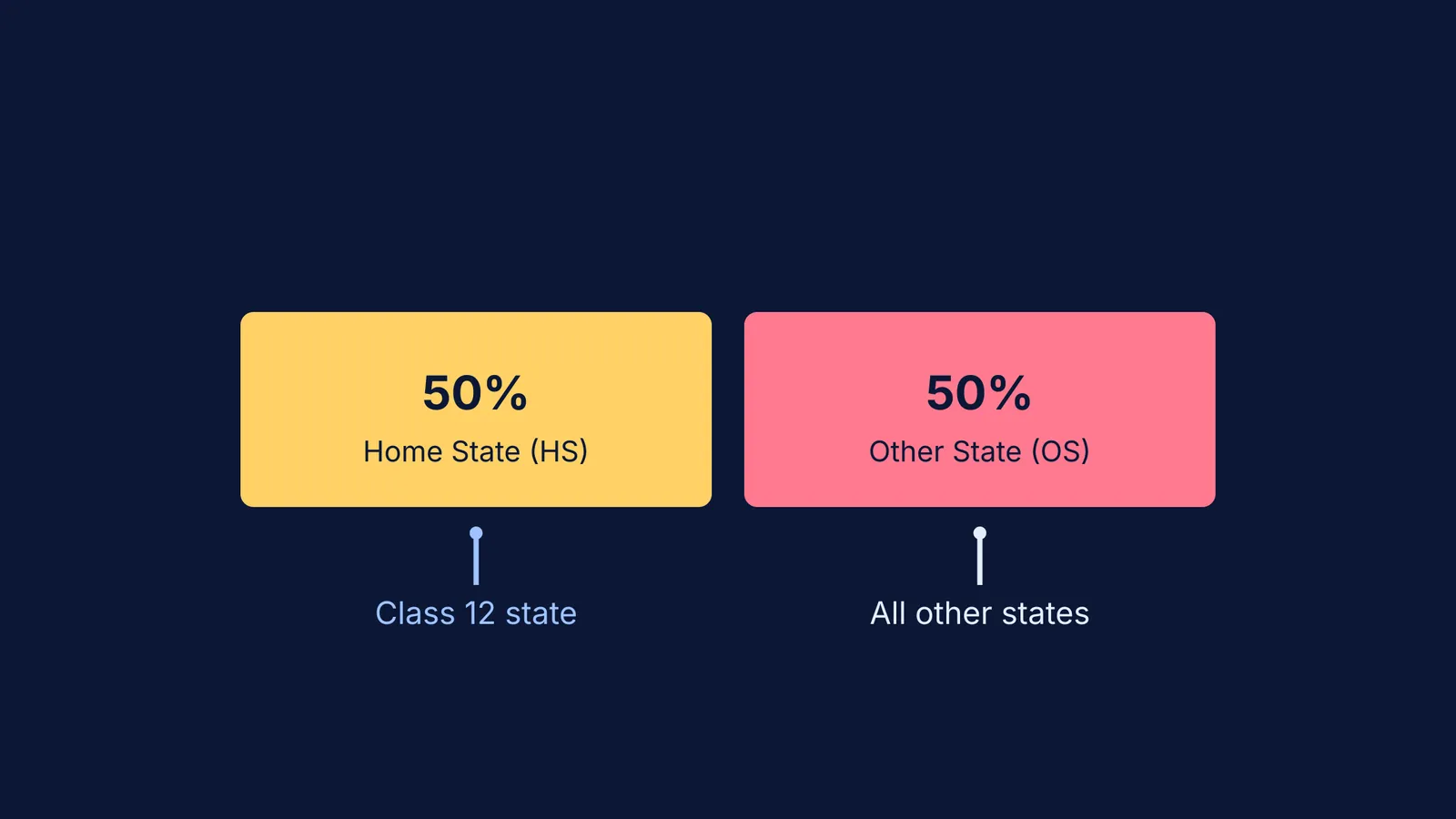
In the NIT system, exactly 50% of the total seats in each institute are reserved for the Home State quota, while the remaining 50% of seats form the Other State quota (JoSAA Business Rules 2024).
Your home state is strictly the state or Union Territory where you passed your Class 12 board examination. It is not where you were born, where your parents live, or where you took your JEE Main exam.
If you passed Class 12 from a school in Maharashtra, your home state is Maharashtra. You will therefore compete for the 50% Home State seats at VNIT Nagpur. For every other NIT across the country, you will compete for the 50% Other State seats.
Does your domicile matter for NIT admissions?
No, your state of domicile does not decide your NIT quota. The only thing that matters is the location of the school from which you cleared your qualifying exam (Class 12).
If a student has a permanent home address in Uttar Pradesh but completed their schooling at a residential campus in Rajasthan, their home state for JoSAA counselling is Rajasthan. They will get the home state advantage at MNIT Jaipur, not MNNIT Allahabad.
There are specific rules for candidates who passed Class 12 from the National Institute of Open Schooling (NIOS). In their case, the state of eligibility is the state where their study centre was located. Furthermore, for Indian nationals who completed their Class 12 abroad, the home state is determined by the permanent address printed in their passport.
How does the quota change your choice list?
The home state quota restricts the pool of applicants for half the seats to just one state. Because the competition is smaller, the closing rank for a home state seat is often lower than the closing rank for the identical branch in the other state quota.
This creates a distinct advantage if you live in a state with a top-tier NIT. However, the advantage is sometimes less pronounced in states with high competition and a very dense population of engineering aspirants.
When planning your JoSAA choices, use this framework to structure your list:
Dream OS options: Top NITs outside your state where you want to study. These require a high percentile, as you are competing nationally.
Your HS advantage: Your home state NIT. Place this high on the list, as the home state reservation gives you a statistical edge for your preferred branch.
Newer OS options: Newer NITs or IIITs in other states. These act as solid backups if the top-tier institutes are out of reach.
If you are worried about meeting the steep cut-offs for the Other State seats, you might be looking for ways to strengthen your problem-solving speed. Fermi's AI tutor can work out what you already know and build a plan for the session, so you sit down to a clear next step instead of staring at a blank page.
Will the quota help you?
The quota's impact depends heavily on your state's engineering population. If you are aiming to push your score higher to clear the Other State cut-offs for a top NIT, the Fermi Problem Library has worked problems with a step-by-step solver that explains the reasoning rather than printing an answer.
Keep in mind that the standard reservation categories (SC, ST, OBC-NCL, EWS, and PwD) apply within both the Home State and Other State quotas.
Also, remember that securing a seat requires meeting the board marks rule for NIT and IIIT admission. If you are looking at the road ahead, understanding how to plan around JEE Main's two sessions can help you decide when to aim for your peak score. Finally, if you are also preparing for the IITs, read about how JEE Main and JEE Advanced really differ so you know what it takes to clear the next hurdle.


