

On this page
If you are planning to study science or engineering, figuring out how to pay for your degree is just as important as clearing the entrance exams. Both the Indian government and private companies offer scholarships specifically to support girls in STEM. These schemes help cover college fees, books, and living expenses, letting you focus on your studies.
Knowing what is available and what applications usually ask for helps you prepare before you even finish Class 12.
What do government scholarships for girls offer?
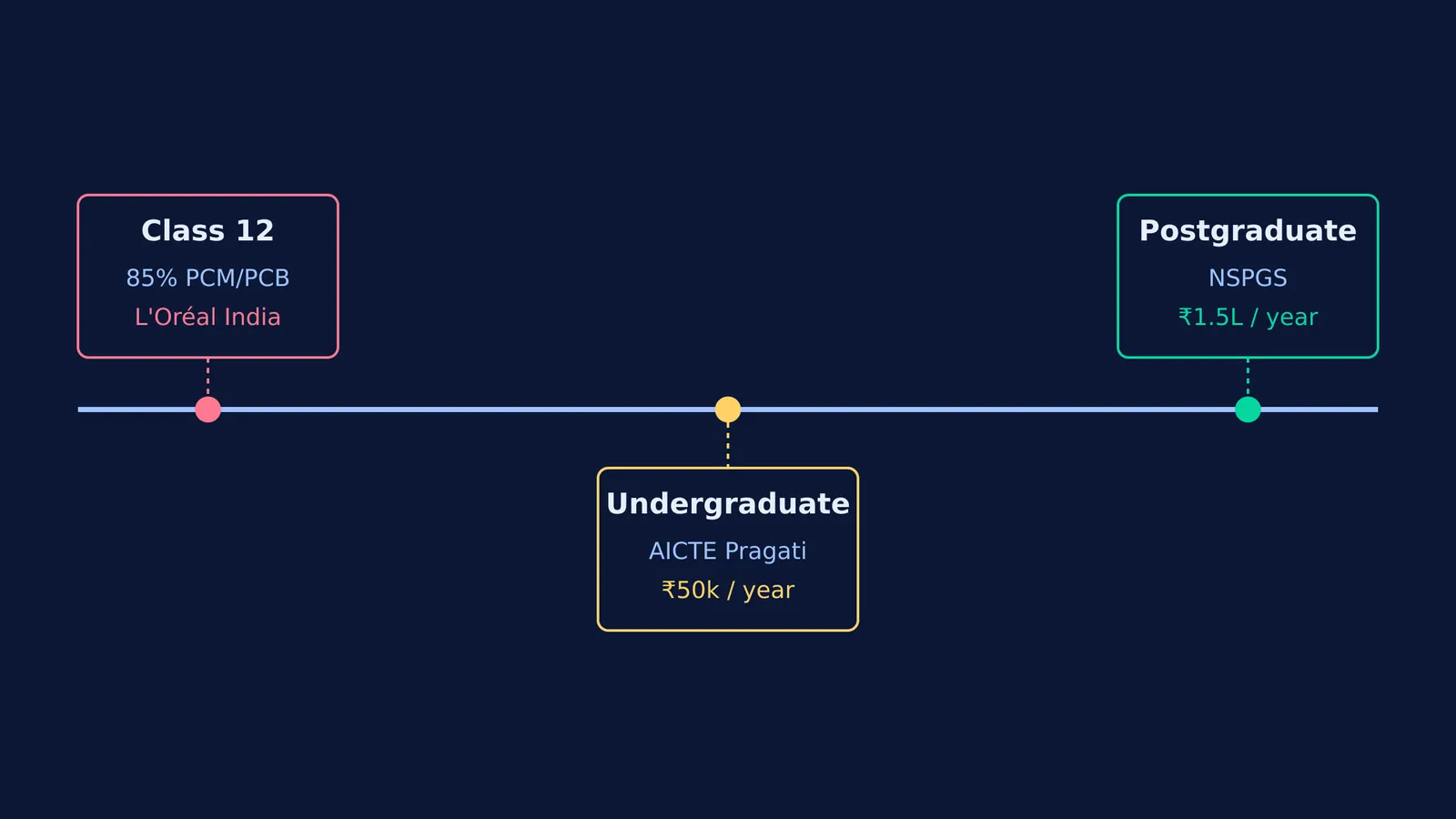
The All India Council for Technical Education (AICTE) runs the Pragati Scholarship Scheme for Girl Students. It pays ₹50,000 per annum for every year of study to help with college fees, books, and equipment. To be eligible, you must be admitted to the first year of a degree or diploma in an AICTE-approved institution, and your annual family income must be under ₹8 lakh. A family can apply for a maximum of two girls. Out of the 10,000 scholarships awarded annually, half go to degree students and half to diploma students. Lateral entry students entering the second year are also eligible.
If you are aiming for a Master's degree, the University Grants Commission has merged several older schemes into the National Scholarship for Post Graduate Studies. This scheme pays ₹15,000 per month for 10 months of the year, totalling ₹1.5 lakh annually for a two-year full-time course. You must be under 30 years old at the time of admission. Out of 10,000 slots, 30% are reserved for women, and preference is given to single girl children (including twin daughters). Unlike many other needs-based schemes, there is no specific income limit to apply.
Which private companies fund STEM degrees?
Several private organisations fund girls pursuing undergraduate science degrees. A prominent example is the L’Oréal India For Young Women In Science Scholarship. It awards up to INR 2,50,000 distributed across the duration of an undergraduate degree in fields like pure sciences, applied sciences, and engineering.
The academic cut-off is strict: you must have passed Class 12 in the science stream with at least 85% marks in PCM, PCB, or PCMB. The annual family income limit is set at INR 6,00,000. For postgraduate and PhD students who scored at least 60% in their undergraduate degrees, the scheme offers a separate grant of up to INR 1,00,000.
Maintaining those high marks in Class 12 is critical for these private scholarships. If you are struggling with a topic, bringing your wrong-method mistakes to the Fermi Problem Library gives you a step-by-step solver that explains the reasoning rather than just printing an answer.
How can you plan your scholarship applications?
Applying for scholarships is a project on its own. It requires planning so you do not miss deadlines while focusing on your Class 12 board exams and entrance tests like JEE Main or NEET-UG.
Here is a step-by-step plan you can follow during your final year of school:
Understand the income brackets: Most schemes classify eligibility based on family income from all sources (typically under ₹6 lakh or ₹8 lakh). Check your parents' most recent income tax returns to confirm which brackets you fall into.
Target your academic minimums: Private scholarships demand high academic performance. The L’Oréal scheme requires 85% in Class 12. Set this as your minimum target for boards.
Choose the right institutions: The Pragati scholarship only applies if you enroll in an AICTE-approved institution. When shortlisting engineering colleges, verify their AICTE approval status on their official website.
Prepare the paperwork early: Income certificates and affidavits can take weeks to process. Apply for an updated income certificate in April or May, right after the financial year ends, so it is ready when college admissions start in July.
What documents do applications usually ask for?
Most scholarship windows open between July and October of your first college semester. Government schemes usually run through the National Scholarship Portal (NSP). Private scholarships use their own websites or platforms like Buddy4Study.
Keep this checklist of documents ready:
Income Certificate: Issued by a competent authority (like a Tehsildar or SDM). This is mandatory for almost all needs-based schemes.
Aadhaar-seeded bank account: Government scholarships route money via Direct Benefit Transfer (DBT). Your bank account must be linked to your Aadhaar card.
Proof of admission: You will need the fee receipt or admission letter from a recognised university or AICTE-approved college.
Affidavits: Schemes like the National Scholarship for Post Graduate Studies require a standard stamp paper affidavit attested by a magistrate to claim single girl child preference.
Women have long shaped science—from Agnes Pockels and the kitchen trough that measured surface films to Hertha Ayrton and the physics of the electric arc. Today's scholarships ensure you have the financial backing to follow in their footsteps. When you feel overwhelmed by entrance preparation, remember that Fermi's AI tutor can work out what you already know and build a plan for the session, so you sit down to a clear next step. Start researching the colleges you want to attend, and check their scholarship cells as soon as you apply for admission.


