

On this page
Board timetables often give uneven gaps. One paper can come a day after the last, the next after five. Many students spend every gap the same way: reread notes, panic at night, sleep late. A better plan changes with the length of the gap, but the three jobs stay the same: pull facts out of memory, rehearse under time, and sleep. Check your gaps on the official date sheet at cbse.gov.in or your state board's site, and match each to a plan below.
What should you do on a gap day before a board paper?
Spend most of it testing yourself, not rereading. In a 2006 experiment by Henry Roediger and Jeffrey Karpicke, students who practised recalling a passage remembered more of it two days and one week later than students who restudied it, even though restudying made students feel more confident (Psychological Science). That confidence is the trap on a gap day: rereading feels productive. A timed past paper is the same kind of test at full scale, and our write-up of a meta-analysis on whether practice tests help on new questions covers how far the benefit carries.
Protect sleep too. In a diary study that followed 535 adolescents from ninth grade, students who gave up sleep to study more than usual had more trouble understanding class material, and struggled more with tests or assignments, the next day (Child Development, 2013). The CDC lists 8 to 10 hours of sleep for teenagers aged 13 to 17 (CDC).
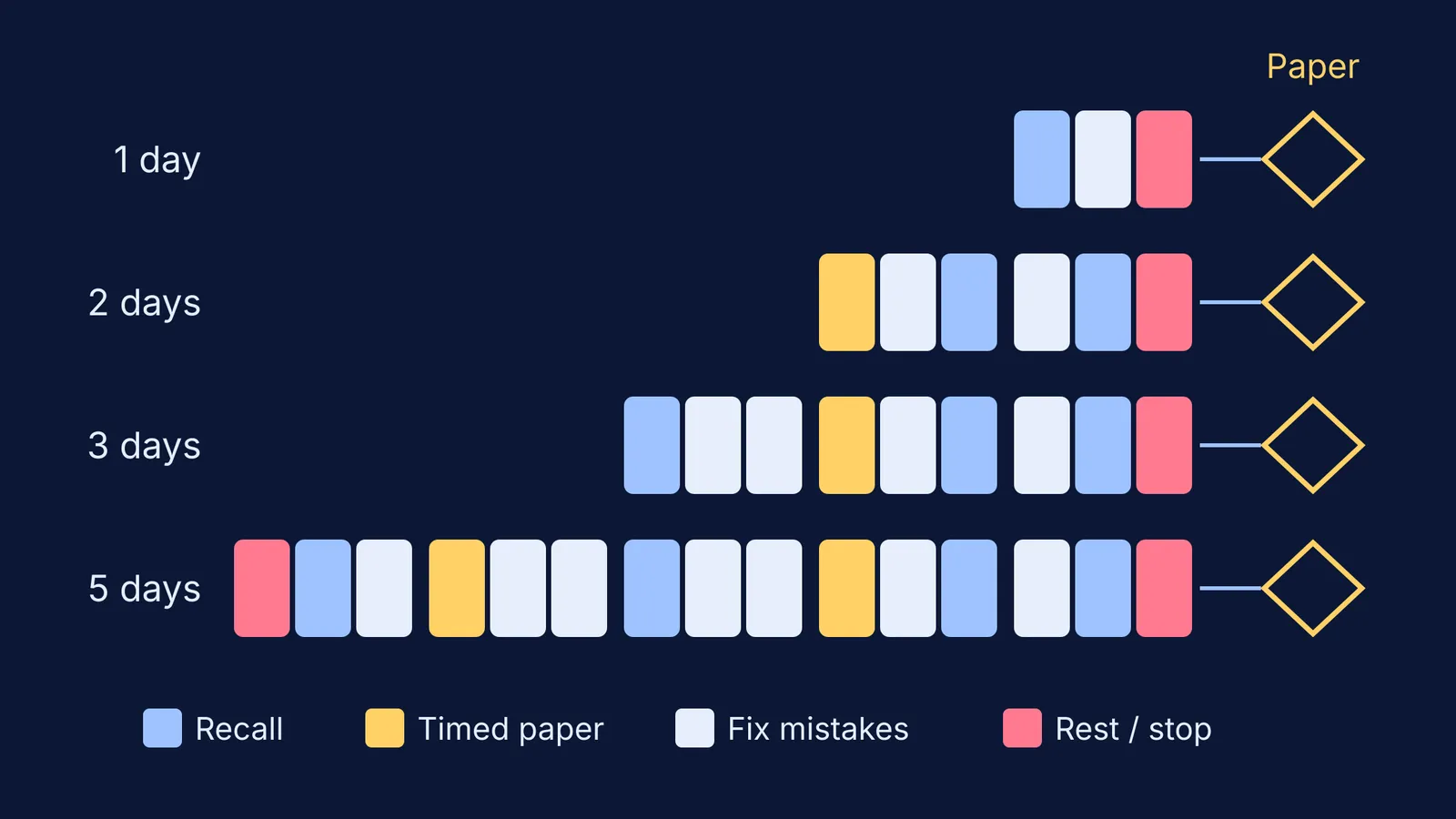
How to use a 1-day gap
There is no time for a full paper, so keep the day short and sharp.
Morning: blank-page recall. Close the book and write every formula, definition, diagram label and reaction you remember, chapter by chapter. Then check against your notes and circle what you missed.
Afternoon: fix the circled gaps with past board questions on those topics, untimed. Pick the three weakest, not all of them.
Evening: the stop rule.
How to use a 2-day gap
Day 1 morning: one full past paper, timed, at the same time of day as the real exam. Practise the final minutes too, with a routine for checking your answers in the last 10 minutes.
Day 1 afternoon: mark it honestly against the marking scheme. Log each lost mark as wrong concept, wrong method, careless slip or ran out of time.
Day 1 evening: blank-page recall of formulas and diagrams.
Day 2: redo every question you lost marks on without looking at the solution, then a final recall sweep. Stop rule in the evening.
If your marked paper shows the method went wrong rather than the arithmetic, the Fermi Problem Library has worked problems with a step-by-step solver that explains the reasoning rather than printing an answer.
How to use a 3-day gap
Day 1: list every chapter, write its key points from memory, and mark it green (could answer anything), amber (shaky) or red (would lose marks). Spend the rest of the day on red chapters, starting with those that carry the most marks.
Day 2: a timed paper in the morning, marking in the afternoon, recall in the evening.
Day 3: redo the questions you lost marks on, a last recall sweep, then the stop rule.
For a red chapter where the idea itself never made sense, the Fermi Concept Library gives every concept in physics, chemistry, biology, mathematics and computing its own lesson.
What about a 5-day gap?
Five days leaves room for two timed papers with a fix-up day between them.
Day 1: rest in the morning after the last exam. In the afternoon, do the from-memory green, amber and red sort, then start on red chapters.
Day 2: timed paper one, then mark it and work through the mistakes.
Day 3: no paper. Mixed past questions across red and amber chapters, plus recall.
Day 4: timed paper two, from a different year, marked the same afternoon. Compare its mistake types with paper one.
Day 5: redo lost-mark questions, final recall, stop rule.
For a 4-day gap, drop Day 3. For longer gaps, repeat Days 2 and 3 before the final two days.
When should you stop and rest?
Stop a timed paper when the time runs out, even mid-question. Finishing late hides a timing problem. Never sit a full paper the day before the exam: there is no time left to fix what it shows, and a bad score that evening only costs sleep. After each exam, give the post-mortem fifteen minutes at most, then turn to the next subject.
Parents, a useful line on the evening before a paper is: "What's left on today's plan? Okay, let's get the bag ready." Skip "How much have you finished?" late at night. Our guide on how much sleep teenagers need and how parents can help has more. If worry stops your child eating or sleeping for days at a time, talk to a doctor, or call Tele MANAS, the government's toll-free 24/7 mental health helpline, on 14416 (PIB).


